Jurgen Klopp's First Germany Squads: 44 Players and a New Direction
Jurgen Klopp has not eased himself into international management. In his first major act as Germany head coach, he has named two separate squads for the upcoming Nations League fixtures, calling up 44 players and signalling a reset in both personnel and tone.
Germany face four games in quick succession — away to the Netherlands, home to Greece, then Serbia in Munich and a return meeting with Greece in Thessaloniki. Klopp will use one group for the first two matches and a second for the latter pair, effectively splitting his opening international window into two distinct phases of experimentation.
Two squads, one overhaul
The scale of change is striking. Sixteen uncapped players have been included, a clear indication that reputations count for less than form and potential under the new regime.
Among the debutants are Said El Mala of Koln, Freiburg trio Max Rosenfelder, Philipp Treu and Derry Scherhant, and Celtic midfielder Mika Baur. They represent the breadth of Klopp’s trawl across the Bundesliga and beyond, and a willingness to accelerate younger players into the national picture.
Some established names, though, have been left out. Stuttgart striker Deniz Undav is the most eye-catching omission. Klopp put that down to fitness, but it is still a bold call given Undav’s club impact and the scrutiny that always surrounds Germany’s centre-forward options.
There was clarity, too, on Joshua Kimmich. Under Julian Nagelsmann, Kimmich often shuffled between right-back and midfield. Klopp shut that debate down, stating that his captain will be used as a midfielder. No hybrid role. No positional ambiguity. Kimmich is now fixed at the heart of the team.
Marc-Andre ter Stegen, currently on loan at Ajax from Barcelona, has been confirmed as first-choice goalkeeper, ending any lingering uncertainty around the position. There are also recalls for Karim Adeyemi, Leeds United midfielder Anton Stach and Brentford forward Kevin Schade, players who had drifted to the fringes but now have a route back.
A calendar built for experimentation
Klopp’s first Germany side will be on show in Amsterdam against the Netherlands next Thursday, September 24, before facing Greece in Augsburg on September 27. That initial group will offer the first glimpse of his tactical ideas and his willingness to trust new faces under pressure.
Then comes the second wave.
A different squad will take on Serbia in Munich on October 1 and travel to Thessaloniki to face Greece again on October 4. With four competitive matches in 11 days, Klopp has created internal competition and given himself the freedom to test combinations without overloading his players.
It is a sharp contrast to the end of the Nagelsmann era, which concluded with Germany’s World Cup last-32 elimination by Paraguay and his subsequent resignation. Where that period drifted, this one begins with a jolt.
The cap, the flag, and a divided country
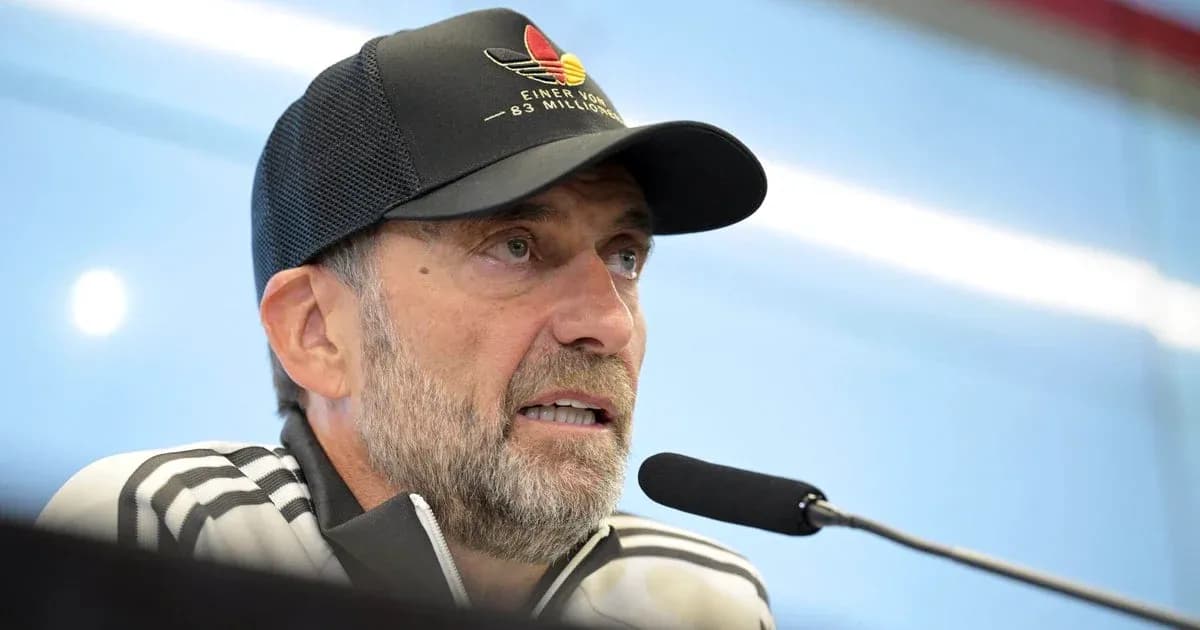
Klopp’s selection was only half the story. He arrived at his press conference wearing a baseball cap emblazoned with the words “one of 83 million” in the colours of the German flag.
It was not a fashion choice.
Germany is in the midst of a fraught political spell. The far-right Alternative für Deutschland (AfD) party recently claimed a significant victory in the Saxony-Anhalt state election, winning more than 43 per cent of the vote and a majority. Their support has been building in the region and across much of East Germany, but their reach is no longer confined to the former east; their anti-immigration, nationalistic rhetoric has found fertile ground in areas of industrial decline elsewhere in the country, too.
That context framed Klopp’s message. Asked about the cap, he spoke of wanting to “rediscover the fun” in football and “reclaim the flag” so that people could feel happy and fortunate to live in Germany. He stressed that he did not want to leave national pride “to the wrong people” and that his role filled him with pride, not just as a coach but as a citizen.
His words cut into one of Germany’s most sensitive debates: what does patriotism look like in a country still shaped by the legacy of national socialism? What does the flag mean when the nation is increasingly multicultural and symbols of nationalism can be twisted or co-opted?
Those questions have no easy answers. The AfD’s rise has deepened existing divisions, but the uncertainty runs wider than one party. Germany is a federal state stitched together from regions with their own histories and identities. There are competing visions of what the country is and what it should become.
Klopp cannot solve that from the touchline. He knows that. What he can do is try to build a national team that people want to gather around again, a side that offers a shared experience at a time when so much else pulls in different directions.
His first squads show he is ready to take risks on the pitch. His cap showed he is not afraid to take a stance off it.
Now the question is whether his Germany can turn that symbolism into something tangible when the Nations League begins.