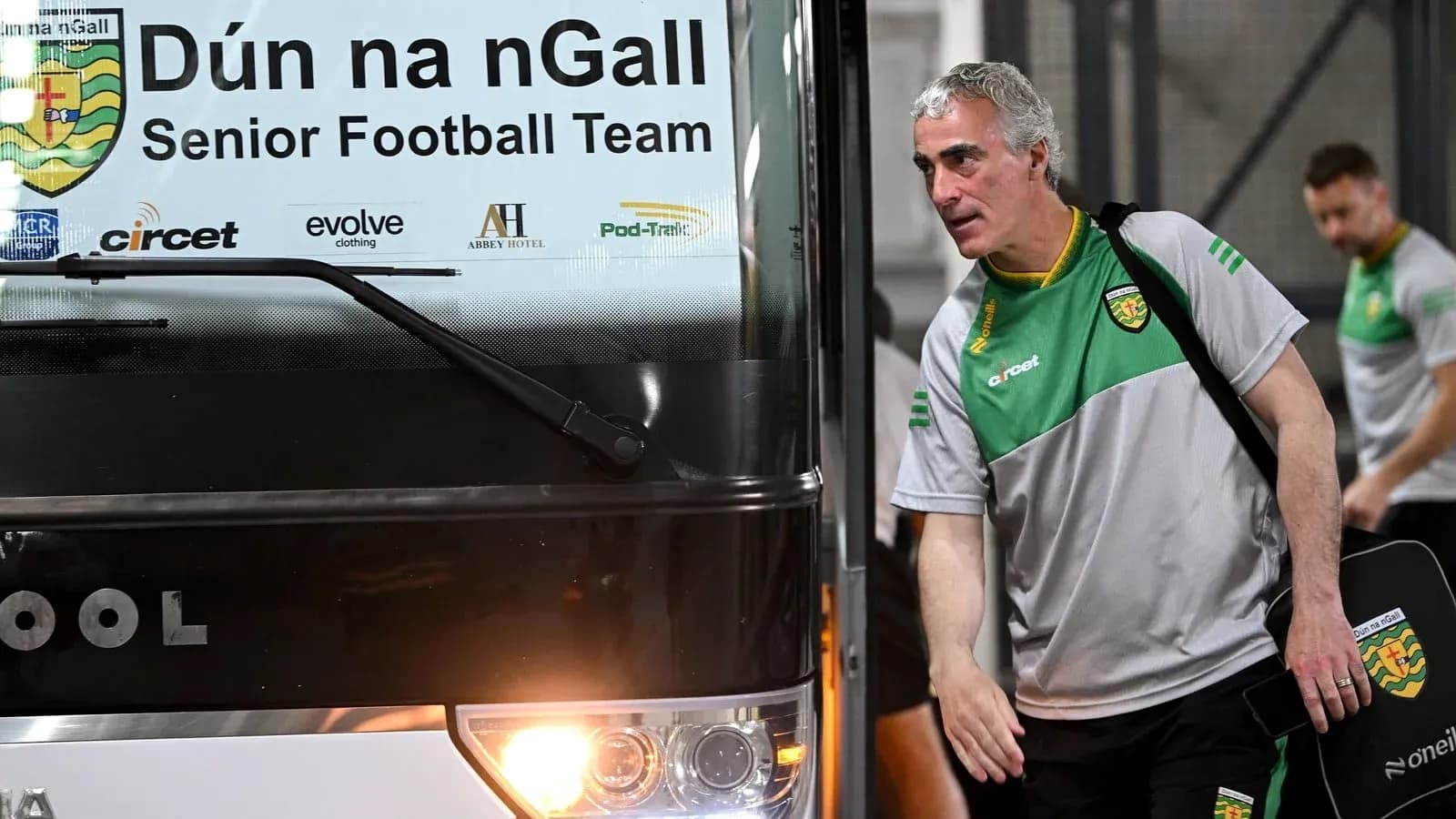
Jim McGuinness Continues as Donegal Manager – A New Chapter Begins
Would he walk or would he dig in? The answer landed this week. Jim McGuinness is taking up the option of a fourth year in charge of Donegal, extending his second spell at the helm of the county’s senior footballers.
No great shock, perhaps. Not after the way 2026 slipped away from them.
A strange exit on the longest day
On the longest day of the year, Donegal’s championship run ended in a way that felt utterly at odds with the previous six months. Croke Park was bathed in sunshine, but Donegal drew little from it as Dublin finally pulled clear in extra-time.
They had dragged the game that far through sheer stubbornness, Michael Murphy landing a late two-pointer that briefly jolted life into the contest. It only stalled the inevitable. Dublin finished with something to spare, Donegal looking like a team churning through treacle.
As the cameras locked on Murphy, the bigger question began to swirl: had we just seen his last act on the Jones’s Road turf? At 37, his Tír Chonaill future remains unresolved. No announcements. No hints. Just silence.
The manner of Donegal’s exit jarred with everything that had gone before. Given their body of work from January to early summer, describing their championship collapse as almost unbelievable doesn’t feel like a stretch.
From Ulster slip to All-Ireland surge
You can almost park the Ulster defeat to Down on its own shelf. One of those days. The Mourne men arrived in Letterkenny with a point to prove, leaning on their own proud tradition and refusing to play the underdog. Donegal misfired, Down pounced, and the provincial route closed off.
Supporters could rationalise it. That loss spared Donegal a few hazardous Ulster assignments, and the real business – Sam Maguire – still lay ahead. In most people’s eyes, Donegal were, at worst, second favourites for the All-Ireland.
There was logic behind that billing. At the end of March, they dismantled Kerry in the Division 1 league final at Croke Park. Kerry were missing a few regulars, but that didn’t explain the gulf. David Clifford was restricted to two scores, his late goal arriving when Donegal had already climbed the ladder and pulled it up behind them.
That day, Jimmy’s team played like men on a mission, determined to rip up the script after the 2025 All-Ireland final, when they had been reduced to spectators while Paudie Clifford conducted the Kerry orchestra. His influence, his distribution, his timing – it all left McGuinness’s approach under the microscope.
How had Jim McGuinness, the great tactician, been outmanoeuvred like that? The criticism stung. Early this year, he snapped back, insisting only “an All-Ireland winning manager or a top coach” had earned the right to question his coaching credentials.
He was in combative form. And Donegal played like it.
Fire in Killarney, and a warning sign
Killarney in May brought a different kind of test. Donegal went to Kerry and not only won – they won the battle and the war. The football was sharp, the edge even sharper.
McGuinness appeared to shove Diarmuid O’Connor on the sideline. Micheál Burns saw red. David Clifford thundered into a hefty shoulder that lit the fuse. The game crackled with needle and spite, and Donegal thrived in the chaos.
Their emphatic victory almost became a subplot to what followed – McGuinness’s spiky post-match interview with Newstalk’s Tommy Rooney and the looming prospect of a suspension for his touchline behaviour. In the end, the CCCC decided the referee had dealt with the incidents on the day. No ban. No Ger Brennan-style exile to the “room of non-involvement”.
By Whit weekend, Donegal had inherited the All-Ireland favourites’ tag. On form, it was hard to argue. They had the league title, the big scalp in Killarney, depth across the pitch. The pieces seemed to be in place.
And then, over two June weekends, the whole thing unravelled.
Cork crack the veneer
Cork’s visit to Ballybofey should have been another step on the ladder. Instead, it exposed a team running low on something you can’t measure on a GPS.
Down had already bloodied them. Cork finished the job.
Coming down the stretch, the Rebels simply had more in the tank. The intensity that had rattled Kerry was nowhere to be seen. The verve, the dash, the speed of transition – gone. Cork took time to warm up, but when they did, they made Donegal look flat and listless on their own pitch.
To twist Lady Bracknell, losing to Down might be chalked up as misfortune. Losing again at home, with so much on the line, looked a lot like carelessness.
Dig beneath the surface and the picture is more complex, but the outcome was stark. By the time Donegal reached Croke Park, they were stripped of the drive needed to go that next step. The energy that had defined their spring had drained away.
“Our players were running out of gas and looking on from the outside it is just a mystery,” said Brian McEniff, the man synonymous with Donegal football, as he tried to process the campaign post-league final.
If McEniff was baffled, he wasn’t alone.
Too much Kerry, not enough Sam?
One question lingers: did Donegal pour too much emotional fuel into Kerry? The league final at Croker, the storm in Killarney – did those days become the mountain, when the real climb was still ahead?
That Killarney showdown, with its flashpoints and fallout, may have emptied the adrenaline reserves that needed to be carefully rationed for July. The draw that paired them with Kerry so often may have felt like a curse, but the bigger issue was what came after.
Since the 2025 All-Ireland final, the debit column has been filling up. That reality will gnaw at McGuinness, even with a Division 1 crown on the mantelpiece. Donegal were outstanding in the league decider and superb in Killarney. Outside those marquee days, the drop-off was stark.
In a championship widely praised for its quality, Donegal ended up as bystanders. They never quite stamped themselves on the summer the way their early-season form suggested they would.
One more shot, and a ticking clock
So McGuinness returns with something to prove and, perhaps, one last swing at it as an inter-county boss.
In 2027, his gaze will be fixed less on March and more on what happens after May. The league title is already secured. Ulster medals are in the drawer. The early months can now be used to harden the next wave – Shea Malone, Max Campbell, Turlough Carr, Conor MacCahill – and ease them towards the furnace of high-summer football.
The Michael Murphy question will answer itself in time. For now, it hangs over everything.
Bookmakers already have Donegal as second favourites for Sam Maguire next July. On paper, they’re right there. But Mayo showed this year that the trick is not to peak in spring or in a grudge match in May. It’s to time the surge, to arrive in July with legs and minds still fresh, not emptied by earlier battles.
Donegal learned that lesson the hard way.
If this is to be McGuinness’s final season on the inter-county line, he needs more in the credit column – fewer dramatic spikes, fewer alarming dips, and a team that doesn’t hit the red in the games that define legacies.
The pressure will be fierce. The scrutiny unforgiving.
But Jimmy McGuinness has lived in that world before. The only question now is whether he can bend one more season to his will.