Iraola's Challenge: Balancing Fatigue and Cup Aspirations Against Spurs
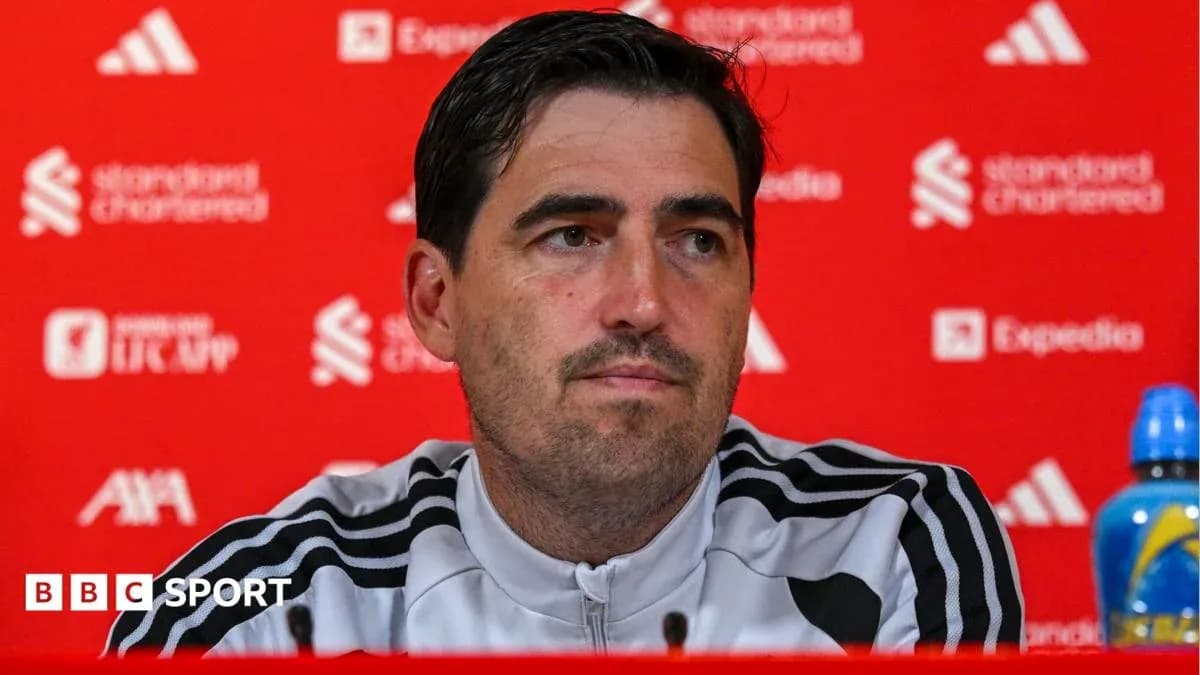
Andoni Iraola is barely a month into his Anfield reign and already learning one of the Premier League’s oldest truths: the schedule does not care how tired your players are.
Asked whether he can simply go full strength again in the Carabao Cup, the Liverpool manager didn’t pretend.
“You can decide and put the same players in every game,” he said. “The problem is there’ll be a moment when they’re really tired. And there is more risk of injury.”
That’s the tightrope. Liverpool have Tottenham at Anfield in the EFL Cup, not a lower-league side where wholesale rotation feels routine. Every decision now carries weight.
“There are players who play every three days with no issues,” Iraola added. “They are very robust, their performances don’t change too much. There are other players where the risk is bigger and the performances are different. I have to learn who is ready to play games every three days and who needs a rest so their performance level isn’t affected.”
He thought he knew. With some, he still does. With others, this congested start has thrown up surprises — even for players who have never faced this kind of workload. Liverpool, and their head coach, are finding things out on the fly.
Cup history, present tension
This is not just any competition for Liverpool. It is their cup.
Ten times they have lifted the League Cup, more than anyone else. The first came in 1980-81, the start of a remarkable run of four in a row that ended in 1984. Then a long wait, broken in 1995 when Steve McManaman’s brace sank Bolton at Wembley.
The modern era brought another surge. Gerard Houllier delivered the trophy in 2001 and again in 2003, that second win coming against Manchester United in a snarling final. Kenny Dalglish added another in 2012, edging Cardiff City on penalties.
The most recent chapter belongs to Jurgen Klopp. His Liverpool edged Chelsea in an extraordinary 11-10 shootout in 2022, then beat the same opponents again in 2024 to claim number 10.
Now Iraola walks into that lineage. The question is not just whether he can take Liverpool to number 11, but how hard he dares push for it in a season already creaking under its own demands.
Do you go strong to jolt the team out of a flat league start and wash away the frustration of Saturday’s stalemate? Or do you rotate heavily, accept the risk against another Premier League side and protect legs for the long winter ahead?
For a club with Liverpool’s history in this competition, that’s not a simple call.
Anfield stalls as fatigue bites
The warning signs were there against Fulham.
Two league games at Anfield. Two draws. For only the third time in 63 years, Liverpool have failed to win either of their opening home fixtures in a top-flight season. It is not a meltdown, but it is jarring.
This came just 72 hours after a high-octane Champions League win over Atletico Madrid, a night full of intensity and purpose. Against Fulham, that edge vanished. The visitors arrived under pressure, Alvaro Arbeloa still searching for his first league point as a Premier League manager after three straight defeats. They left with a clean sheet and something to build on.
Liverpool, by contrast, looked drained. Physically and mentally. A different side entirely from the one that had overpowered a Diego Simeone team that reached last season’s Champions League semi-finals.
On the first real test of Iraola’s ability to manage a two-games-a-week rhythm, his team stumbled. They are still unbeaten in the league, but six points from four matches — with home draws against Nottingham Forest and Fulham, a draw at Newcastle and a single win at Ipswich — is not the standard this club sets itself.
Big-money attack, small impact
The focus inevitably falls on the attack. The £364m front line of Alexander Isak, Bradley Barcola and Florian Wirtz started together in the league for the first time. On paper, it is an elite trio. On the pitch, they flickered rather than burned.
Liverpool had chances but never sustained pressure. Isak’s involvement was alarmingly low: just 16 touches in 90 minutes, the second-fewest on record for a Liverpool outfield player in a full league game. Two weeks earlier against Forest, he had the fewest with 14.
Wirtz, so sharp and inventive against Atletico, looked a shadow of that player. Barcola and Isak had moments, half-openings and flashes of understanding, but this is clearly a partnership that will need time and, crucially, freshness.
Iraola rotated where he could. Kostas Tsimikas, Ryan Gravenberch and Victor Munoz came into the side, with Milos Kerkez, Alexis Mac Allister and Rio Ngumoha dropping out. Arbeloa, back at the ground where he played 98 times as a Liverpool defender, handed a debut to Austrian centre-back David Affengruber in place of Joachim Andersen and brought in Sander Berge for Cesar Palacios.
The early drama was self-inflicted. A mix-up between Alisson and Gravenberch left Gonzalo Garcia with a clear sight of goal, and only Jeremy Jacquet’s goalline clearance spared Liverpool an early deficit. Fulham were sharper in that opening spell, with Josh King denied by Alisson and Antonee Robinson heading wide.
Munoz forced a strong save from Bernd Leno with a close-range header, Barcola saw a volley deflected behind by Timothy Castagne, and Iraola reacted at the break. Kerkez replaced the struggling Tsimikas. By the hour, Mac Allister and Cody Gakpo were on for Gravenberch and Munoz as the coach tried to tilt the game.
Isak finally carved out a decent opening, but Leno gathered comfortably. The Fulham keeper then beat away a powerful strike from Dominik Szoboszlai. More changes followed: Ngumoha and Jeremie Frimpong arrived with 18 minutes left. The pattern did not change.
Isak headed wide from a stoppage-time corner. Fulham, who threatened late themselves through King and Kevin, dug in and earned a point that felt huge for them and hollow for Liverpool.
Learning on the run
Strip away the emotion and the pattern is clear. When the games stack up, Liverpool’s energy drops, the press blunts, the attack loses its edge. Iraola knows it. He said it. Some players can go again and again, their levels barely dipping. Others cannot.
“It is still early,” he admitted in essence, “but we are learning.”
There is no time for a slow education. At least seven more Champions League fixtures lie ahead. Tottenham in the Carabao Cup arrive next. The calendar will not relent.
If Liverpool are serious about chasing trophies on multiple fronts, Iraola has to solve this puzzle quickly: who is truly “robust”, who needs protection, and how hard he dares chase a competition this club has always treated as its own.