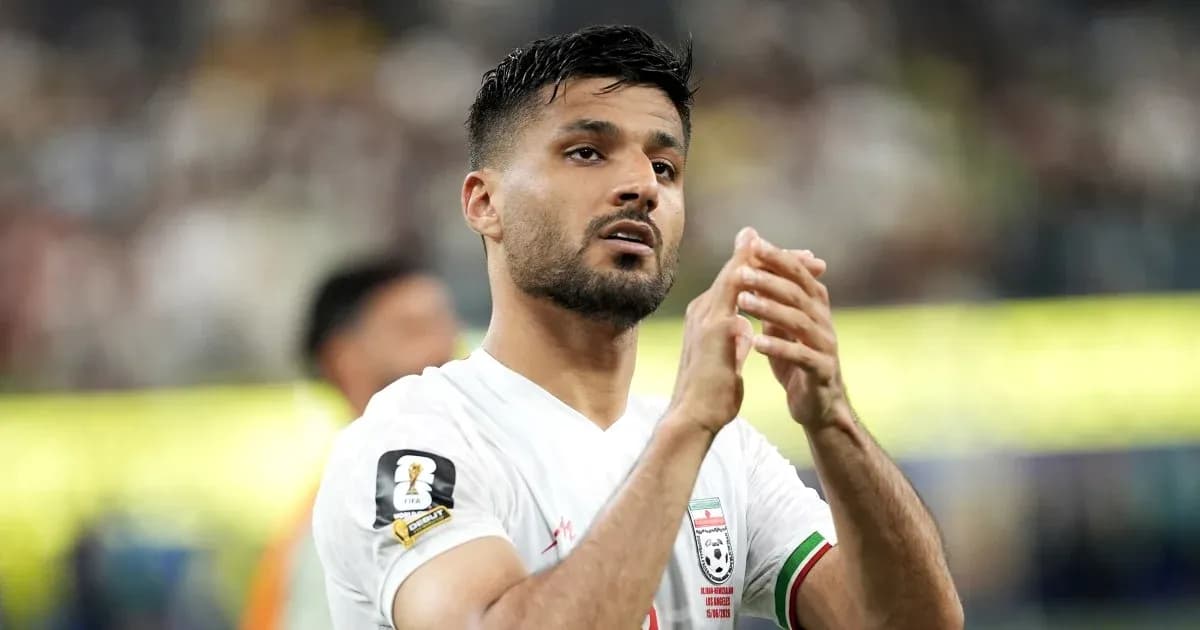
Iran’s World Cup Journey Begins in Chaos
The final whistle had barely faded at SoFi Stadium when Iran’s players were told to get out.
No warm-down, no ice baths, no night in Los Angeles to let the adrenaline drain away after a draining, politically charged 2-2 draw with New Zealand. Just orders. Bags. Security. A late-night dash back across the border.
Coach Amir Ghalenoei said Iran’s World Cup squad was instructed to leave the U.S. and return immediately to its training base in Tijuana, only hours after its opening game on Monday night. The plan had been simple: arrive two nights before, stay in California after the match, recover properly, fly back at lunchtime the next day. That plan vanished in a single post-match message.
“They didn’t even give us time to recover,” Ghalenoei said through an interpreter. “After the game today, they said to us, ‘You have to leave immediately.’ … We are asked to get on a plane and return to our camp in Tijuana, and we are really troubled by that.”
Who gave the order? Ghalenoei didn’t say. What he did make clear was the sense that Iran’s World Cup is being run by forces far beyond the touchline.
“It seems like others are doing the planning for us,” he said. “The decision-making for us is being made elsewhere.”
A World Cup played under fire
Iran’s campaign has unfolded against the backdrop of war. Since the U.S. and Israel began military action against Iran on Feb. 28, the very idea of this team appearing at a World Cup on American soil has been freighted with politics, logistics and emotion.
Iran asked FIFA to move its three group-stage games out of the U.S. The request was rejected. The team came anyway, dragging a trail of bureaucratic and diplomatic problems behind it.
Key staff never made it. The president of Iran’s football federation, several coaching support staff and media officials were all denied U.S. visas, according to Ghalenoei and captain Mehdi Taremi. The absences stripped away layers of support that elite teams usually take for granted.
Taremi described a five-hour slog of travel and security checks just to make the short trip from Tijuana to the Los Angeles area on Sunday. A journey that should feel routine for a World Cup side instead resembled an obstacle course.
“We don’t know why they are returning us, to be honest,” Ghalenoei said. “We have no idea why.”
Then he delivered the line that hung over the whole night: “I think our team is perhaps the most oppressed in the World Cup.”
A “home” game in a divided city
On the pitch, the game itself was wild, tense, and at times beautiful. Off it, the stands told a more complicated story.
Los Angeles is home to the world’s largest Iranian community outside Iran, and SoFi Stadium crackled with that energy. The crowd was loudly, unmistakably pro-Iran once the ball started rolling. Before that, it was something else entirely.
Several hundred Iranian Americans protested the government outside the stadium. Inside, many fans turned their backs during the anthem and jeered, a visible rejection of the regime. Yet when the whistle blew, most of those same stands roared for Team Melli.
“It was an incredible atmosphere in the game, all 90 minutes,” Taremi said. “It was like at home for us.”
For 90 minutes, the politics gave way to football.
New Zealand shock, Iran answer
On paper, Iran were heavy favorites. They sit 65 places above New Zealand in the FIFA rankings. On grass, that gap shrank fast.
Elijah Just scored early in each half, punishing Iran twice and threatening to turn a difficult week into a full-blown crisis. Each time, Iran clawed their way back.
Ramin Rezaeian dragged them level first, guiding a clever finish off the side of his boot in the first half. It was a moment of pure technique, the kind of goal that usually settles a nervous team.
It didn’t. Just struck again after the break, and Iran had to chase once more.
The pressure finally told in the 64th minute. Rezaeian delivered a perfect cross, and Mohammad Mohebi met it with a thumping header, sending SoFi into a frenzy. The goal salvaged a point and gave Iran at least something to cling to from a match they were expected to win.
Mohebi’s celebration sparked its own storm. He appeared to mime the shooting of a gun before flashing the “ice in my veins” gesture popularized by D’Angelo Russell just down the road in Los Angeles, then finished with a heart to the crowd. The gun-like motion drew criticism online.
“That celebration, it comes in the mind, and I did like this for all the fans,” Mohebi said, motioning to his arm. “Just a celebration.”
When it was over, players from both teams embraced and swapped shirts. Iran’s squad walked the pitch, applauding thousands of flag-waving fans who stayed behind, roaring them around the stadium. Ghalenoei stayed back in the dugout, alone with his thoughts as his players soaked up the noise.
A team running on fumes
The game unfolded in mild conditions, but Iran’s players faded. Cramps spread through the side, forcing substitutions that had nothing to do with tactics.
“Before the game, I said we haven’t had time to adjust because of the travel,” Ghalenoei said. “Many of our players, they had cramps, and that’s why we had to substitute them. So it wasn’t for technical reasons.”
The coach blamed the disrupted schedule, the late arrivals, the long security checks, the absence of a normal build-up. Recovery, he stressed, is not a luxury at this level. It is the foundation. Iran never had it.
Now, even the little they planned has been stripped away. Instead of resting in Los Angeles, the players were hustled back to Tijuana, facing another round of travel and another truncated recovery window before their next game.
“We have to leave Los Angeles right now, and it’s not good for us,” Taremi said. “I think FIFA have to help us more than this. … Everything is like a disaster, actually, for us.”
The road only gets steeper
The table offers no comfort. All four teams in the group — Iran, Belgium, Egypt and New Zealand — sit on one point after the opening round. On paper, Iran’s hardest work still lies ahead.
Belgium await in Inglewood on Sunday. Egypt follow in Seattle next week. Both present a far sterner test than a New Zealand side ranked far below Iran.
Both of Iran’s remaining group games are tougher assignments, and the margins for error are already thin. Iran have never escaped the group stage at a World Cup. That ambition now collides with a schedule and environment that seem designed to exhaust them.
Ghalenoei, though, refused to yield.
“We’re facing more hurdles, but we’re not going to let that stop us from doing our best,” he said. “I think today was one of the best games in the World Cup so far, and I think the fans really enjoyed it inside the stadium and outside the stadium.”
The football, for one night, lived up to the noise. The question now is whether a team that feels “oppressed” and overruled at every turn can summon the energy — physical and emotional — to push through a tournament that seems determined to drain it.