Iran Faces Political Tensions Ahead of World Cup Opener
On Monday night in Los Angeles, Iran will walk into a World Cup with more than a game on their shoulders.
They arrive in a host nation that, until this week, was at war with them. They step into a city that houses one of the biggest Iranian diasporas on the planet. They open their campaign against New Zealand at SoFi Stadium, but the real contest is already raging outside the touchline.
A ceasefire and an agreement to reopen the Strait of Hormuz were announced on Sunday. It eased fears of immediate escalation. It did not ease the mood.
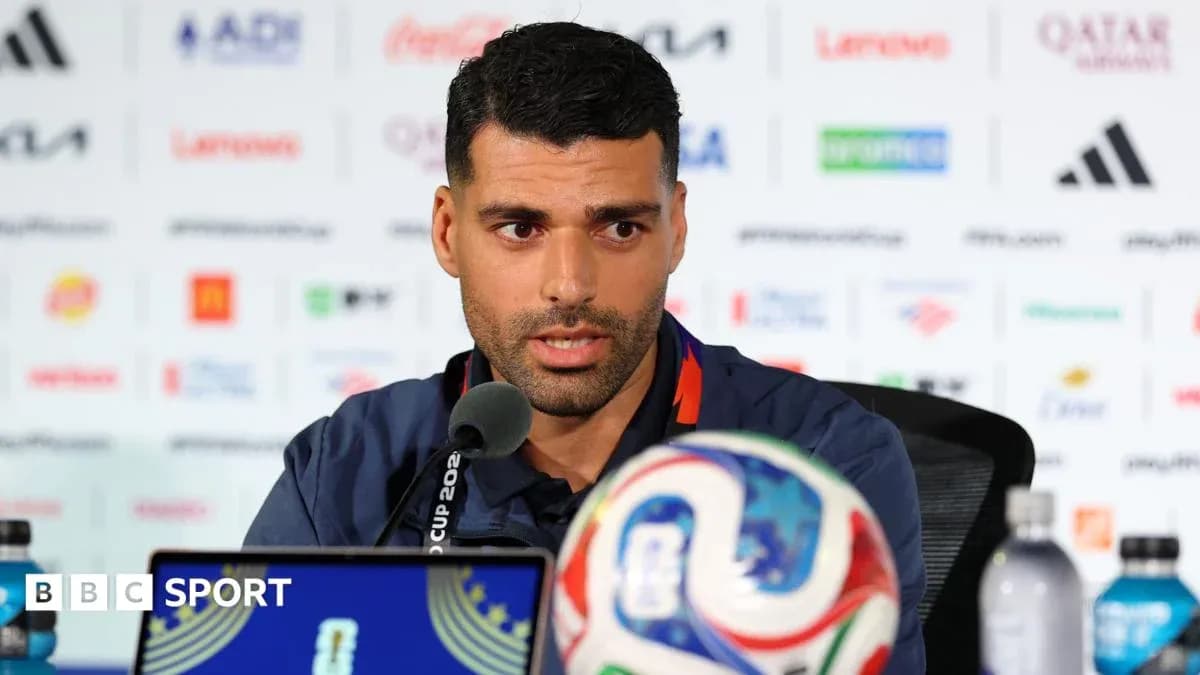
“This kind of tension undermines the joy of the World Cup,” said striker Mehdi Taremi. “I felt the tension from the first moment we arrived. The tension started even before we got here.”
He is not exaggerating. Iran’s route to this tournament has been a logistical maze and a political storm.
Their base camp was supposed to be in Tucson, Arizona. Months of uncertainty over visas, security and a hardening political climate forced a late rethink. The squad uprooted and shifted to Tijuana, on the Mexican border, a move that cost them time, stability and calm.
Head coach Amir Ghalenoei did not hide the impact.
“Without any doubt, this kind of behaviour has impacted the spirit of football,” he told the BBC. “Football is supposed to bring nations and cultures together. It is about bringing joy. These conditions have affected our focus, but I have tried to make sure the players concentrate on strategy and performance.”
They arrived late. They have had little time to adjust. Preparation, in the classic football sense, has been a luxury.
“But I know how committed these players are to performing,” Ghalenoei added, leaning on the one constant he can trust: the squad’s resolve.
Now they land in Los Angeles, a city often nicknamed “Tehrangeles”. The label drew smiles from both manager and striker at the pre-match news conference, a brief moment of levity in a week heavy with symbolism.
That nickname is no accident. The city holds the largest Iranian community outside Iran, and on Monday many of those Iranian-Americans will pour into SoFi Stadium. Not all of them will come to sing.
A significant number will be there to protest.
At the heart of their anger lies a flag. Fifa has banned the pre-revolutionary Lion and Sun flag, a powerful emblem for many Iranians abroad and a visible rejection of the Islamic Republic. The ruling has cut deep into a community that often defines itself through that symbol.
“You don’t come to Los Angeles and tell us we can’t fly the Lion and Sun flag,” said activist Arezo Rashidian, who is helping to organise demonstrations outside the stadium. “This is the largest Iranian community outside Iran. Many of us came here after the revolution. We’re opposing Fifa’s ban and standing in solidarity with the people of Iran.”
For many in the diaspora, the national team sits uncomfortably close to the regime. Some see the squad as an extension of the Islamic Republic’s image-making machine.
“It’s unfortunate that the regime turns athletes into mouthpieces,” Rashidian said. “We want athletes to remain athletes.”
Yet the relationship is not simple. She will still go to the game. So will many others who plan to protest.
“We understand the pressure they’re under,” she said. “We’ll carry our colours. We’ll cheer for Iran – the country – held captive by the Islamic Republic.”
That distinction – between the state and the nation, between the regime and the players – will echo around SoFi as loudly as any chant.
Inside, the squad is trying to build a different kind of bubble.
“As players of the national team, we play for every single Iranian, whether in the diaspora or in Iran,” Taremi said. “In every country people have different opinions. We are here to unite people and bring joy. Everyone is entitled to their opinion. We don’t get involved in politics.”
That is the ideal they cling to. The reality is harsher.
For this group, politics is not a background noise; it is the soundtrack. Every venue, every security check, every question at a press conference drags them back to the same themes. Even the location of their matches – in a city where the diaspora is vocal, organised and angry – ensures that nothing happens in isolation.
“There is no winning for Iran’s team,” said investigative football journalist Samindra Kunti. “Given the circumstances, the political pressure, the location of the matches and the diaspora in Los Angeles, they’re under enormous pressure. It’s impossible to avoid the politics. Everything becomes a reminder of their situation.”
Pressure from home. Pressure from the host nation. Pressure from a diaspora determined not to let this stage pass quietly.
All of it before a ball has even been kicked.