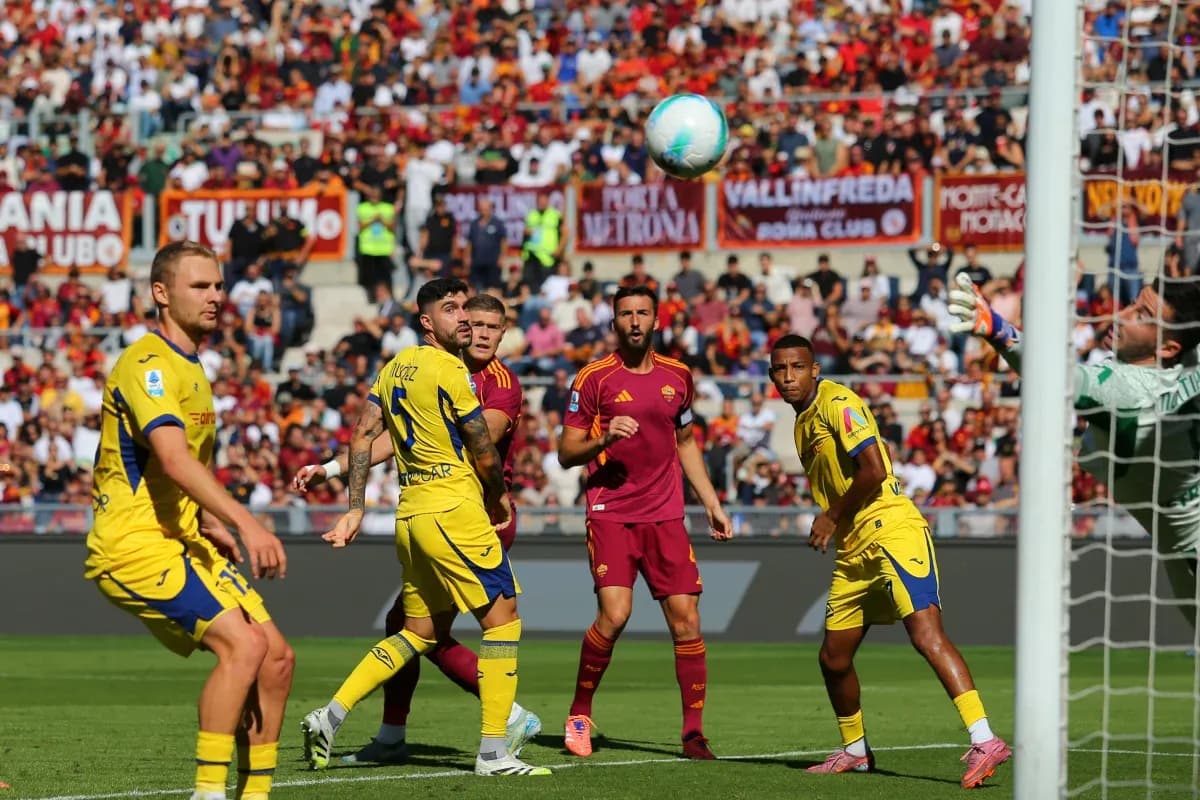
Hellas Verona vs AS Roma: A Tale of Two Seasons
Under the Verona dusk at Stadio Marcantonio Bentegodi, a season’s worth of divergence crystallised into 90 minutes. Hellas Verona, already locked into 19th place with 21 points and a bruising overall goal difference of -36 (25 scored, 61 conceded), closed a tormented campaign with a 0–2 home defeat to an AS Roma side whose trajectory could hardly be more different. Roma finished 3rd on 73 points, their overall goal difference a commanding +28 (59 for, 31 against), and this performance felt like a neat encapsulation of the broader story: one team clinging to damage limitation, the other sharpening Champions League steel.
The tactical shapes told you as much before a ball was kicked. Paolo Sammarco doubled down on Verona’s seasonal identity, rolling out the familiar 3-5-2 that has been his most-used structure (26 league matches in this shape). L. Montipo sat behind a back three of N. Valentini, A. Edmundsson and V. Nelsson, with M. Frese and R. Belghali as wide outlets. Inside, J. Akpa Akpro, S. Lovric and A. Harroui formed a compact, industrious midfield, while T. Suslov floated off K. Bowie in a two-man frontline.
Across from them, Piero Gasperini Gian stayed true to Roma’s own dominant template: a 3-4-2-1, the system they have used in 30 league matches. M. Svilar anchored a back three of M. Hermoso, D. Ghilardi and G. Mancini, with Z. Celik and D. Rensch as aggressive wing-backs. The double pivot of B. Cristante and N. Pisilli underpinned a front trio of M. Soule and P. Dybala behind central spearhead D. Malen.
The absences only heightened the contrast in resources. Verona were stripped of spine and experience: R. Gagliardini (suspended for yellow cards), D. Mosquera and S. Serdar (both knee injuries), G. Orban (inactive), plus D. Oyegoke and J. Peci (injuries) all missed out. Gagliardini’s ball-winning and positional discipline, along with his 73 tackles and 54 interceptions this season, had been a rare stabilising force in a team that conceded an overall average of 1.6 goals per match. Without him, Akpa Akpro and Lovric had to shoulder extra defensive and distributional weight in central zones.
Roma, too, were without important pieces: E. Ferguson (ankle), E. Ndicka and L. Pellegrini (thigh injuries), K. Tsimikas (illness), Wesley Franca (suspended after a red card) and B. Zaragoza (knee injury). Yet their squad depth allowed them to replace high-profile absentees with fully integrated starters. Hermoso and Mancini, both high-volume defenders with nine yellow cards each this season, again became the structural pillars of Roma’s back line, offering both build-up quality and a hard edge in duels.
From the first whistle, the pattern followed the league table. Roma, whose attack has averaged 1.4 goals on their travels and 1.6 overall, settled into a controlled territorial dominance. Cristante’s metronomic passing and Pisilli’s energy gave them a platform to rotate the ball around Verona’s 5-3-2 defensive shell (Frese and Belghali often dropping deep to form a back five). Dybala and Soule, two of Serie A’s most creative profiles this season, drifted between the lines to drag Verona’s centre-backs into uncomfortable decisions.
Soule’s season numbers — six goals and five assists, with 46 key passes — were reflected in his role as Roma’s primary conduit between midfield and attack. He repeatedly found pockets behind Lovric and Harroui, threading passes into Malen’s diagonal runs. Dybala, with six league assists and 55 key passes, provided the complementary chaos: receiving between Valentini and Frese, turning onto his left, and forcing Verona’s block to collapse inward.
For Verona, the plan was pragmatic: compress the centre, survive, and break into the spaces behind Roma’s wing-backs. With only 12 goals at home all season (an average of 0.6 per match at Bentegodi), their margin for error was vanishingly thin. Suslov tried to knit counters together, dropping off Bowie to link with Harroui and Belghali, while Frese — whose campaign has blended defensive graft (84 tackles, 10 blocked shots) with forward thrust — was tasked with driving them up the left when opportunities arose.
But Roma’s defensive structure has been one of the league’s most reliable, especially at home, and it travelled well enough here. Overall, they conceded just 31 goals across 38 matches, an average of 0.8 per game, and kept 18 clean sheets. Even away, where they allowed 21 goals in 19 fixtures (1.1 per match), they have usually been able to absorb pressure and spring forward with venom. Mancini and Hermoso were aggressive in stepping into Bowie’s feet, while Ghilardi covered depth against Suslov’s movements into the channels.
The “Hunter vs Shield” duel between Malen and Verona’s porous defence was always likely to decide the tone. Malen arrived as one of Serie A’s deadliest forwards: 14 goals and two assists in just 18 appearances, with 31 shots on target from 49 attempts and three penalties converted out of four (one miss a reminder that he is not infallible from the spot). Against a Verona side that has conceded 28 at home and 61 overall, his combination of acceleration and penalty-box timing was a constant threat.
The “Engine Room” battle in midfield was more attritional. Without Gagliardini, Verona leaned heavily on Akpa Akpro’s work rate and tackling (44 tackles, seven blocked shots this season) to disrupt Roma’s rhythm. He snapped into duels with Soule and Dybala, trying to deny them the half-turn. Yet Cristante’s experience and aerial presence, allied to Pisilli’s mobility, gradually tilted the central corridor Roma’s way. Once the visitors began to win second balls around the centre circle, Verona’s counters grew more sporadic, and their front two increasingly isolated.
Discipline, too, played its part in the narrative. Verona’s season-long yellow-card profile shows a spike between 46–60 minutes (24.72%) and a late-game surge between 76–90 minutes (15.73%), a pattern of fatigue and desperation that has often seen them defending deeper and later than they would like. Roma, by contrast, tend to collect their cautions in the second half as well, particularly between 61–75 minutes (23.53%) and 76–90 minutes (23.53%), but their game-state control and superior bench usually keep them from unravelling.
Following this result, the statistical prognosis of the campaign feels brutally logical. Verona’s overall scoring average of 0.7 goals per match, combined with 20 league games in which they failed to score, meant that any concession was likely to be fatal. Roma’s blend of away scoring (1.4 per match) and defensive solidity, plus an attack led by Malen and orchestrated by Soule and Dybala, tilted the balance decisively.
In narrative terms, Bentegodi’s final chapter of 2025–26 reads as a coda rather than a twist. Verona’s 3-5-2, stripped of key lieutenants and starved of cutting edge, fought to keep the scoreline respectable rather than to rewrite their fate. Roma’s 3-4-2-1, even with notable absentees, looked every inch a top-three machine: structured at the back, inventive between the lines, and ruthless in the decisive zones. The 0–2 scoreline did not merely close a match; it underlined the gulf between a side sinking towards Serie B and one striding into the Champions League with its tactical identity fully intact.