France Dominates Sweden 3-0 in World Cup Round of 32
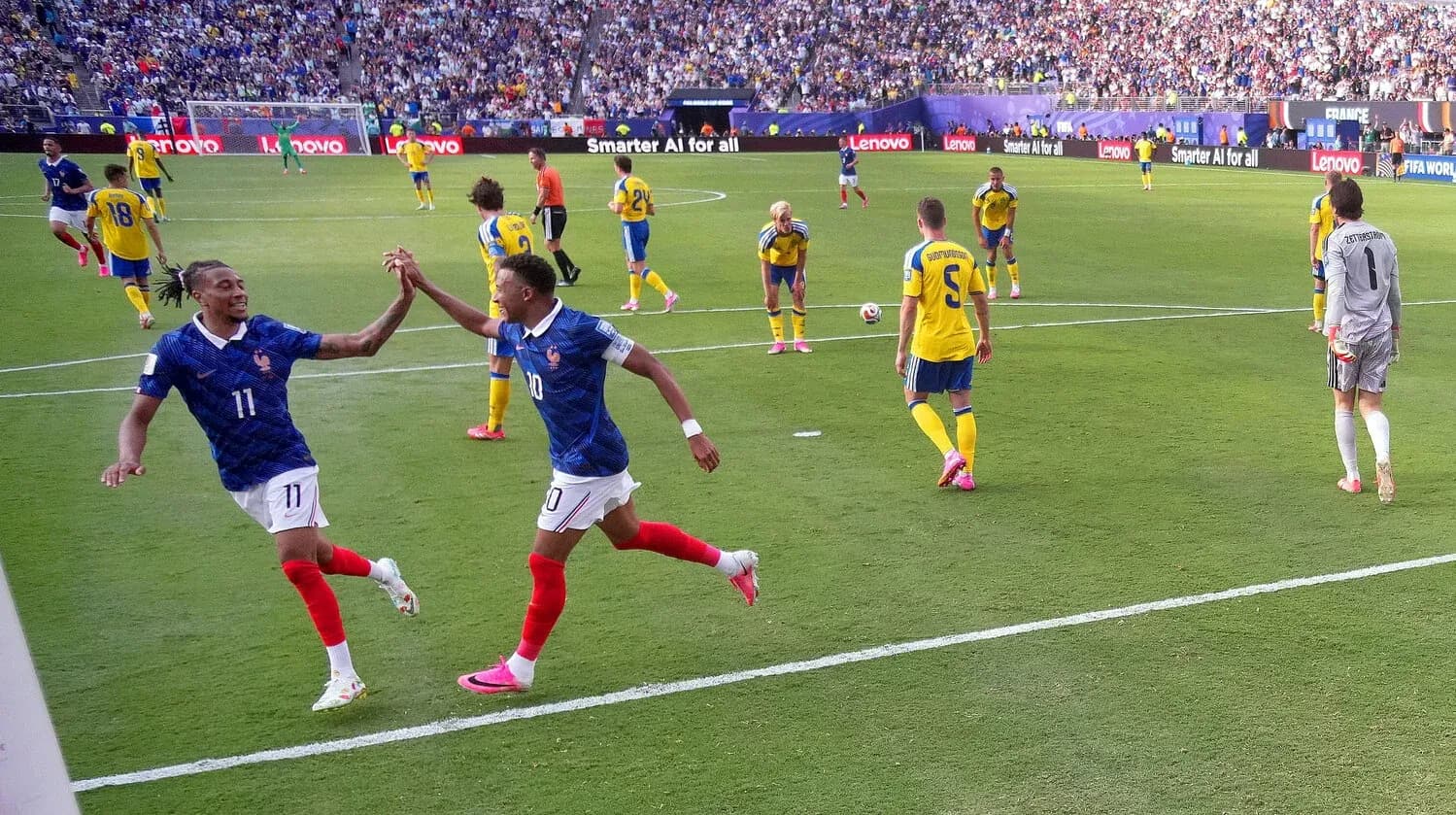
France’s 3-0 win over Sweden at MetLife Stadium was a controlled, methodical dismantling built on structural superiority in and out of possession. Didier Deschamps’ 4-2-3-1 consistently overloaded Sweden’s 4-4-2 in central zones, and once the tempo was established, the Round of 32 tie became a question of how efficiently France could convert their territorial dominance into goals.
France’s passing platform underpinned everything: 551 passes, 485 accurate at 88%, against Sweden’s 352 (280 accurate, 80%). With 61% of the ball and 16 of their 25 shots coming from inside the box, France were able to compress the game into Sweden’s half for long stretches. The expected goals numbers – 3.17 for France versus 0.65 for Sweden – mirror the scoreline and confirm that this was not just sterile possession but sustained, high-quality chance creation.
Out of possession, France’s 4-2-3-1 behaved more like a 4-4-2 press, with Michael Olise stepping up alongside Kylian Mbappé to block Sweden’s first pass into midfield. Aurélien Tchouaméni and Adrien Rabiot then controlled the central lane behind them, screening Viktor Gyökeres and Alexander Isak and forcing Sweden wide, where full-backs Jules Koundé and Lucas Digne could defend aggressively. The shot profile tells the story: Sweden managed only 8 attempts, 7 of them inside the box, but those were largely low-quality, crowded efforts, reflected in the modest 0.65 xG.
With the ball, France’s shape was fluid. The nominal 4-2-3-1 often became a 3-2-5 in settled possession: Digne advanced high on the left, Koundé tucked slightly to form a back three with Dayot Upamecano and William Saliba, while Tchouaméni and Rabiot held the double pivot. Ahead of them, Ousmane Dembélé and Bradley Barcola stretched Sweden horizontally, Olise floated between the lines, and Mbappé occupied both centre-backs with his movement across the front.
First Goal
The first goal on 45 minutes encapsulated that structure. France had already forced Sweden deep with repeated waves of possession, and the volume of shots – 25 total, 12 on target, with only 4 blocked – showed how often they were able to work clean looks at Jacob Widell Zetterström’s goal. Dembélé’s assist for Mbappé’s opener came from the right, exploiting the space created by Olise’s interior positioning and Barcola’s width on the opposite flank. Sweden’s midfield four, stretched laterally, could not get enough pressure on the ball, leaving their back line repeatedly exposed to 1v1s and late box runs.
Sweden’s 4-4-2 was built for vertical transitions through Gyökeres and Isak, but the structure rarely materialised. With only 39% possession, they struggled to establish stable build-up. When they did, France’s first line of pressure forced them into longer passes, which Saliba and Upamecano dealt with comfortably. The Swedish wide players – Anthony Elanga and Elliot Stroud initially, later supported by Besfort Zeneli and Taha Abdi Ali – were mostly forced into deep defensive roles, limiting their ability to drive counters. Sweden’s 1 corner and 10 fouls underline how much of the game was spent reacting rather than dictating.
Second Half Substitutions
The second half substitutions did little to change the tactical pattern. Sweden’s double change on 66 minutes, with Besfort Zeneli (IN) coming on for Elliot Stroud (OUT) and Taha Abdi Ali (IN) for Lucas Bergvall (OUT), was an attempt to inject more ball-carrying and creativity into the wide and central channels. Yet by then, France were already 2-0 up thanks to Barcola’s 53rd-minute strike, assisted by Olise, a move again born from overloads between the lines and quick circulation to isolate Sweden’s full-backs.
France’s own rotation was about energy management and preserving control rather than altering the system. Malo Gusto (IN) came on for Jules Koundé (OUT) and Désiré Doué (IN) for Dembélé (OUT) on 75 minutes, followed by Theo Hernández (IN) for Digne (OUT) at 78, and later Jean-Philippe Mateta (IN) for Olise (OUT) and Rayan Cherki (IN) for Mbappé (OUT) on 85. Crucially, the structural principles remained: a back four morphing into a back three in possession, a double pivot, and five lanes occupied in attack. The fresh legs simply maintained the intensity of the press and the width of the attacking line.
Closing the Tie
Mbappé’s second goal on 74 minutes, assisted by Olise, effectively closed the tie and was the logical outcome of France’s control between Sweden’s midfield and defence. As Sweden tired, the distances between their lines increased, and France’s attacking midfielders repeatedly received on the half-turn. With 9 French corner kicks to Sweden’s 1, even set-piece territory favoured Deschamps’ side, further pinning Sweden back and preventing sustained relief.
Defensively, France’s work without the ball ensured that Mike Maignan ([France]) had a relatively straightforward evening. Sweden generated 3 shots on target, all of which Maignan dealt with, reflected in France’s 3 goalkeeper saves. At the other end, Jacob Widell Zetterström ([Sweden]) was far busier, making 9 saves. The goals prevented metric – 1.16 for both teams – suggests that both goalkeepers performed well relative to the quality of chances faced, but the volume of French pressure eventually overwhelmed Sweden’s resistance.
The statistical verdict reinforces the tactical impression: France married territorial control (61% possession), high-tempo circulation (551 passes at 88% accuracy), and a relentless shot volume (25 total, 12 on target, 16 inside the box, xG 3.17) with a compact, disciplined defensive block that limited Sweden to sporadic, low-yield attacks (8 shots, 3 on target, xG 0.65). Sweden’s 80% passing accuracy and 352 passes indicate they were not technically overwhelmed, but structurally outmatched: their 4-4-2 could not cope with France’s fluid front four and advancing full-backs, and their own transitions were smothered by France’s counter-press and central screen.
In the context of a World Cup Round of 32 tie, this was the archetype of a top seed’s performance: patient, territorially dominant, and tactically coherent from first whistle to last, with the scoreline and underlying metrics perfectly aligned.