
England's World Cup Opener: Distractions and Expectations Against Croatia
England head into their World Cup opener against Croatia looking less like a finely tuned tournament machine and more like a side dodging distractions from every angle – some of them self‑inflicted, many of them manufactured.
The football has barely started. The noise is deafening.
Tuchel, Maguire and the FaceTime fallout
The first jolt came with Harry Maguire’s admission that Thomas Tuchel delivered his World Cup axe over FaceTime. Not a quiet visit to the house. Not even an old‑fashioned phone call. A video chat.
It sounds trivial, but the manner of these conversations still matters in elite dressing rooms. Maguire, a senior England international and a veteran of major tournaments, discovered his omission via a screen. It fed into an image of a camp scrambling through late decisions rather than gliding into a World Cup with clarity and conviction.
Maguire’s own account of the conversation only underlined the muddle. He explained that Tuchel told him he was sticking with “the four lads that he got through the qualifying in the autumn camps where he felt like they did well during those six games,” then immediately added: “But he did say that he can’t really give me an excuse.”
That contradiction lands heavily. The explanation is there, then instantly disowned. It sounds like a manager trying to soften a hard call, and a player left to piece together the logic. For a squad that prides itself on togetherness, it is hardly the cleanest pre‑tournament storyline.
No margin for excuses
The pressure on Tuchel has been dialled up with familiar tabloid bluntness. On the eve of England’s opener, one headline framed the World Cup in stark terms: make the semi‑finals at least or he has failed.
No nuance, no allowance for the chaos of tournament football, no recognition that even the most polished favourites can be tripped up. Spain, reigning European champions and widely tipped to go deep again, have already been reminded how unforgiving this stage can be. Their stumble has not stopped some insisting England must march serenely to the last four as a bare minimum.
This is the environment Tuchel walks into: a World Cup presented as a pass‑fail exam, with no room for context.
Saka’s “gamble” and the Arsenal angle
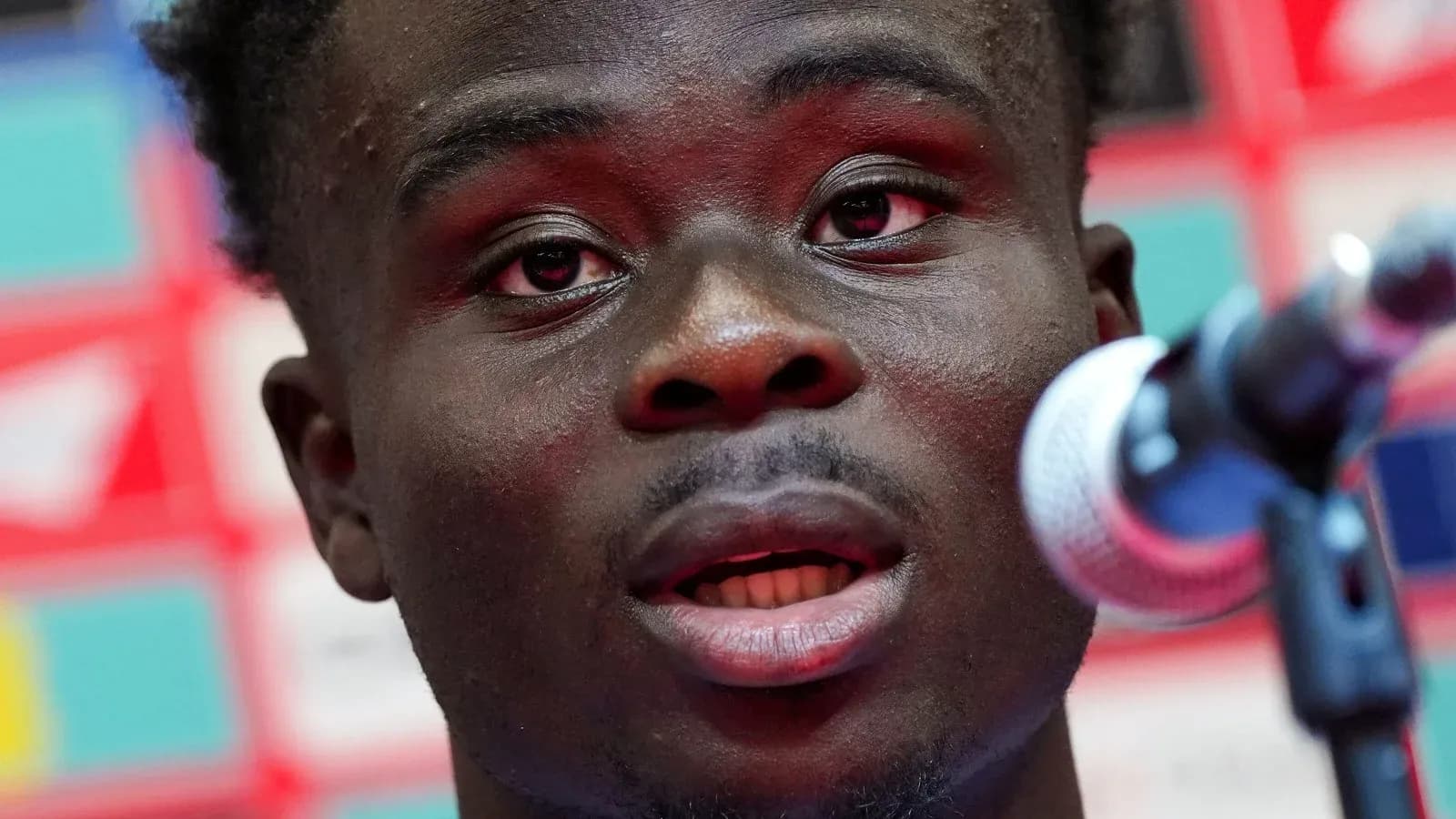
Then there is Bukayo Saka, who has become the latest lightning rod for pre‑tournament anxiety.
Saka spoke openly about his condition, acknowledging he is not at full tilt but declaring himself “ready to go” and “happy to take the gamble” on his fitness. Given his recent workload, that honesty was hardly shocking.
He has started and finished just one game for club or country since mid‑March. He began only two of Arsenal’s final seven Premier League matches in the title run‑in. He was limited to under an hour in their Champions League semi‑final second leg. He missed England’s March fixtures through injury and played less than half an hour across the warm‑up games.
This is not a secret. Arsenal know it. England know it. Saka himself knows it.
He even went out of his way to praise “the Arsenal medical team” and Mikel Arteta for managing him “amazingly since March,” and Tuchel echoed that, stressing how carefully Arsenal had handled an ongoing Achilles issue.
Yet those measured comments were twisted into a far more dramatic narrative. A straightforward piece about Saka’s willingness to play through risk, originally framed as a “gamble” that boosts England’s chances, was repackaged elsewhere as him “sparking Arsenal concerns with alarming England comments.”
The reality? A player on the edge of full fitness, desperate to play at a World Cup, and two medical departments coordinating his minutes. The headline hysteria belongs to everyone else.
Manufactured peril off the pitch
If the injury talk wasn’t enough, England’s build‑up has been accompanied by a stream of off‑field “threats” that barely survive contact with their own copy.
Reports of a tornado “shaking” the camp turned out to describe an evening where the squad stayed inside on a quiet night and changed nothing about their schedule. Now a SWAT team response to an armed incident a mile from England’s opening venue has been pushed towards the front of the narrative.
The framing is breathless: armed police, a suspect arrested, all within touching distance of where Tuchel’s side will kick off their campaign. Only deeper into the story comes the crucial line: there is no indication the incident was connected to the World Cup or posed any threat to the tournament or its venues.
The implication is clear. England are being cast as a team under siege from every conceivable danger, even when those dangers are, in reality, distant and unrelated. The next step in this escalating drama might be fireworks a few miles away being billed as a psychological earthquake for the camp.
Spain stumble, England warned
Even results elsewhere are being bent to fit the narrative.
Spain’s draw with Cape Verde has been presented as both a warning and an invitation. On one hand, it is used to underline how hazardous this World Cup could be for any favourite. On the other, it comes with the reassurance that Spain “still cannot be ruled out of contention for the trophy” with two group games to play.
That duality hangs over England as well. They are reminded constantly that nothing is guaranteed here, that one poor performance can derail years of planning. At the same time, they are told semi‑finals are the baseline and that anything less is a failure.
Between those poles sits Tuchel, trying to steer a squad that has already endured late selection drama, fitness doubts over a key forward and a swirl of off‑field noise.
Liverpool, Wirtz, Isak – and another strange leap
Even away from England, the World Cup has become a canvas for curious leaps of logic.
Liverpool’s interest in Florian Wirtz and Alexander Isak has been cast in a positive light after both impressed in their early outings. The opposition – Curacao for one, Tunisia for the other – hardly represents the sharp end of tournament pressure, but good form on the biggest stage always draws attention.
Yet the analysis around Andoni Iraola and Isak veered into the bizarre. The suggestion that Iraola “would never admit” he wants his star striker to rediscover his best form at the World Cup makes little sense. Of course he wants that. Every manager does. The idea that he would somehow keep quiet about hoping his most expensive forward shines, then brings that confidence back to Anfield, is a narrative stretch too far.
It is another example of how this World Cup is being wrapped in layers of drama that don’t always withstand scrutiny.
A fragile calm before Croatia
Strip away the headlines, the tornado tales, the SWAT‑team drama and the semantic knots over Maguire, and the picture is more straightforward.
England have a manager under intense expectation, a key attacker willing to push his body to the limit, a high‑profile omission handled in a way that has raised eyebrows, and a tournament opener against a battle‑hardened Croatia side that has made a habit of spoiling grand plans.
The question now is simple: when the whistle blows and the noise fades, will this England side look like a team burdened by the chaos around them, or one hardened by it?





