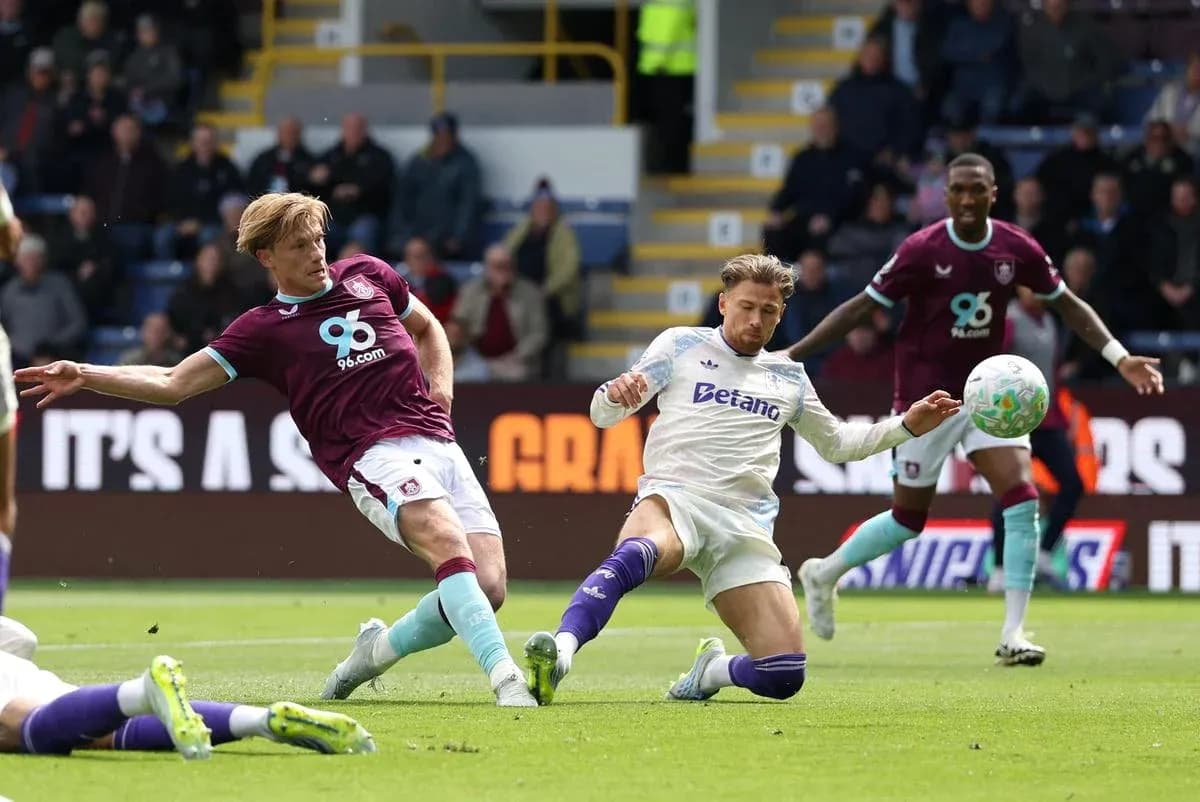
Burnley vs Aston Villa: Tactical Analysis of a 2-2 Draw
Burnley and Aston Villa shared a 2-2 draw at Turf Moor in Round 36 of the Premier League, a match that neatly reflected contrasting game models. Burnley, under Mike Jackson, leaned into a compact 4-2-3-1 and direct transitions, while Unai Emery’s Aston Villa dominated the ball, circulating patiently in their own 4-2-3-1. The scoreline mirrored the underlying metrics: Burnley generated 1.77 xG to Villa’s 1.42, while Villa owned 66% possession and a 18–15 shot edge. The contest became a tactical tug-of-war between Burnley’s vertical aggression and Villa’s structured, possession-heavy control.
I. Executive Summary
Burnley’s approach was built around a low-to-mid block, fast outlets in wide areas, and the creative freedom of Zian Flemming between the lines. Jaidon Anthony’s early goal set the tone for a home side willing to concede territory but not central space. Villa, by contrast, used Youri Tielemans and Victor Lindelöf as a double pivot to dictate rhythm and find the advanced midfield trio, with Ross Barkley and John McGinn key in breaking Burnley’s lines. Ultimately, Burnley’s more efficient chance creation compensated for their territorial deficit, while Villa’s structural dominance did not fully translate into clear chances.
II. Scoring Sequence & Disciplinary Log
The game opened with Burnley striking first. On 8', Jaidon Anthony (Burnley) scored a Normal Goal, capitalising on Burnley’s early directness and the space Villa left when pushing their full-backs on. That early breakthrough allowed Burnley to sink into a more conservative block and invite Villa onto them.
Villa thought they had levelled when a potential goal by Ollie Watkins was disallowed by VAR at 40', a key tactical moment: Burnley’s high defensive line had been exploited, warning Jackson’s side about the danger of space in behind. Villa adjusted by pushing their attacking midfielders closer to Watkins, and the pressure told shortly after. On 42', Ross Barkley (Aston Villa), assisted by John McGinn, scored a Normal Goal, arriving from the second line to exploit the half-space as Burnley’s double pivot was dragged sideways.
After the interval, Villa’s territorial control intensified. On 49', Tyrone Mings (Aston Villa) received a Yellow Card — Foul — reflecting Villa’s need to counter Burnley’s transitional threat with aggressive counter-pressing. That high back line and front-foot defending allowed Villa to keep Burnley penned in, and on 56' they turned it around: Ollie Watkins (Aston Villa), assisted by Emiliano Martínez, scored a Normal Goal, a sequence starting from the goalkeeper and exploiting Burnley’s stretched shape in transition.
Burnley’s response was immediate and tactical. On 58', Zian Flemming (Burnley), assisted by Hannibal Mejbri, scored a Normal Goal, arriving from his No.10 zone to punish space between Villa’s centre-backs and midfield. Two minutes later, on 60', Zian Flemming (Burnley) was booked with a Yellow Card — Persistent fouling — a symptom of Burnley’s increasingly combative attempts to disrupt Villa’s rhythm in central zones.
Substitutions then reshaped the contest. On 69', Lyle Foster (IN) came on for Hannibal Mejbri (OUT), shifting Burnley towards a more direct, dual-threat front line. At 74', Lucas Digne (IN) replaced Ian Maatsen (OUT), and Emiliano Buendía (IN) replaced Victor Lindelöf (OUT), with Emery injecting more creativity and fresh width while altering his midfield balance. Burnley countered on 79' with Josh Laurent (IN) for Lesley Ugochukwu (OUT) and Zeki Amdouni (IN) for Zian Flemming (OUT), adding legs and a new penalty-box profile.
Villa’s final offensive push came via Douglas Luiz (IN) for Ross Barkley (OUT) and Lamare Bogarde (IN) for Matty Cash (OUT) on 80', plus Leon Bailey (IN) for John McGinn (OUT) on 85', signalling a switch towards more wing-driven attacks and late box entries from deep. Burnley’s closing substitutions at 87' — James Ward-Prowse (IN) for Florentino Luís (OUT) and Jacob Bruun Larsen (IN) for Jaidon Anthony (OUT) — were about fresh legs and set-piece quality for the final minutes.
Card totals (locked): Burnley: 1, Aston Villa: 1, Total: 2.
Discipline log:
60' Zian Flemming (Burnley) — Persistent fouling
49' Tyrone Mings (Aston Villa) — Foul
III. Tactical Breakdown & Personnel
Burnley’s 4-2-3-1 was clearly designed to compress central spaces and spring quickly. Max Weiss made 5 saves, and Burnley’s defensive index was mixed: they allowed 18 shots and 1.42 xG, but many of Villa’s efforts came from outside the box (9 shots outside, 9 inside), showing that Burnley often succeeded in forcing lower-quality attempts. The back four of Kyle Walker, Axel Tuanzebe, Maxime Estève and Lucas Pires held a relatively narrow line, inviting crosses rather than through-balls. Walker’s presence on the right was crucial in dealing with overlapping full-backs and wide overloads.
The double pivot of Florentino Luís and Lesley Ugochukwu focused on screening Barkley and McGinn, but Villa’s rotations — especially McGinn drifting into the right half-space — frequently pulled them out of shape. Burnley’s attacking three of Loum Tchaouna, Hannibal Mejbri and Jaidon Anthony operated as transition outlets, with Anthony’s goal emblematic of their plan: win the ball, play early into the channels, and attack Villa’s defensive rest-structure before it could reset. Zian Flemming as the lone forward was more of a roaming No.10/9 hybrid, dropping to connect and then arriving late in the box, as seen in his 58' goal.
The substitutions subtly shifted Burnley’s structure. With Lyle Foster and later Zeki Amdouni on, Burnley moved towards a more classic striker profile, targeting Villa’s centre-backs with longer passes. Josh Laurent added ball-carrying from midfield, while James Ward-Prowse introduced late-game set-piece threat and calmer distribution. Jacob Bruun Larsen offered fresh width, allowing Burnley to stretch Villa’s tiring back line horizontally.
Villa’s 4-2-3-1 was possession-centric. Emiliano Martínez, with 4 saves, played an active role in build-up, as highlighted by his assist for Watkins on 56': Villa used him as an extra outfield player to draw Burnley’s first line, then hit vertical passes into space. The back four of Matty Cash, Ezri Konsa, Tyrone Mings and Ian Maatsen pushed high, especially the full-backs, to pin Burnley’s wingers deep. This contributed to Villa’s 66% possession and 510 total passes, 439 accurate (86%), underlining a strong overall form in ball circulation.
In midfield, Victor Lindelöf and Youri Tielemans formed a double pivot, with Lindelöf more conservative and Tielemans tasked with line-breaking passes. Ahead of them, John McGinn, Ross Barkley and Morgan Rogers operated fluidly, interchanging positions to overload the half-spaces. Barkley’s 42' goal came from exploiting the gap between Burnley’s midfield and defence, while McGinn’s assist underscored his role as a connector and final-third supplier.
Ollie Watkins was the focal point of Villa’s attack, constantly attacking the space behind Burnley’s defence. His disallowed effort at 40' and his 56' goal both stemmed from runs that split the centre-backs. When Emery introduced Emiliano Buendía, Douglas Luiz and Leon Bailey, Villa’s shape became more asymmetrical, with Bailey stretching the right touchline and Buendía drifting inside to act as a secondary playmaker, while Luiz provided deeper passing range.
Defensively, Villa’s high line and aggressive counter-press limited Burnley to 34% possession and just 255 passes, 186 accurate (73%). However, Burnley’s 15 total shots and 1.77 xG show that when the press was broken, Villa’s rest-defence was vulnerable, particularly to vertical passes into Flemming and later Foster/Amdouni.
IV. The Statistical Verdict
The numbers paint a balanced but stylistically divergent contest. Villa’s 66% possession, 510 passes (439 accurate, 86%) and 18 shots with 8 corners demonstrate clear territorial and structural control. Burnley, with 34% possession, 255 passes (186 accurate, 73%) and 15 shots, leaned on efficiency and directness. Both goalkeepers posted -0.16 in goals prevented, indicating they conceded slightly more than the model expected from the chances faced.
Burnley’s 1.77 xG versus Villa’s 1.42 suggests the home side carved out marginally better-quality chances despite having less of the ball. Defensively, Burnley’s 17 fouls and single yellow card for Persistent fouling show a deliberate strategy of disruptive pressure, while Villa’s 8 fouls and one booking for a Foul reflect a more controlled, positional approach with occasional tactical infringements. Ultimately, the 2-2 scoreline aligns with the underlying data: Villa’s control met Burnley’s vertical punch, and neither tactical plan could fully subdue the other.