Brazil vs Norway: Tactical Analysis of World Cup Clash
Brazil’s 2-1 defeat to Norway at MetLife Stadium in the World Cup Round of 16 was a classic clash between territorial control and transition efficiency. Norway dominated the ball and the tempo, while Brazil relied on vertical surges, individual quality and penalty-box volume. Across 90 minutes, the tactical story is one of a Brazilian side built to punch through space, gradually suffocated by Norway’s structure, pressing triggers and superior passing rhythm.
With no formations specified, the patterns on the pitch are best read from roles. Brazil’s back four of Danilo, Marquinhos, Gabriel Magalhães and Douglas Santos operated behind a midfield triangle of Casemiro, Bruno Guimarães and Rayan, with Vinícius Júnior and Gabriel Martinelli flanking Matheus Cunha as the central reference. This spine under Carlo Ancelotti was clearly designed for verticality: Brazil generated 14 total shots, 10 from inside the box, and 2.73 xG despite only 34% possession. The plan was to compress the game into high-value final-third moments rather than long spells on the ball.
Norway, under Stale Solbakken, built around a technically secure midfield of Martin Ødegaard, Sander Berge and Patrick Berg, supporting a front line of Erling Haaland, Alexander Sørloth and Antonio Nusa. Their 66% possession and 680 total passes (617 accurate at 91%) underline a methodical, circulation-heavy approach. They used the back line of Julian Ryerson, Kristoffer Ajer, Torbjørn Heggem and David Møller Wolfe to widen the pitch and create stable platforms for Ødegaard between the lines. The result was a controlled tempo that forced Brazil to defend for long stretches and then attack over longer distances.
Early Opportunities
Early on, Brazil’s tactical blueprint nearly paid off. A VAR intervention at 12' confirmed a penalty for a foul on Matheus Cunha, the classic example of Brazil’s direct running destabilising Norway’s block. Bruno Guimarães then missed the penalty at 14', a key hinge moment: tactically, it validated Brazil’s approach of attacking quickly into the box, but the failure to convert meant Norway could persist with their higher defensive line and ball-dominant plan without scoreboard pressure.
Defensive Structure
Defensively, Brazil’s structure hinged on Casemiro’s screening and the compactness of the two centre-backs. They limited Norway to just nine total shots and only one blocked effort, a sign that the block itself was reasonably well-organised. Yet Norway’s best chances were not about volume but about the quality of their connections into Haaland. Twice in the final stages, Andreas Schjelderup’s introduction as a substitute gave Norway a sharper link between midfield and the striker. His timing of runs and passes in transition exposed Brazil when their midfield line was stretched by late-game chasing.
On the other side, Norway’s defensive game plan was to absorb Brazil’s wide threats and protect the central lane. With only one blocked shot conceded and five saves made by Ørjan Nyland (Norway), the Norwegians largely forced Brazil to finish under pressure rather than from clean looks. Their foul count (six) stayed low, reflecting a preference for positional defending over constant duels. When they did have to defend deep, Ajer and Heggem held a tight line around the edge of the box, with Berge dropping to form an auxiliary shield.
Substitution Patterns
The substitution pattern sharpened these tactical tendencies. At 46', Solbakken replaced Antonio Nusa with Andreas Schjelderup (IN) and Alexander Sørloth with Oscar Bobb (IN), signalling a shift towards more technical control and better ball retention in the half-spaces. This helped Norway maintain their 66% possession and continue to circulate the ball even as Brazil introduced more attacking talent. Later, at 63', Julian Ryerson (OUT) made way for Fredrik Aursnes (IN), adding another intelligent, press-resistant midfielder to protect the lead and close central channels.
Ancelotti’s changes were more aggressive and risk-acceptant. At 58', Endrick (IN) came on for Matheus Cunha (OUT), adding a more explosive penalty-box presence. At 68', Danilo Santos (IN) replaced Rayan (OUT), and Neymar (IN) replaced Gabriel Martinelli (OUT), effectively rebalancing the side toward creativity and dribbling. At 79', Éderson (IN) came on for Bruno Guimarães (OUT), freshening the midfield legs for the final push. These moves tilted Brazil further towards a 4-2-4–style attacking structure in phases, with Casemiro and Éderson tasked with covering huge spaces behind a front line of Vinícius Júnior, Neymar, Endrick and the remaining forward.
Late-Game Dynamics
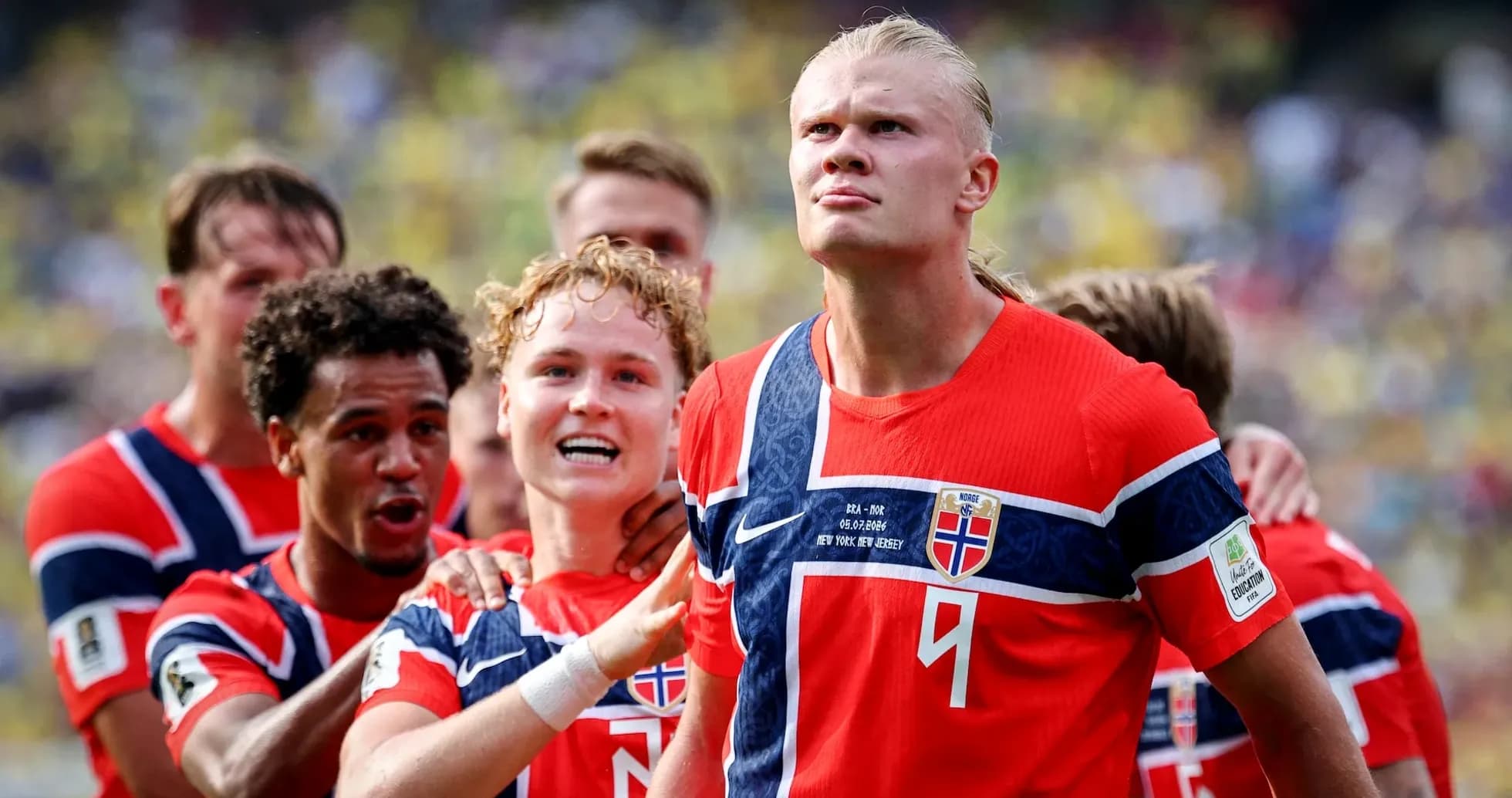
The late-game pattern reflected this risk. Brazil’s penalty at 90+9', converted by Neymar, came from relentless pressure and numbers in the box, but it also left them more vulnerable in transition. Norway’s second goal, again finished by Haaland from a Schjelderup assist, punished the stretched Brazilian rest defence. The fact that Norway produced only 0.84 xG yet scored twice illustrates how effectively they exploited these few moments when Brazil’s structure was broken.
In goal, Alisson (Brazil) made three saves, while Ørjan Nyland (Norway) made four. The goals prevented metric, 0.76 for both sides, underlines that both goalkeepers broadly performed in line with shot quality faced, with no extreme overperformance. The difference lay not in shot-stopping but in how each team protected their box and managed transitions.
Discipline played a minor but telling role. Neymar’s yellow card at 90+6' for “Foul” reflected Brazil’s increasing desperation as they chased the game. Norway, by contrast, finished without a booking, reinforcing the impression of a side in control of tempo and emotional rhythm.
Statistically, Brazil’s 329 total passes, 279 accurate at 85%, show that when they did have the ball, they used it reasonably well, but the sheer disparity in volume compared with Norway (680 passes) meant they were largely reacting rather than dictating. Their five corner kicks matched Norway’s five, which indicates that Brazil still generated territorial pressure despite the possession deficit; however, Norway’s superior control of phases between boxes ultimately shaped the match.
From a tactical verdict standpoint, Brazil’s high xG and shot volume suggest the game plan to attack quickly and directly into the box was fundamentally sound but undermined by execution at key moments (notably the missed first-half penalty) and late-game structural risk. Norway’s plan, built on possession dominance, compact defending and maximising the efficiency of Haaland’s chances, proved better aligned with knockout football: fewer chances, higher control, and ruthless finishing when Brazil’s shape finally fractured.