Brazil vs Norway: World Cup 1/8 Final Analysis
MetLife Stadium in East Rutherford staged a World Cup 1/8 final that felt like a narrative pivot for both nations: Brazil, serial contenders, against a Norway side arriving with the swagger of new money in world football. Ninety minutes later, the scoreboard read Brazil 1–2 Norway, and the story of this tie was as much about structural choices and squad profiles as it was about the headline result.
Carlo Ancelotti set Brazil up in a 4-4-2, a notable departure from the 4-3-3 that has been his most-used shape this tournament. Across the campaign in total, Brazil had leaned on that 4-3-3 in three matches, with only one previous outing in a 4-4-2. Here, the second striker role went to Matheus Cunha alongside Vinicius Junior, with G. Martinelli and Rayan stretching the flanks from a flat midfield line. Behind them, the trusted axis of Casemiro and Bruno Guimaraes anchored the centre.
Norway, by contrast, doubled down on their identity. Stale Solbakken’s 4-3-3 has been his default – used in four of their five matches in total – and he rolled it out again with minimal compromise: Erling Haaland flanked by Alexander Sorloth and A. Nusa, and Martin Odegaard orchestrating ahead of Sander Berge and P. Berg. It was the purest expression of their plan: a high-ceiling, high-variance side that, overall, scores 2.4 goals per game but concedes 1.8.
Heading into this game, the statistical DNA of both teams framed the clash clearly. In total this campaign, Brazil had played 5 fixtures, winning 3, drawing 1 and losing 1, with 10 goals for and 4 against. That gives them an overall average of 2.0 goals scored and 0.8 conceded per match, a goal difference of +6 – a profile of control, if not outright flamboyance. Norway, from their 5 matches in total, had 4 wins and 1 defeat, with 12 goals for and 9 against. Their overall goal difference of +3 came from a more open style: 2.7 goals scored on their travels and 2.0 at home, but 3.0 conceded at home and 1.0 away, underlining how much they lean into transition and risk.
The lineups told the story of absences as much as presences. Brazil were without Raphinha and Lucas Paquetá, both ruled out with hamstring injuries. In tactical terms, that stripped Ancelotti of two of his most flexible problem-solvers: Raphinha’s touchline width and pressing intensity, and Paquetá’s ability to knit midfield and attack between the lines. Their absence pushed Brazil towards a more orthodox, rigid 4-4-2, with Rayan and Martinelli tasked with both ball progression and defensive coverage.
On the bench, Brazil’s attacking insurance policy was still formidable: Neymar, Luiz Henrique, Endrick and I. Thiago all waited as potential game-changers. But the starting shape hinted at caution – perhaps a nod to Norway’s explosive front three and the knowledge that, overall, Brazil had yet to fail to score in any match, while keeping 2 clean sheets in total. Ancelotti seemed intent on protecting that defensive record first.
Norway, in contrast, had a bench designed to tilt the game further towards chaos if needed. A. Schjelderup, one of the competition’s leading assist providers with 3 in total, offered a creative injection from the left or as a second striker. J. Larsen provided an alternative reference point up front, while midfield options like F. Aursnes, M. Thorsby and K. Thorstvedt gave Solbakken the tools to either reinforce the press or add a late runner from deep.
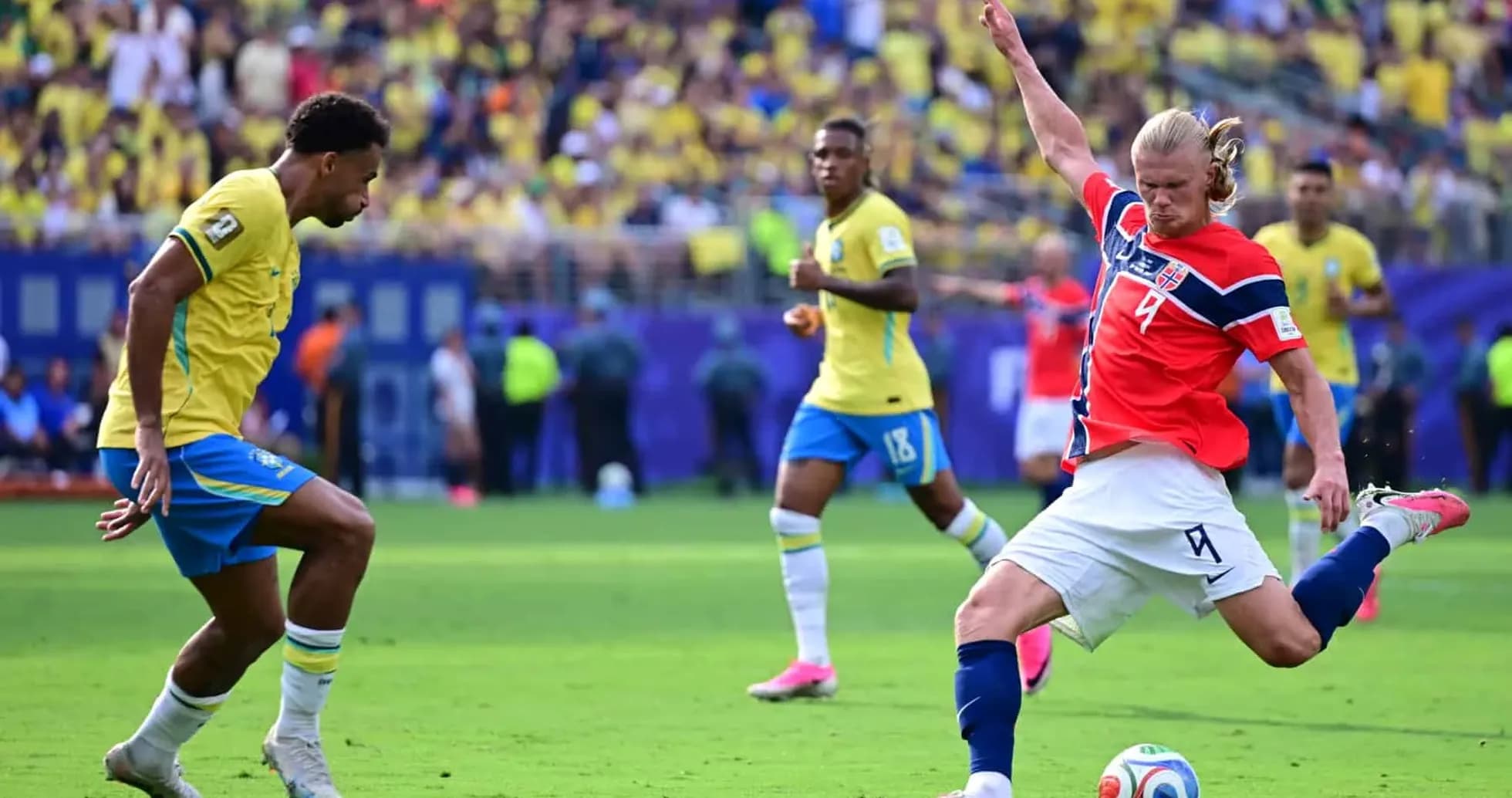
In the “Hunter vs Shield” matchup, few duels on this stage have felt as elemental as Haaland against Brazil’s back four and Alisson. Haaland came into the tie with 7 goals in total from 4 appearances, averaging nearly a goal every half, off 15 shots with 12 on target. His duel volume – 37 contests, 18 won – underscored how often Norway funnel possession and chaos through him. Brazil’s shield was built around Marquinhos and Gabriel, screened by Casemiro, whose defensive metrics across the tournament are elite: 14 tackles, 4 blocked shots and 6 interceptions in total, plus 27 duels won out of 46.
Yet Casemiro also carried disciplinary risk. He leads the yellow card charts with 2 bookings in total, and Brazil as a team have a clear disciplinary pattern: a late-game surge in yellows between 31-45 minutes (25.00%) and 61-75 minutes (25.00%), plus further spikes in added time phases. In a knockout setting, those timings matter. Norway, by contrast, have picked up their few yellows early – 50.00% in the opening 15 minutes and 50.00% between 46-60 – suggesting an aggressive start and restart, then relative calm.
The “Engine Room” duel between Bruno Guimaraes and Odegaard shaped the rhythm. Bruno, with 4 assists in total and 10 key passes, is Brazil’s metronome and vertical passer, combining 86% pass accuracy with 11 tackles and 2 interceptions. Odegaard mirrors that creative burden for Norway: 3 assists in total, 4 key passes, 263 completed passes at a 90% success rate, and 6 tackles. Where Bruno tends to drive play forward from a slightly deeper base, Odegaard drifts into half-spaces, connecting with Haaland and Sorloth on the run.
One hidden subplot lay from the spot. Brazil’s relationship with penalties this tournament has been uneasy: in total they have taken 2, scoring 1 and missing 1, a stark 50.00% split that includes a miss by Bruno Guimaraes himself. Norway’s record is even more brutal: 1 penalty in total, missed, for a 0% conversion. In a knockout game where marginal gains decide survival, neither side carried the aura of inevitability from 12 yards.
From a structural standpoint, Brazil’s defensive record – only 4 goals conceded in total across 5 matches – suggested they would try to drag Norway into longer, more controlled phases, banking on Vinicius Junior’s individual quality. The Brazilian winger arrived with 4 goals and 1 assist in total, 14 shots (11 on target), and a massive 36 dribble attempts, 16 successful. His duel count – 61 contests, 29 won – underlined his role as the primary outlet under pressure.
Norway’s counter was to stretch the field with Nusa and Sorloth, isolating full-backs Danilo and Douglas Santos. Danilo, for all his experience, had already committed 7 fouls in total and taken 2 yellows; he was a likely pressure point. Behind them, O. Nyland’s presence in goal contrasted with Alisson’s calm, but Norway’s defensive data – 9 goals conceded in total, no clean sheets – made clear that their route to victory would be through outscoring, not shutting down, Brazil.
Following this result, the statistical prognosis that Brazil’s defensive solidity would hold against Norway’s volatility was overturned by the raw efficiency of Solbakken’s front line. Yet the underlying numbers still sketch a clear tactical logic: Brazil remain a side built on structure, control and star-driven incision, while Norway are a momentum machine, powered by Haaland’s gravity and Odegaard’s supply line. Over 90 minutes in East Rutherford, the latter proved just enough to bend the narrative of this World Cup in a new, distinctly Scandinavian direction.