Mexico vs England: Tactical Analysis of World Cup 2023 Match
Mexico’s 3-2 defeat to England at Estadio Azteca in this World Cup Round of 16 tie was defined less by chance creation than by contrasting game models. Mexico imposed themselves with a 4-3-3 geared towards territorial dominance and wide overloads, while England’s 4-2-3-1, reshaped by an early red card, leaned into compactness, vertical efficiency and ruthless execution in decisive moments.
Mexico’s structure with Erik Lira as the central pivot and Luis Romo and Gilberto Mora as the advanced interiors was designed to stretch England’s double pivot of Declan Rice and Elliot Anderson. The hosts’ 67% possession and 455 passes (420 accurate, 92%) underline how effectively they controlled the rhythm. Full-backs Jorge Sánchez and Jesús Gallardo pushed high to pin England’s wide midfielders, allowing Roberto Alvarado and Julián Quiñones to attack the half-spaces around Harry Kane’s single cover shadow.
This dominance translated into volume: 20 total shots, with 12 inside the box, 7 blocked and 5 on target. Yet the xG figure of 1.87 reveals that many of these looks were either from suboptimal angles or under defensive pressure. England’s back four, especially Ezri Konsa and Marc Guéhi, defended the width of the box rather than the full width of the pitch, willingly conceding crosses but protecting the central lane. The high number of blocked shots is a direct consequence of that narrow, low-block stance once England were reduced to ten men.
England’s offensive plan before the red card revolved around Jude Bellingham as the advanced playmaker between Mexico’s lines, with Bukayo Saka and Anthony Gordon stretching horizontally and Kane dropping to link. That pattern is visible in the event chain: Bellingham scores twice in quick succession, once assisted by Saka and then by Kane, both at moments when Mexico’s midfield line was caught in transition and the centre-backs were exposed to direct combinations. With only 6 total shots (4 inside the box, 5 on target), England’s xG of 1.55 shows they created fewer but cleaner opportunities, maximising each surge through central channels.
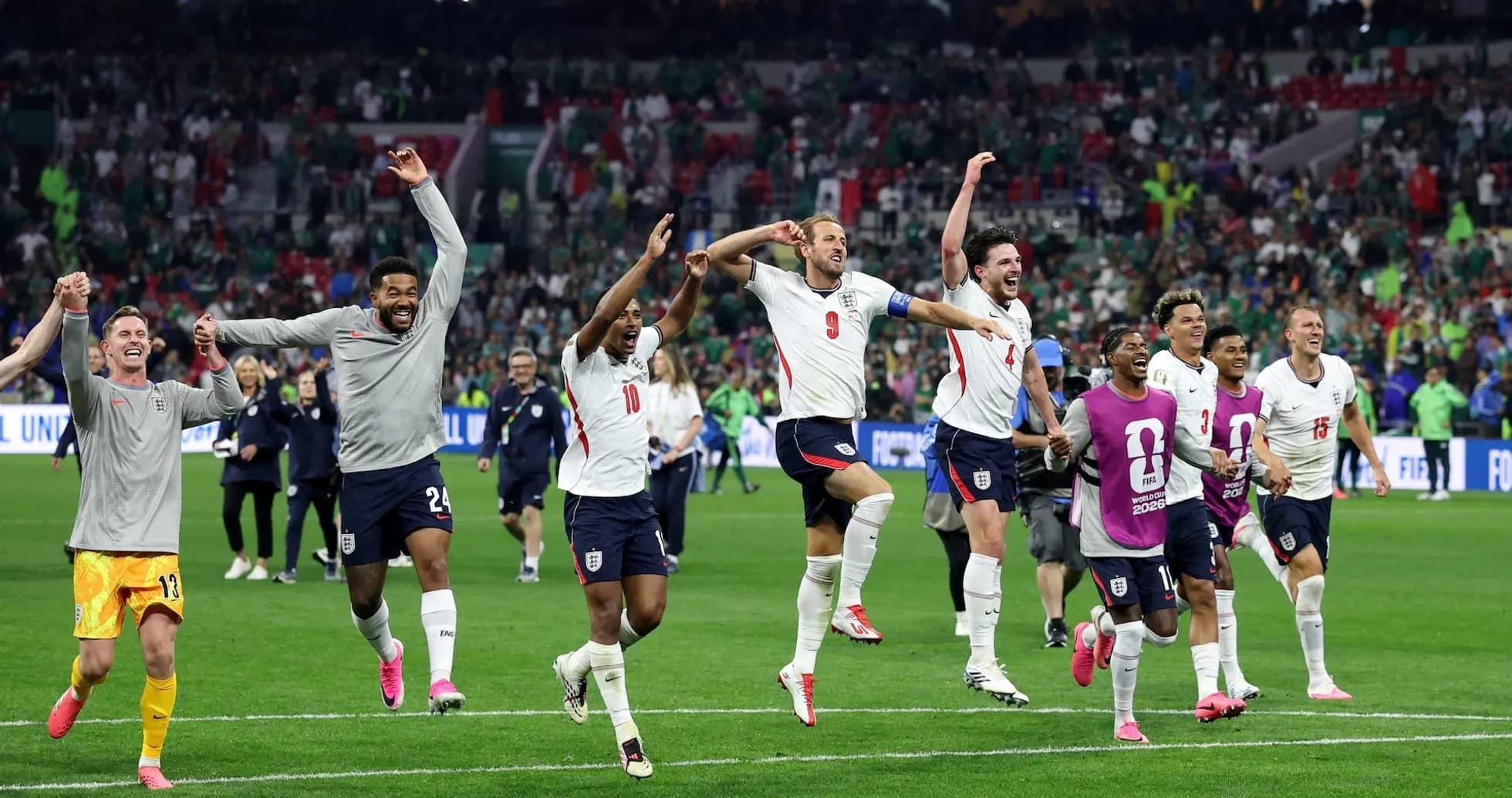
The penalty converted by Kane at 60 minutes illustrates England’s transition from structured possession to pure opportunism. Down to ten men after Jarell Quansah’s dismissal, England no longer tried to build consistently. Instead, they relied on direct balls into Kane, quick lay-offs from Bellingham and Gordon, and set-piece or penalty situations. Their 244 passes (195 accurate, 80%) and just 33% of the ball highlight a side that ceded control but remained lethal when they did advance.
Tactically, the turning point came with Quansah’s red card. Thomas Tuchel’s response was immediate and conservative: Saka was withdrawn for John Stones at 57 minutes, sliding England into a back five in defensive phases, with Nico O’Reilly and Gordon dropping to form a 5-3-1 block ahead of Rice and Anderson. This adjustment compressed the central lane further, forcing Mexico to circulate in front of the block and attack primarily via wide deliveries and second balls.
Javier Aguirre’s changes were aggressively offensive. At 46 minutes Edson Álvarez (IN) came on for César Montes (OUT), effectively turning Mexico into a 3-4-3 in possession, with Álvarez stepping into midfield and full-backs acting as wing-backs. The double substitution at 61 minutes — Santiago Giménez (IN) for Gilberto Mora (OUT) and Brian Gutiérrez (IN) for Luis Romo (OUT) — pushed Mexico into a more direct, two-striker look, with Raúl Jiménez and Giménez occupying both centre-backs and freeing Quiñones to roam between lines. Later, Álvaro Fidalgo (IN) for Jorge Sánchez (OUT) at 79 minutes and Guillermo Martínez (IN) for Quiñones (OUT) at 81 minutes removed a natural right-back altogether, committing fully to a siege with multiple forwards and an extra playmaker.
This relentless attacking posture explains Mexico’s 12 corner kicks to England’s 2 and the sustained pressure in the final half-hour. But it also left them vulnerable to counters and reliant on individual duels at rest defence, which England exploited just enough before retreating fully into survival mode.
In goal, Raúl Rangel (Mexico) was beaten three times and registered 2 saves. The negative goals prevented figure (-0.15) suggests he conceded slightly more than an average keeper might have from the same shot quality, though England’s finishes from Bellingham and Kane were high-calibre, close-range actions. Jordan Pickford (England), with 3 saves and also -0.15 goals prevented, faced more volume but a similar overall shot quality profile. His interventions, particularly on mid-range efforts and crowded-box headers, were critical in preserving England’s lead once they went down to ten men.
Discipline also shaped the tactical landscape. England committed only 7 fouls but collected 4 yellow cards and 1 red, reflecting a high-risk, last-ditch defending pattern once under siege. Mexico, with 14 fouls and 2 yellow cards, used tactical infringements higher up the pitch to slow English counters, but lacked the same level of individual defensive interventions in their own box.
Statistically, Mexico’s territorial and passing superiority, plus a marginal xG edge (1.87 to 1.55), would normally be associated with at least parity on the scoreboard. Yet England’s efficiency — 5 shots on goal from just 6 attempts, turning 1.55 xG into 3 goals — underscores a clinical edge in decisive zones. Mexico’s structural choices produced pressure and volume but not enough clear, unopposed finishes, especially against a deep, numerically reinforced block.
In synthesis, this match was a case study in how control without penalty-box clarity can lose to compactness and elite finishing. Mexico’s 4-3-3 morphed into increasingly attacking shapes but never fully solved England’s narrow block. England’s 4-2-3-1, then emergency 5-3-1, bent under sustained possession but did not break, riding Bellingham and Kane’s quality to a brutally efficient knockout win.