Vinicius Jr and the Premier League's Superstar Dilemma
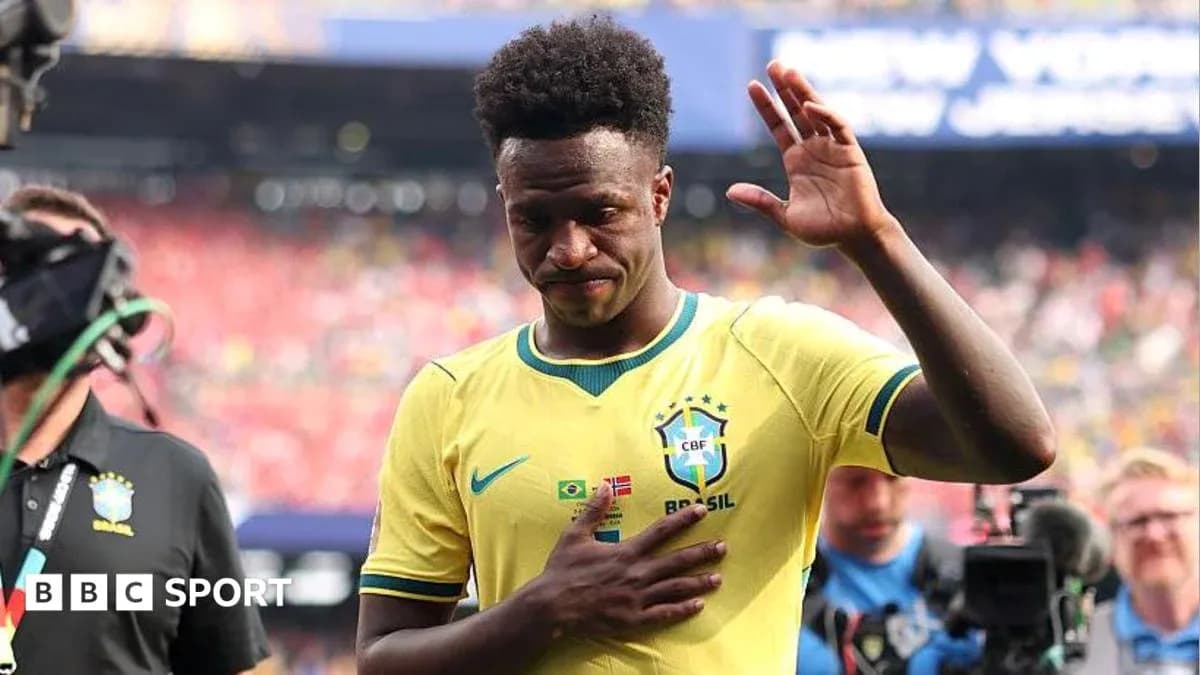
If Vinicius Jr had walked into Arsenal’s dressing room this summer, it would have felt like a rupture in football’s natural order. A genuine, fully formed global superstar, mid-peak, swapping the white of Real Madrid for the red of a Premier League challenger. Not a prospect. Not a reclamation project. The finished article.
Arsenal were ready for that reality. Vinicius, 26, was high on their list, the player they were prepared to build a window – and a forward line – around if he chose to leave the Bernabeu. He was open to listening.
Then he signed until 2032.
One pen stroke in Madrid, and the Premier League’s most persistent contradiction flickered back into view.
The richest league, without the biggest stars
No competition spends like England’s top flight. No league is as deep, as relentless, or as commercially powerful. Yet when it comes to attracting players who are already living on the Ballon d’Or podium, the Premier League still walks into the room and finds Real Madrid and, historically, Barcelona and Serie A already at the top table.
Since 1992, only three men have won the Ballon d’Or while playing for an English club: Michael Owen in 2001, Cristiano Ronaldo in 2008, Rodri in 2024. Three decades, three winners, in a league that insists it is the centre of the sport.
The pattern is clear. England has no problem paying huge fees or wages. It has no issue luring elite centre-backs and goalkeepers, or holding on to them. The shortage lies further up the pitch, where the very top tier of attackers and creators still tend to be made elsewhere, then occasionally pass through.
The Premier League is brilliant at turning talent into superstardom. It is far less successful at importing players who arrive already at the summit.
A finishing school, not the final destination
History underlines that point. Dennis Bergkamp did not land at Arsenal as a global icon. He arrived from a bruising spell at Inter Milan, his reputation dented, and left as one of the most influential players the league has seen.
Eric Cantona was a mercurial talent in France and at Leeds. At Manchester United he became something else entirely – the defining figure of their first great Premier League era.
Thierry Henry reached north London with questions hanging over him after an underwhelming stint at Juventus. In England, he turned into one of his generation’s most devastating forwards.
Even Ronaldo’s first spell at United fits the pattern. He joined as an 18-year-old phenomenon from Sporting, won the Ballon d’Or five years later, then left for Madrid at the precise moment he became the sport’s central figure.
Erling Haaland is the most modern example. At Borussia Dortmund he was already a terrifying prospect, a forward every major club wanted. At Manchester City he has become something else: a statistical avalanche, a specialist in turning half-chances into title-defining goals.
Those are players who became global superstars in England. Vinicius belongs to a different category: already a multiple Champions League winner, already one of the sport’s most recognisable faces, already a reference point for the next generation. That kind of player rarely chooses the Premier League at their absolute peak.
The rare exceptions
There have been attempts. There have been statements.
Andriy Shevchenko is the closest parallel to what a Vinicius-to-Arsenal move would have represented. When Chelsea prised him from AC Milan in 2006, he was 29 and only two years removed from winning the Ballon d’Or. He had finished fifth in the voting in 2005. He arrived as an established global superstar, not an emerging one.
Other Ballon d’Or winners have passed through, but mostly on the downward slope. Ruud Gullit and George Weah both joined Chelsea late in their careers. Ronaldo returned to Manchester United at 36. Zlatan Ibrahimovic landed at Old Trafford at 34. Jurgen Klinsmann signed for Tottenham at 30, his best years already behind him in Serie A and the Bundesliga.
Those moves carried glamour and headlines. They did not redefine the balance of power in their primes.
From Serie A’s age of giants to England’s age of depth
To understand why, it helps to look back. In the 1980s and 1990s, Serie A didn’t just have money. It had a gravitational pull.
Diego Maradona left Barcelona for Napoli and turned the south of Italy into the centre of the football universe. Brazil’s Ronaldo, at his explosive peak, swapped Barcelona for Inter. Michel Platini, Marco van Basten, Lothar Matthaus, Zinedine Zidane – all spent some of their finest years in Italy. If you were the best, you ended up there.
Today, the Premier League is the financial powerhouse. But the money is spread differently. English clubs pour vast sums into squads rather than a single ‘Galactico’ figurehead. The model is built on depth and durability.
Look at the internal market. Alexander Isak, Morgan Rogers, Elliot Anderson, Moises Caicedo, Declan Rice, Jack Grealish – all have moved between Premier League clubs for fees north of £100m. Not all are global household names, but they are seen as essential pieces in the puzzle of a 60-game season.
From abroad, players such as Liverpool’s Florian Wirtz arrive with big reputations and bigger ceilings. The logic is consistent: buy players whose peak years are ahead, then let the league’s intensity and spotlight turn them into superstars.
The goal is not one icon on every billboard. It is 18 to 22 elite players capable of withstanding the grind.
Haaland, Madrid and the ceiling problem
Haaland stands as both proof of concept and a warning.
City signed him from Dortmund at 21. In Manchester, he has become the most feared number nine on the planet, the embodiment of what the Premier League can do for a young phenomenon placed in the right structure.
Yet even his story carries a familiar echo. During the 2026 World Cup, speaking to DAZN, his father Alfie Haaland was asked about the prospect of the striker one day moving to Real Madrid.
"He's happy at City, he's got a long contract… but any player wants to play for Real Madrid," he said.
It was not a transfer request. It was not a timetable. It was something more revealing: an admission that, for many players, Madrid still represents the ultimate stage, the place you go when you want your career to be framed in gold.
And that is the Premier League’s problem in a single line. It can provide the platform on which superstars are made. It can pay more than almost anyone. It can offer a level of competition and exposure unmatched anywhere else.
Yet persuading those already at the very top to walk away from the Bernabeu, and convincing those who reach the summit in England to resist its pull, remains the hardest task of all.