
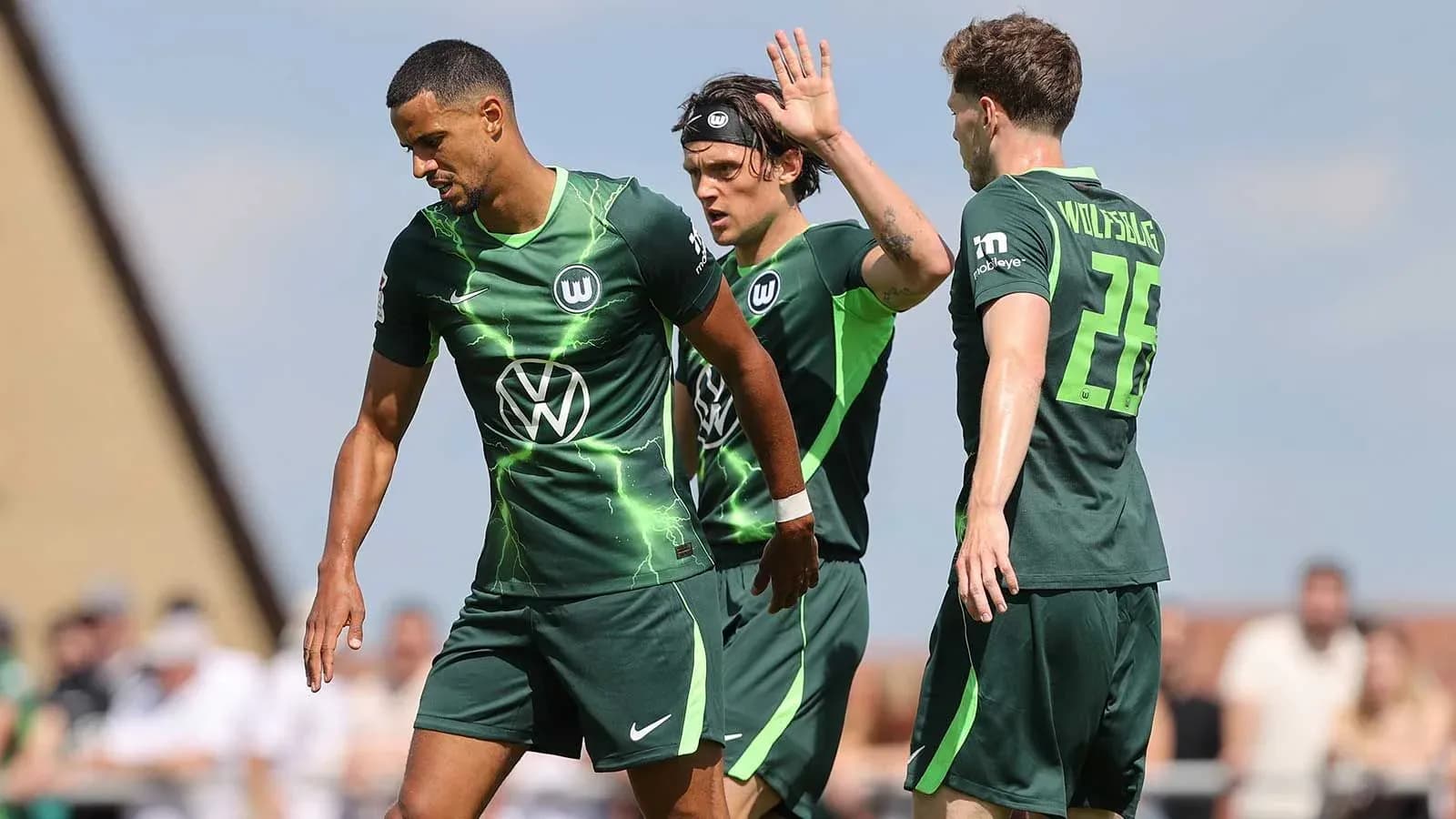
VfL Wolfsburg's Dominance in 2. Bundesliga Transfers
VfL Wolfsburg were supposed to crash back to earth after relegation. Less TV money, a trimmed budget, a painful reset. Instead, they have walked into the 2. Bundesliga like a heavyweight dropping in on a sparring session.
One number tells the story. Wolfsburg have already spent 22.7 million euros on new players this summer. The other 17 clubs in the division, combined, are just under 19 million.
One club outspending an entire league. That is not a gap. That is a chasm.
Reese transfer exposes the imbalance
Nothing captures this new reality better than Fabian Reese in green and white.
Eight million euros to Hertha BSC for their captain, their symbol, their project. A fee that would be ambitious in the Bundesliga. In the 2. Bundesliga, it is a statement.
Reese was one of the league’s defining figures in recent seasons: 91 competitive games for Hertha, 35 goals, 31 assists. A winger and leader rolled into one. Wolfsburg sporting director Pirmin Schwegler called him “one of the strongest players in the 2. Bundesliga” when he arrived. Few would argue.
For Reese, this was no casual move. He admitted as much when he signed, describing how hard the decision was and pointing to the way Wolfsburg had pursued him, the professional setup and “the values of the club, of Volkswagen and of the people around it” as decisive factors.
That is the sporting side. The emotional side cuts deeper.
Reese had become a face of the “new” Hertha, a player who seemed to stand for something more than the weekly result. In November 2025, he signed an early extension to 2030. The club staged it as a manifesto. Sporting director Benjamin Wieber spoke of a player who identified “one hundred per cent” with Hertha BSC. The message: this is not just another contract. This is our future.
Less than a year later, that future has been sold to a direct rival in the same division.
Wolfsburg laid eight million euros on the table and the supposed cornerstone of Hertha’s rebuild walked out of the capital. For many in Berlin, this will feel like more than losing a star. It is losing a figure they thought was different, a player whose words about Hertha being the club closest to his heart were meant to transcend the usual football clichés.
Sportingly, Hertha lose one of their best players and have not bought a single replacement. Emotionally, they lose their main figure of identification. Wolfsburg gain both – and expose the reality of the league’s economics in the process. When a freshly relegated club can pay eight million euros for a second-division player from another major 2. Bundesliga side, the financial hierarchy is no longer theoretical. It is on the pitch.
A squad built like a promotion machine
Reese is not an isolated case. He is part of a pattern.
Fraser Hornby has arrived from SV Darmstadt 98 for four million euros. Another direct rival stripped of a key man. Muhammed Damar has come in from TSG Hoffenheim. Hauke Wahl joined from a relegated Bundesliga club for 1.8 million euros.
Robert Glatzel cost only around 1.7 million euros in fee, but his signing underlines a different Wolfsburg advantage. They can offer wages that most of the division simply cannot touch. Glatzel brings more than 180 second-division appearances and a record of hitting double figures season after season. For many 2. Bundesliga clubs, he would be the marquee signing of the summer. In Wolfsburg, he is one of several.
The spending does not stop there. VfL paid 700,000 euros to SC Freiburg for Swiss forward Alessio Besio, a 22-year-old who did not make a single professional appearance for Freiburg and spent last season on loan in the third tier with Verl. Timon Wellenreuther joined from Feyenoord for around one million euros before a knee injury sidelined him for weeks. Elvis Rexhbecaj arrived on a free from FC Augsburg, but his profile – more than 150 Bundesliga games – would represent a completely different financial and sporting dimension for many in this league even without a fee.
This is not a scattergun youth project. Wolfsburg are assembling a promotion squad with proven quality: players who have already shown they can perform either in the Bundesliga or at the top end of the 2. Bundesliga.
Only when you set Wolfsburg’s activity against recent history does the scale really come into focus.
Schalke 04, in the 2025/26 second-division season, generated around 8.75 million euros from sales and spent just 3.4 million euros on new players. Transfer surplus: 5.35 million. Their most expensive signing was Christian Gomis for 1.5 million euros.
Fabian Reese alone has cost Wolfsburg more than double Schalke’s entire transfer summer that year.
Hamburger SV, before their promotion in 2024/25, spent around nine million euros on new signings with roughly three million coming in. Their top buy, Alexander Rossing-Lelesiit, cost about 2.8 million euros. Hannover 96 in 2025/26 brought in 11 million euros and spent only 4.33 million, ending with a surplus of around 6.68 million euros.
Wolfsburg are operating on a different level. And they are doing it in the same league.
Big spending, but not blind spending
This is not, though, a story of a club simply lighting a bonfire under a pile of cash.
Wolfsburg’s transfer balance this summer is actually positive. They have taken in around 24 million euros: Patrick Wimmer to TSG Hoffenheim for roughly ten million, Jakub Kamiński to 1. FC Cologne for 5.5 million, Lovro Majer to AEK Athens for around six million, plus smaller deals. Against 22.7 million euros spent, that leaves a small surplus.
The difference lies not in the balance sheet, but in what they can do with it. Wolfsburg can reinvest almost every euro straight back into a squad designed for an immediate return to the Bundesliga. That is the privilege of a club with a strong backer and an infrastructure built for the top flight.
There is precedent. When VfB Stuttgart chased instant promotion after relegation in 2019/20, they also spent heavily – around 25.4 million euros on new players. Silas cost eight million from Paris FC, Sasa Kalajdzic around six million from Admira Wacker. Stuttgart, though, sold players for about 79.5 million euros, ending the window with a surplus of more than 54 million euros despite the investment.
Wolfsburg are not at that scale of trading, but the principle is similar: big sales, big buys. The context, however, is different. Stuttgart were already a giant in the second tier. Wolfsburg arrive with the additional weight of Volkswagen behind them and a recent transfer history that underlines how normal these sums have become at the club.
Last season alone, Wolfsburg generated around 37 million euros from sales but spent about 68 million on new signings. A deficit of just under 31 million euros. Vinicius Souza cost roughly 15 million from Sheffield United. Mohamed Amoura, made permanent from Union Saint-Gilloise after his loan, came in at around 14.75 million.
For Wolfsburg, multi-million deals are business as usual. What has changed is the environment. In the Bundesliga, they were one of many clubs operating in that financial bracket, competing with Bayern Munich, Borussia Dortmund, Bayer Leverkusen, RB Leipzig and others who regularly drop eight-figure fees on individual players.
In the 2. Bundesliga, those same sums land very differently. When the fee for one Wolfsburg winger outstrips the entire transfer budget of some rivals, the imbalance is no longer abstract.
The Bayern of the basement? Not even close
Look at the squad values and the gap becomes almost absurd.
According to transfermarkt.de, Wolfsburg’s squad is valued at 194.15 million euros. That figure would place them ninth in the Bundesliga. In the 2. Bundesliga, the next closest is fellow relegated side FC St. Pauli at 45.93 million euros. Wolfsburg’s squad is worth roughly 4.5 times more.
To call them the “FC Bayern Munich of the second division” does not quite capture it. Bayern’s squad, at around 1.07 billion euros, is not even worth double that of RB Leipzig at 604 million. Dortmund are still buying and still not close to that kind of multiple.
Wolfsburg are further ahead of their new peers than Bayern are of their main domestic rivals.
And that is before you factor in continuity. Players like Amoura have followed the club into the second tier. Reese, Hornby, Glatzel, Wahl, Rexhbecaj, Wellenreuther – each transfer points in the same direction. The plan is not subtle. One year in the 2. Bundesliga, if everything goes to script. No more.
Will it amount to a distortion of competition? Only the season can answer that. For now, the transfer window has already delivered one clear verdict: financially, VfL Wolfsburg are not just the biggest player in the 2. Bundesliga. They are playing a different game.





