UEFA Champions League Final: Arsenal vs Paris Saint Germain
The UEFA Champions League Final at Puskas Arena brings together a flawless Arsenal side and a high-scoring but less consistent Paris Saint Germain. In the league phase, Arsenal arrive as the competition’s benchmark, top of the table with 24 points from 8 wins out of 8 and a dominant 23:4 goal record, while Paris Saint Germain come in as dangerous outsiders, ranked 11th with 14 points from 4 wins, 2 draws and 2 losses, scoring 21 and conceding 11. This is not about qualification anymore but about legacy: Arsenal are trying to convert league-phase supremacy into the trophy, while Paris Saint Germain are aiming to turn a strong but imperfect campaign into their first Champions League title.
Head-to-Head Tactical Summary
The recent head-to-head history is rich and competitive, with several high-stakes Champions League ties.
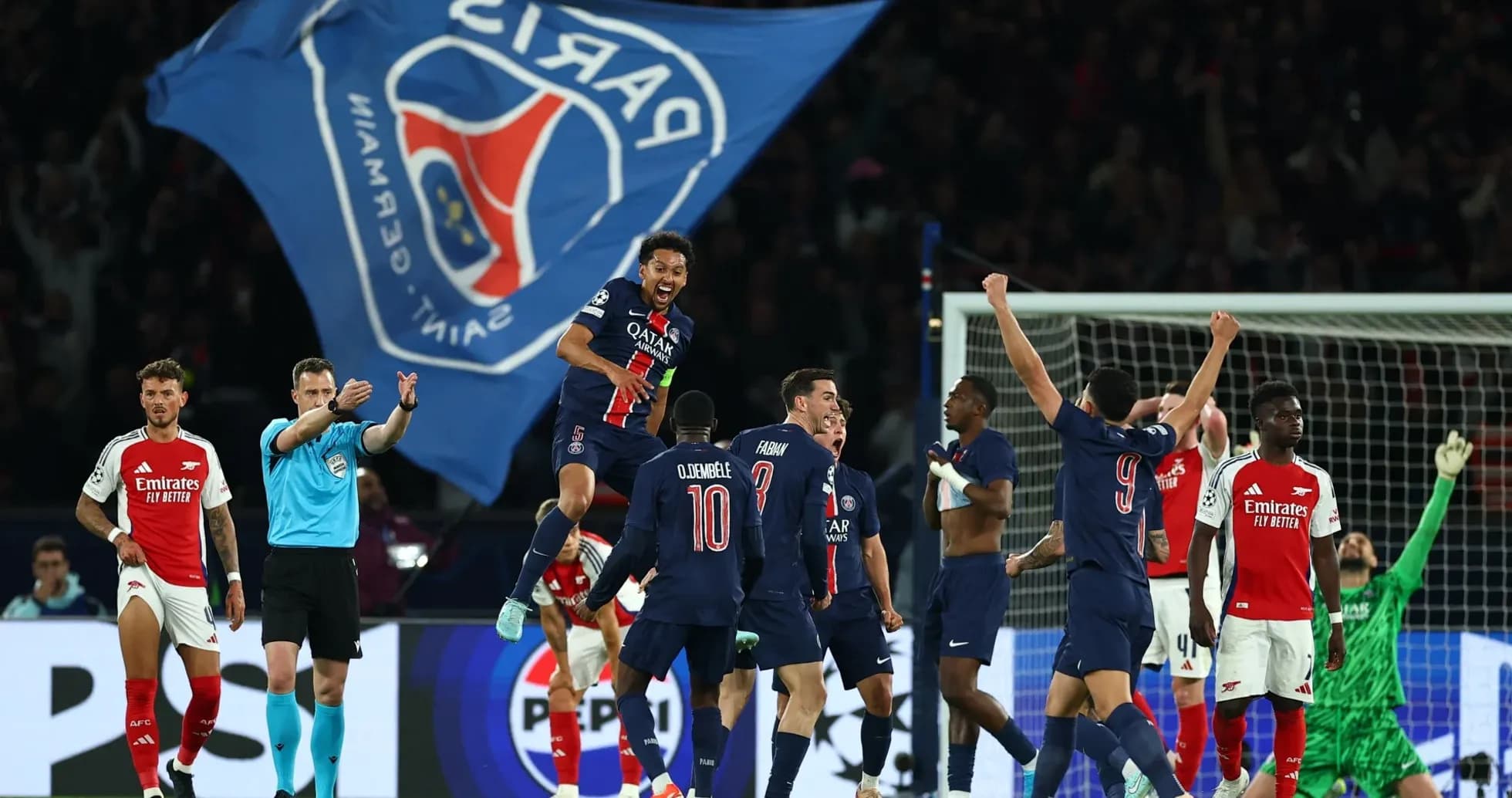
- On 2025-05-07 at Parc des Princes in the Champions League Semi-finals, Paris Saint Germain beat Arsenal 2-1 (HT 1-0). Paris Saint Germain managed to protect a first-half lead and edge a tight knockout contest.
- On 2025-04-29 at Emirates Stadium in the Champions League Semi-finals, Paris Saint Germain won 1-0 away (HT 1-0), showing their capacity to control an away knockout leg once in front.
- On 2024-10-01 at Emirates Stadium in the Champions League League Stage - 2, Arsenal defeated Paris Saint Germain 2-0 (HT 2-0), asserting early control and then managing the game from a strong first-half platform.
- On 2018-07-28 at The National Stadium (Singapore) in the International Champions Cup Regular Season - 2, Arsenal recorded a 5-1 win over Paris Saint Germain (HT 1-0), a friendly but still notable for the margin and Arsenal’s ability to accelerate after the break.
- On 2016-11-23 at Emirates Stadium in the Champions League Group Stage - 5, Arsenal and Paris Saint Germain drew 2-2 (HT 1-1), an open game where both sides found ways to break each other down.
Overall, the recent competitive meetings in Europe show Paris Saint Germain capable of winning both home and away in knockout ties, while Arsenal have produced some of the heaviest scorelines when they get on top, particularly at Emirates Stadium and in neutral or friendly settings.
Global Season Picture
- League Phase Performance: In the league phase, Paris Saint Germain rank 11th with 14 points from 8 matches (4 wins, 2 draws, 2 losses), scoring 21 goals and conceding 11, for a goal difference of +10. Arsenal sit 1st with a perfect 24 points from 8 matches (8 wins, 0 draws, 0 losses), with 23 goals for and only 4 against, a goal difference of +19.
- Season Metrics: Scope detection shows Paris Saint Germain have played 16 fixtures and Arsenal 14, compared with 8 each in the league phase, so these statistics apply across all phases of the competition. Paris Saint Germain’s numbers describe a very attacking but more open side: 44 goals scored and 22 conceded across all phases, averaging 2.8 goals for and 1.4 against per match, which points to a high-variance, front-foot approach (high scoring, but defensively vulnerable in spells). Arsenal’s profile is more controlled and balanced: 29 goals for and just 6 against across all phases, with averages of 2.1 scored and 0.4 conceded per game, indicating a highly efficient attack and an elite, low-allowance defense (very few goals conceded over a substantial sample). Card distributions underline discipline with late-game intensity: Paris Saint Germain accumulate a large share of yellow cards between minutes 76-90 (6 yellows, 42.86%), suggesting aggressive late defending, while Arsenal see their heaviest yellow concentration between minutes 61-75 (7 yellows, 31.82%), often during the phase where they protect leads and manage transitions.
- Form Trajectory: In the league phase, Paris Saint Germain’s form string “DLDWL” reflects inconsistency: only 2 wins in their last 5 league-phase matches, with 2 losses and 1 draw, combining high attacking output with occasional defensive lapses. Arsenal’s “WWWWW” is a perfect five-game winning run in the league phase, underlining momentum, confidence, and a capacity to repeat performance levels under different match conditions.
Tactical Efficiency
Across all phases of the competition, the efficiency profiles are sharply contrasted. Paris Saint Germain’s attack is aggressive and high-volume, with 44 goals in 16 games (2.8 per match), and their biggest away win of 2-7 underlines their ability to overwhelm opponents when transitions open up. However, conceding 22 goals (1.4 per match) and having only 5 clean sheets shows a defense that can be stretched by structured, high-level opposition, especially if Paris Saint Germain commit numbers forward.
Arsenal’s tactical efficiency is built on control and risk management. With 29 goals in 14 games (2.1 per match) they are not as explosive as Paris Saint Germain in raw scoring, but the defensive return of only 6 goals conceded (0.4 per match) and 9 clean sheets is elite. Their biggest wins (4-0 at home, 0-3 away) show they can extend leads without losing shape. The card profile, with a cluster of yellows between minutes 61-75, suggests a team that tightens the game in the key control phase of the second half rather than chasing chaotic transitions.
Given these season averages, any comparison-based Attack/Defense Index would rate Arsenal as more balanced and structurally efficient, with a slightly lower attacking volume but far superior defensive solidity. Paris Saint Germain’s index would skew toward a high attacking rating but a more vulnerable defensive rating, implying that their path to success in this final likely relies on creating a high-tempo, chance-rich game, while Arsenal’s optimal script is a controlled contest with limited chances conceded.
The Verdict: Seasonal Impact
This final is the culmination of two very different Champions League campaigns. For Arsenal, victory would validate total dominance in the league phase, converting an 8-win, 23:4 run into the ultimate prize and reinforcing their status as the reference model in Europe: a side that couples consistent attacking output with the competition’s most secure defense. It would also set a high bar for future campaigns, turning this 2025 run into a benchmark season.
For Paris Saint Germain, lifting the trophy would reframe an uneven league-phase performance into a historic success. Coming from 11th in the league-phase table with 14 points and a more volatile “DLDWL” form line, a win here would prove that their high-variance, attacking profile can peak at the right moments in knockout football. It would also ease scrutiny on their defensive numbers across all phases and encourage the club to double down on their aggressive, front-foot identity, perhaps adding targeted defensive refinement rather than structural overhaul.
From a wider Champions League landscape perspective, an Arsenal triumph would reinforce the value of sustained league-phase control and defensive excellence as the clearest path to the title. A Paris Saint Germain success would highlight the power of knockout adaptability and attacking ceiling over league-phase perfection, showing that a team outside the very top league-phase ranks can still navigate the bracket and win the biggest game. In either case, this final will heavily influence how elite clubs calibrate the balance between attacking ambition and defensive stability in future Champions League campaigns.