
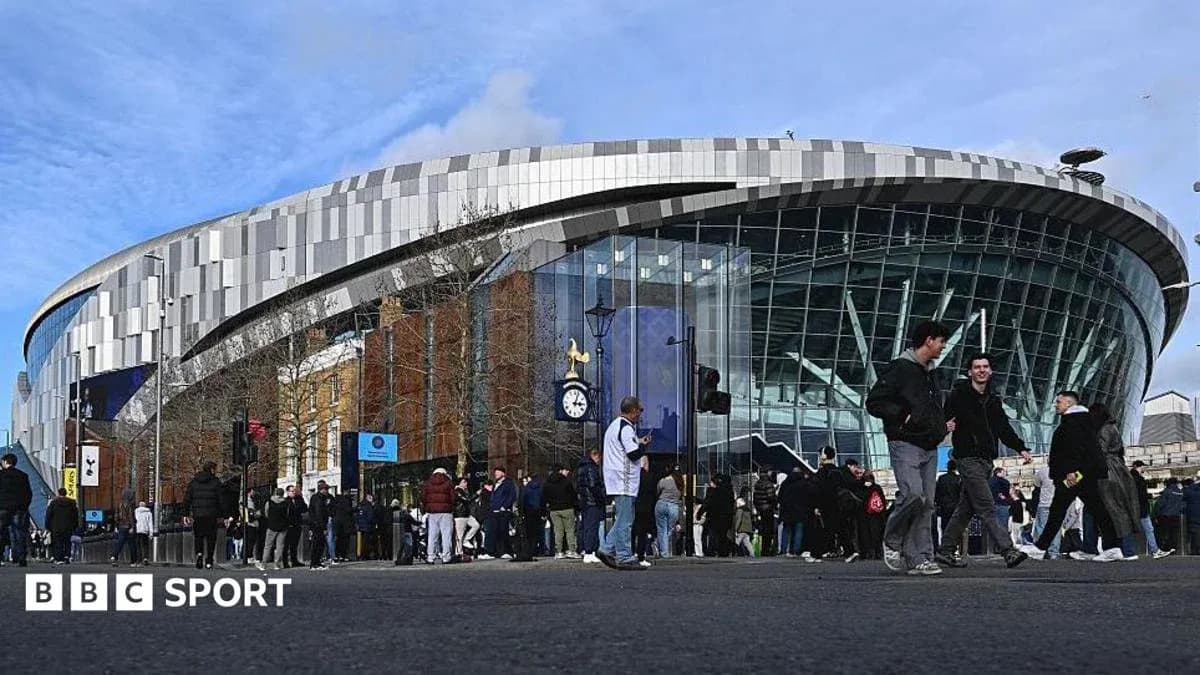
Tottenham's Stadium Era: A Case Study in Financial Growth
Tottenham’s season on the pitch was a slog. Again.
Another manager gone, key players in the treatment room, and a final day spent glancing nervously at the live table as one of the richest clubs in the sport flirted with the unthinkable. Seventeenth for the second year in a row is not a blip. It’s a warning siren.
Yet step outside the dressing room and into the concourses of their gleaming home and the picture flips completely. While the team stumbles, Tottenham Hotspur the business is booming.
This is the stadium era – and Spurs are the case study everyone is watching.
The stadium that prints money
When Tottenham left White Hart Lane in 2017, they walked away from history and into a building site. Emotionally, it hurt. Financially, it has transformed the club.
“Spurs' matchday income has increased from £45m in 2016-17, the season they left White Hart Lane, to £126m in 2024-25,” says football finance expert Kieran Maguire.
Less than double the capacity. Two and a half times the money.
That doesn’t happen by accident. The club has built a venue designed to keep people inside, and spending, for as long as possible.
“What Spurs have done is they've created a welcoming environment,” Maguire explains. “So if people are spending an extra 40 to 50 minutes in the stadium itself they're not just spending time - more importantly they're spending money.”
Bars, food outlets, premium lounges, attractions – every extra pint, every extra hour, feeds into the balance sheet. Matchday is no longer just 90 minutes. It’s an event.
And that’s before the football even starts.
The 30-event weapon
Tottenham’s stadium is not just a football ground. It’s a year-round entertainment hub.
Spurs can host up to 30 non-football events a year at full capacity. That clause alone changes the economics.
Major concerts. NFL games. Boxing world title fights – including Anthony Joshua’s heavyweight clash with Oleksandr Usyk in 2021. Since 2023, it has also staged Saracens v Harlequins in rugby union’s London derby.
Every one of those nights fills the tills again.
The result? Commercial revenue that has rocketed from £73m in 2016-17 to £277m in 2024-25. That is the gap between treading water and starting to throw serious weight around in the transfer market.
It is no coincidence that Spurs could go out last month and land Sandro Tonali for a club-record fee that could reach £100m. The stadium pays for ambition.
New rules, same loophole
This summer, the Premier League’s financial landscape shifts. Profitability and sustainability rules (PSR) are out. A new framework comes in, built around squad-cost ratio (SCR) and sustainability and systemic resilience (SSR).
Strip away the jargon and SCR is simple enough: it caps what a club can spend on its playing squad – wages, transfer amortisation, agent fees – as a percentage of its overall revenue.
Spend too much on players relative to what you earn, and you’re in trouble.
But there’s a crucial carve-out.
Stadium infrastructure costs don’t count towards that calculation.
“In the case of Spurs, their infrastructure costs are around £70m a year - but those are excluded,” Maguire says. “Any money that you invest in stadiums is completely ring-fenced and excluded from your ability to invest in players.
“There's a separate issue in that stadiums do cost a lot of money. But Spurs borrowed from banks at spectacularly cheap interest rates.”
So Tottenham carry a heavy stadium bill. On the balance sheet, it’s real. Under SCR, it’s invisible.
For a club trying to compete with the elite, that’s gold dust. The more you grow your revenue through the stadium, the more room you have to spend on the squad, without breaching the rules.
The logic driving a stadium arms race
Maguire is blunt about the competitive reality.
“In order to be competitive, you need to have a significant increase in matchday income,” he says. “You could only do that from either increasing prices, which isn't going to go down well, or increasing the size of the stadium with a greater proportion of the tickets going to the non-season ticket fanbase.”
Raise ticket prices sharply and you face a revolt. Grow capacity and build more corporate and hospitality offerings and you can lift income without pricing out the core support – at least in theory.
Tottenham have already made that leap. Everton and West Ham have followed them into new homes, chasing the same long-term financial uplift, even if the emotional trade-off with supporters has been uncomfortable.
Other clubs are staring at the same question: stay and refurbish, or leave and start again?
Renovation is cheaper on paper, but it brings its own headache. Where do you play if your old ground is a building site for a year or more? Who pays for the disruption? And what do you lose if you walk away from a place soaked in history?
Ratcliffe’s Old Trafford statement
At Manchester United, Sir Jim Ratcliffe has made his intentions clear. He wants a new stadium to stand as the defining symbol of his involvement.
The concept is bold: a new build with a 100,000 capacity and a heavy emphasis on corporate areas. The financial logic is obvious. A ground of that size, with that level of hospitality, would generate far more on a matchday than United currently pull from Old Trafford. That extra revenue would feed directly into their ability to strengthen the senior squad under the new financial rules.
But stadium projects are never just about the headline number.
The initial plans, unveiled in March 2025, included a huge canopy stretching over the new ground. It will look spectacular. It will also be expensive. And crucially, everything under that canopy falls within United’s footprint – their responsibility, their maintenance bill.
Will the aesthetics justify the cost?
Club officials have floated the idea that large parts of the structure could be built off site and then shipped in, cutting down on disruption and potentially trimming costs compared to a full on-site build at Old Trafford.
The proposed location, just down the road from the existing ground, solves another thorny issue. United wouldn’t have to find a temporary home. They could play at Old Trafford while the new stadium rises nearby, then move across in one clean switch.
The alternatives are ugly. Manchester City, Liverpool and Everton all have big stadiums, but none is ideal from a security standpoint, all hold fewer fans than Old Trafford, and all would be expensive to hire – even if the idea were palatable.
United’s current vision neatly sidesteps that entire problem.
Newcastle’s dilemma: heart vs head
If Spurs are the poster club for stadium-driven growth, Newcastle United are the warning about standing still.
This summer, Newcastle have effectively had to sell some of their best players simply to stay within financial rules. On Tyneside, the argument for a new purpose-built stadium is not just attractive. It’s becoming urgent.
The raw numbers are stark.
“For the 2024-25 season Newcastle's matchday income was £52m. Manchester United's was £160m, Arsenal's £154m, Spurs' was £126m,” Maguire notes.
That’s a £100m gap to the clubs they want to compete with. Every season.
“If you're £100m behind your competitors, the only way to address that is either to be super smart or to charge more money for the product,” he says.
Newcastle can squeeze more out of each fan. But how far can they push prices and packages before they betray the identity of the club and the loyalty of the Gallowgate End?
“How can Newcastle increase the yield per fan and still be loyal to the Gallowgate hardcore? You need to be able to offer a different product and St James' Park wasn't built for a corporate audience.”
That’s the crux. St James’ Park is a fortress of feeling, not a temple of corporate hospitality. Retrofitting luxury boxes and high-end lounges into a traditional bowl is difficult and limited. A clean slate, like Tottenham had, offers far more flexibility.
Yet for many supporters, the idea of leaving is almost unthinkable.
Newcastle fan Charlotte Robson captures that conflict.
“I think we can host gigs at St James' Park but probably not on the scale of Spurs or West Ham's London Stadium,” she says.
“I don't think it would be stupid to move from the ground but I think there is so much identity for Newcastle fans who are attached to St James' Park that it would break a lot of hearts to move the ground in any significant way.”
The numbers point one way. The heart pulls the other.
Can everyone copy Spurs?
Clubs eyeing Tottenham’s model see more than matchday income. They see the commercial uplift – naming rights, partnerships, global branding, non-football events – all flowing from a modern, flexible venue.
Yet Maguire urges caution.
“Spurs have got the advantage that they're in London - a huge tourist trap. They are also a club with a global fanbase, so it works there,” he says.
A stadium filled with tourists on a Thursday night concert and international visitors on a Sunday afternoon league game is a very London proposition.
“Is that going to work elsewhere in the country where you've got a more localised fanbase and where there is resistance to putting up prices for tickets? Then it becomes more challenging.”
Costs are climbing too. Steel, labour, regulations – every part of a stadium project is more expensive than it was a decade ago. Yet the appetite hasn’t gone away.
“We have seen a substantial increase in the costs of putting stadiums together, but there still seems to be an appetite for it,” Maguire notes.
And that is where English football finds itself: locked in a financial framework that rewards those who can grow revenue, staring at a model that has clearly worked for Tottenham, and wrestling with the emotional and cultural cost of following them.
For clubs like Newcastle, Manchester United and others with ambitions far beyond their current balance sheets, the question is no longer whether a new stadium changes the game.
It’s whether they dare not build one.





