Tottenham's Tactical Control in 1-0 Victory Over Everton
Tottenham’s 1-0 win over Everton at Tottenham Hotspur Stadium was a controlled, system-faithful performance from Roberto De Zerbi’s side, built on territorial dominance, counter-pressing and a compact 4-2-3-1 structure. With both teams finishing on 50% possession and almost identical passing volumes (Tottenham 373 passes, Everton 377), the real separation came in shot quality and field position: Tottenham generated 20 total shots to Everton’s 9, with a 0.99–0.34 xG edge that accurately reflects their greater attacking threat.
De Zerbi’s 4-2-3-1 Structure
De Zerbi’s 4-2-3-1 was aggressive in its spacing. Pedro Porro and Destiny Udogie pushed high and narrow from full-back, effectively creating a box midfield with Rodrigo Bentancur and João Palhinha at the base and the advanced line of Djed Spence, Conor Gallagher and Mathys Tel operating between Everton’s lines. Palhinha’s role was pivotal: as the deepest midfielder he anchored rest defence, stepping in front of Everton’s No. 10 zone to intercept and immediately recycle possession, but he also provided the decisive first-half goal, arriving from deep to exploit the space Everton left at the edge of their box.
Shot Map Analysis
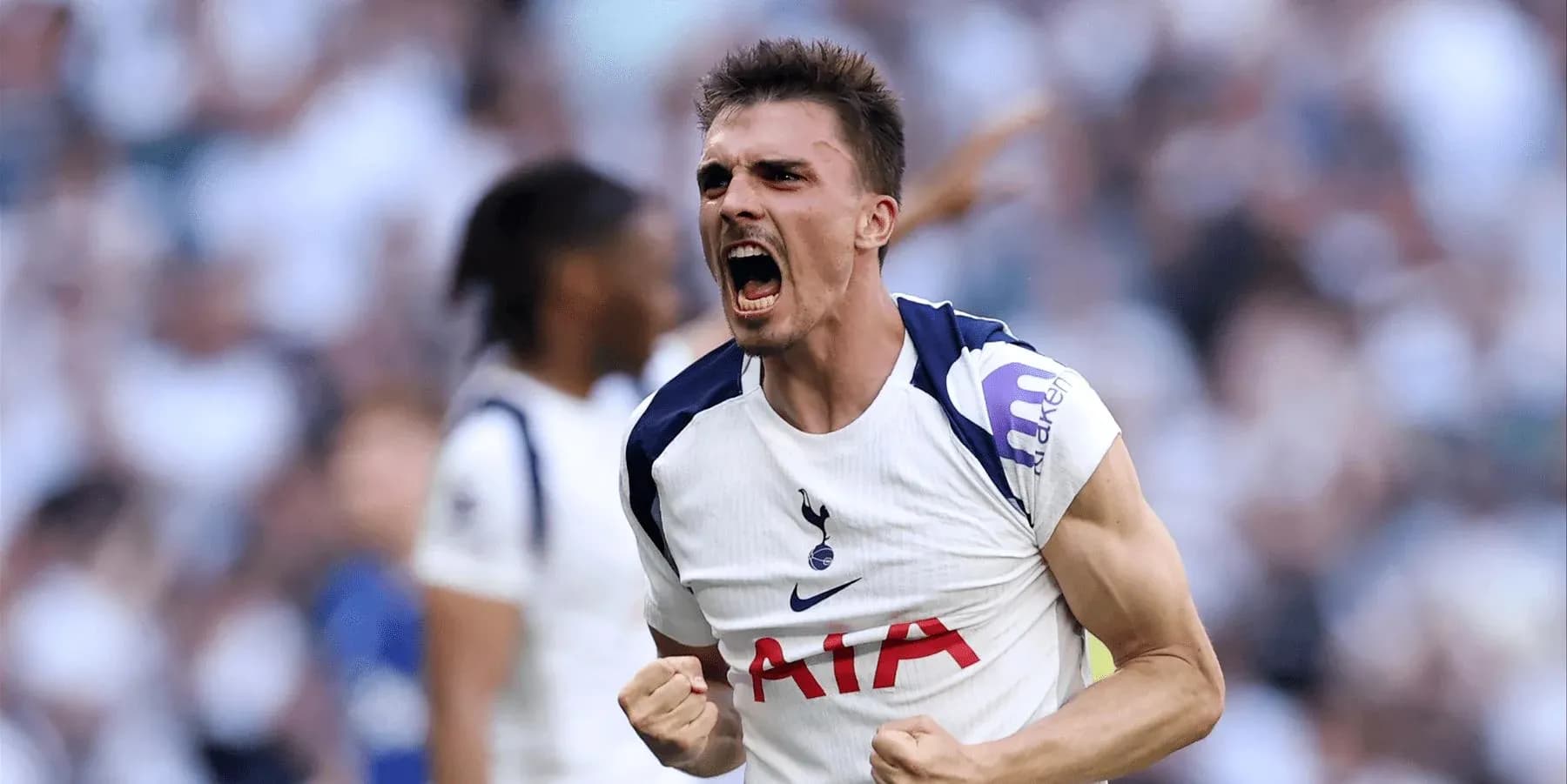
The shot map numbers underline Tottenham’s positional superiority. Fifteen of their 20 efforts came from inside the box, and they forced Everton into 9 blocked shots, evidence of sustained pressure and quick shot selection once they reached the final third. The lone Tottenham goal, scored by J. Palhinha at 43', came at the end of a period where the hosts had pinned Everton back, repeatedly working the ball from side to side until a central lane opened. Even without a registered assist, the pattern is clear: circulation through the double pivot, full-backs high, and late midfield runs into the area.
Everton's Approach
Everton mirrored the 4-2-3-1 shape but were far more conservative in their application. Leighton Baines’ side tried to keep James Garner and Tim Iroegbunam tight in front of the centre-backs, protecting the half-spaces and forcing Tottenham wide. However, with Tottenham’s front four constantly rotating positions, Everton’s midfield screen was often dragged out, particularly when I. Ndiaye and Kiernan Dewsbury-Hall (before his substitution) tucked in to help. That left Tottenham able to sustain attacks and accumulate corners (7–7 overall, but Tottenham’s came from longer pressure spells rather than isolated breaks).
Goalkeeping Performances
In goal, A. Kinsky (Tottenham) had a largely controlled afternoon, officially required to make just 1 save. The defensive line of Porro, Kevin Danso, Micky van de Ven and Udogie limited Everton to 1 shot on target and only 7 attempts inside the box, compressing space whenever Everton tried to combine centrally. The negative goals prevented value (-0.32) suggests the one save he did make was relatively routine compared with the xG of the chance conceded, underlining how well-protected he was by the structure in front of him.
At the other end, J. Pickford (Everton) also recorded 1 save, but his workload was more about managing volume than dealing with clear one-on-ones. Tottenham’s xG of 0.99 from 20 shots indicates a lot of pressure but many efforts from semi-favourable positions rather than constant high-value chances. Everton’s own goals prevented figure of -0.32 mirrors Tottenham’s, implying that neither goalkeeper dramatically overperformed or underperformed relative to the quality of shots faced; the match was decided more by chance creation than shot-stopping heroics.
Discipline and Duels
Discipline and duels tilted slightly towards Everton’s more reactive approach. Everton committed 18 fouls to Tottenham’s 15, and both sides collected two yellow cards. Jake O'Brien’s early booking at 13' for “Foul” highlighted Everton’s need to break Tottenham’s rhythm, while James Tarkowski’s late yellow at 89' for “Foul” came as Everton pushed higher and became more exposed in defensive transitions. For Tottenham, Pape Matar Sarr’s 80' yellow for “Simulation” and Joã o Palhinha’s 87' caution for “Handball” were more individual incidents than structural flaws, but Palhinha’s card did slightly compromise his ability to make aggressive late-game interventions.
Substitutions
The substitutions reflected diverging tactical priorities. At 62', Baines introduced T. George (IN) for M. Rohl (OUT) and H. Armstrong (IN) for J. O'Brien (OUT), freshening the right flank and adding more vertical running to chase the game. Later, Beto (IN) for T. Barry (OUT), C. Alcaraz (IN) for K. Dewsbury-Hall (OUT) and S. Coleman (IN) for T. Iroegbunam (OUT) at 84' indicated a late attempt to blend direct threat with experience, but Everton never translated these changes into sustained box entries.
De Zerbi’s changes were more about game management and maintaining pressing intensity. At 73', R. Kolo Muani (IN) replaced Richarlison (OUT), adding fresh legs to lead the press and attack depth. P. M. Sarr (IN) for M. Tel (OUT) at the same minute gave Tottenham more control and defensive energy in midfield, albeit at the cost of some attacking dynamism. At 82', A. Gray (IN) for Bentancur (OUT) and J. Maddison (IN) for Gallagher (OUT) kept the central zones technically secure while preserving the ability to hold the ball under pressure. Finally, at 90', R. Dragusin (IN) for D. Udogie (OUT) was a classic closing substitution, reinforcing the back line to see out the final moments.
Statistical Overview
Statistically, the match tells a coherent story: Tottenham created more, shot more, and generated higher xG while keeping Everton at arm’s length. Their 373 passes, 317 accurate (85%) show a tidy, controlled circulation, essentially matched by Everton’s 377 passes, 314 accurate (83%), but the context of those passes differed. Tottenham used possession to probe and pin Everton back; Everton often circulated in deeper zones without turning it into penalty-box presence.
The 1-0 scoreline, with Tottenham leading 1-0 at half-time and holding that margin to full-time, aligns with the underlying numbers. Tottenham’s edge in box entries, blocked shots forced and xG, combined with a disciplined defensive display that limited Everton to a single effort on target, justifies the narrow but deserved home win in this final-round Premier League fixture.