St. Pauli's Relegation Reset: A New Chapter Begins
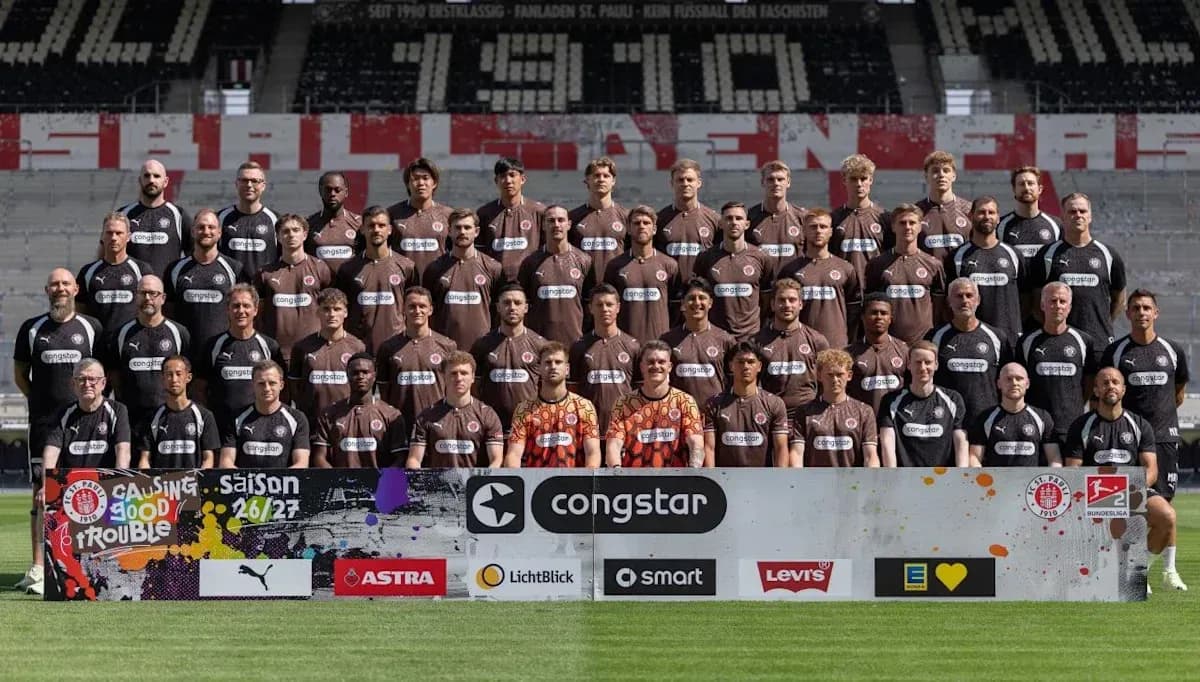
The party didn’t last long at the Millerntor. After the emotional high of staying in the Bundesliga in 2024/25 – something the club hadn’t managed since 1995/96 – St. Pauli tumbled straight back through the trapdoor. Six wins, eight draws, 20 defeats. Bottom of the table in 2025/26, and back to the 2. Bundesliga with a thud.
Relegation always leaves scars. This one has already claimed a coach, a captain, and the spine of a side that only recently felt built for the top flight.
Alexander Blessin was the first big casualty, dismissed in the weeks after the season ended. His departure set the tone for a summer of upheaval in Hamburg’s footballing cult corner.
Irvine leaves a hole you can’t see on a teamsheet
The headline exit is Jackson Irvine, and not just because of his numbers. 153 appearances, 15 goals, 21 assists – the statistics are respectable enough. But they don’t capture what he became at St. Pauli: promotion captain in 2023/24, a symbol of the club’s identity, and a figure deeply woven into the community around the Millerntor.
His decision to request a move to Cerezo Osaka caught many off guard, not least because the transfer was confirmed less than a week before the first fixture of the new season. It felt sudden. It also felt final.
Around him, the dressing room doors kept swinging.
- Goalkeeper Nikola Vasilj, a constant with 167 appearances and 43 clean sheets, left for Al-Diriyah on a free.
- Karol Mets joined Bochum, also for nothing, after 91 games in brown and white.
- Right-back Manolis Saliakas moved to Olympiacos for €1.3 million, having played 120 times.
- Hauke Wahl, another defensive pillar with 105 appearances, went to Wolfsburg for €2 million.
- Daniel Sinani headed to Sampdoria, again for free, after 70 outings.
That is not just turnover. That is a core being ripped out.
Hrgota the new spearhead of a patched-up side
St. Pauli, though, have not simply curled up and accepted their fate. They have recruited with purpose.
Up front, the club landed Branimir Hrgota from Fürth on a free – a quietly shrewd move. Hrgota is Fürth’s all-time leading scorer in the top two tiers of German football, with 69 goals and 41 assists in 238 games. He dragged them back to the Bundesliga in 2020/21 with 16 goals and 7 assists, leading a promotion charge that still defines his time there.
He arrives in Hamburg not as a project, but as a ready-made focal point: a scorer, a creator, and a seasoned voice in a dressing room that has just lost its captain.
At the back, St. Pauli moved for Marcus Mathisen from Magdeburg, again on a free. He brings experience and stability to a defensive unit that has been heavily reshaped.
The biggest new face, though, stands on the touchline.
Marcel Rapp, 47, has been appointed head coach after his work at Holstein Kiel, where he masterminded the club’s first-ever promotion to the Bundesliga in 2023/24. That was the same season St. Pauli won the league. Now, their paths cross in a different context: Kiel on the rise, St. Pauli trying to climb back again.
Rapp’s track record offers something priceless in a relegated dressing room: proof that he knows how to build a promotion side.
A pre-season with hints of identity – and one warning shot
Pre-season rarely tells the whole story, but it often whispers a few truths. Rapp’s St. Pauli already show signs of structure and attacking intent.
The tour started with a familiar local fixture against Altona 93. St. Pauli swarmed their neighbours and ran out 6-2 winners, an emphatic way to blow off the cobwebs. Next came Regionalliga Nord side Kickers Emden, where a more workmanlike 3-1 win suggested a team still finding rhythm but already capable of grinding out results.
The third match, against fan-friendship club Babelsberg, brought both joy and a statement performance. St. Pauli won 4-1, fuelled by a first-half hat-trick from Abdoulie Ceesay. It was the kind of outing that makes a forward feel ten feet tall and a coach quietly satisfied with his attacking patterns.
Then came a step up in opposition. Against Croatian side Gorica, St. Pauli edged a 2-1 win thanks to goals from Louis Oppie and Ricky-Jade Jones. The scoreline looked good; the mood, less so. Ceesay, fresh from that hat-trick, suffered a capsule-ligament injury in his right ankle and was forced off. The timing was cruel. Just as he was emerging as a genuine option, he was sidelined.
The penultimate test was the harshest. Premier League and Europa League participants Bournemouth exposed St. Pauli’s defensive frailties in Austria, winning 4-1. Kaars opened the scoring on 22 minutes, but what followed was alarming: four goals conceded in 27 minutes. It was the first and only defeat of pre-season, but it underlined how thin the margins will be when this team switches off.
The final dress rehearsal came at the Millerntor against newly promoted LaLiga side Deportivo de La Coruña. St. Pauli led twice – first through Taichi Hara, then Kaars – but conceded an 84th-minute equaliser in a 2-2 draw. Encouraging in patches, frustrating at the end. A fitting snapshot of a squad in transition.
How Rapp’s St. Pauli might actually look
Rapp is expected to keep faith with a three-at-the-back setup. It fits his ideas and, with the right personnel, can give St. Pauli both solidity and width.
With Eric Smith’s fitness still uncertain ahead of the opener against Fürth, Tomoya Ando or Adam Dzwigala are likely candidates to slot into the back line in the short term. New arrival Mathisen should anchor that defence, with Nemeth and one of Ando or Dzwigala alongside him.
In midfield, Fujita looks set to operate in the centre, paired with either Rasmussen or Metcalfe. Out wide, Pyrka and Oppie are the probable starters, asked to cover huge distances and provide both defensive support and attacking thrust. Lars Ritzka and Erik Ahlstrand offer reliable depth in the middle, important given the physical grind of a 2. Bundesliga season.
Up front, the combinations are intriguing. Hrgota is expected to play off the main striker, linking midfield and attack, with options around him depending on fitness and form. Jones, Hara and, once recovered, Ceesay all bring different profiles. Kaars, meanwhile, is likely to lead the line as the central reference point.
A likely shape? Voll – Nemeth, Mathisen, Ando – Pyrka, Rasmussen, Fujita, Oppie – Hrgota, Jones – Kaars. On paper, it is not a relegated squad licking its wounds. It is a side that can compete.
Can St. Pauli break their own history?
The warning for St. Pauli supporters is written in their own recent past. The last time they were relegated from the Bundesliga before this drop – back in 2010/11 – it took 13 long years to return. The quickest they have ever bounced back is four seasons, a feat they managed twice in the 1990s and early 2000s.
History, then, is not on their side. But this version of St. Pauli might not care.
Despite losing key players, the club has kept a strong core and added proven quality. Pre-season suggested they can still punch above their weight, especially in attacking phases. The numbers back that up: this is the second most valuable squad in the 2. Bundesliga, trailing only VfL Wolfsburg – albeit by nearly €200 million.
A return to the top flight is not guaranteed, but it is realistic. Wolfsburg will start as clear title favourites. Behind them, the race for second and third is shaping up to be a scrap, with Hannover and fellow relegated side Heidenheim looming as serious contenders.
Within that chaos, St. Pauli have a clear target. A finish outside the top six would be a disappointment. A top-three push is within reach if Rapp’s ideas bed in quickly and the new signings hit stride.
The Millerntor has seen enough false dawns to be wary. But with a promotion specialist in the dugout, a new leader in attack, and a squad that still looks more predator than victim, the real question is not whether St. Pauli can survive this reset.
It’s how fast they dare to chase the Bundesliga again.