Spain vs Austria: Clash of Footballing Ideologies in Knockout Round
SoFi Stadium in Inglewood stages a Round of 32 meeting that feels like a clash of footballing ideologies. Spain arrive as group winners from Group H, having taken 7 points with a goal difference of 5 from 3 matches, built on total control and defensive perfection. Austria come from Group J as runners-up with 4 points and a goal difference of 0, a side forged in Ralf Rangnick’s high-intensity, vertical game. The bracket says knockout football; the numbers say contrast.
Heading into this game, Spain’s seasonal profile in this World Cup is almost unnervingly clean. Overall they have played 4 matches, winning 3 and drawing 1, and they have yet to lose. At home-designated venues they have played 3 times, winning 2 and drawing 1, while on their travels they have a single away win. Across the campaign in total they have scored 8 goals and conceded none, a goal difference of 8 that underpins their status as one of the tournament’s most controlled sides. Their total average of 2.0 goals scored per match is split into 2.3 at home and 1.0 away, while their average goals conceded stands at 0.0 in every dimension.
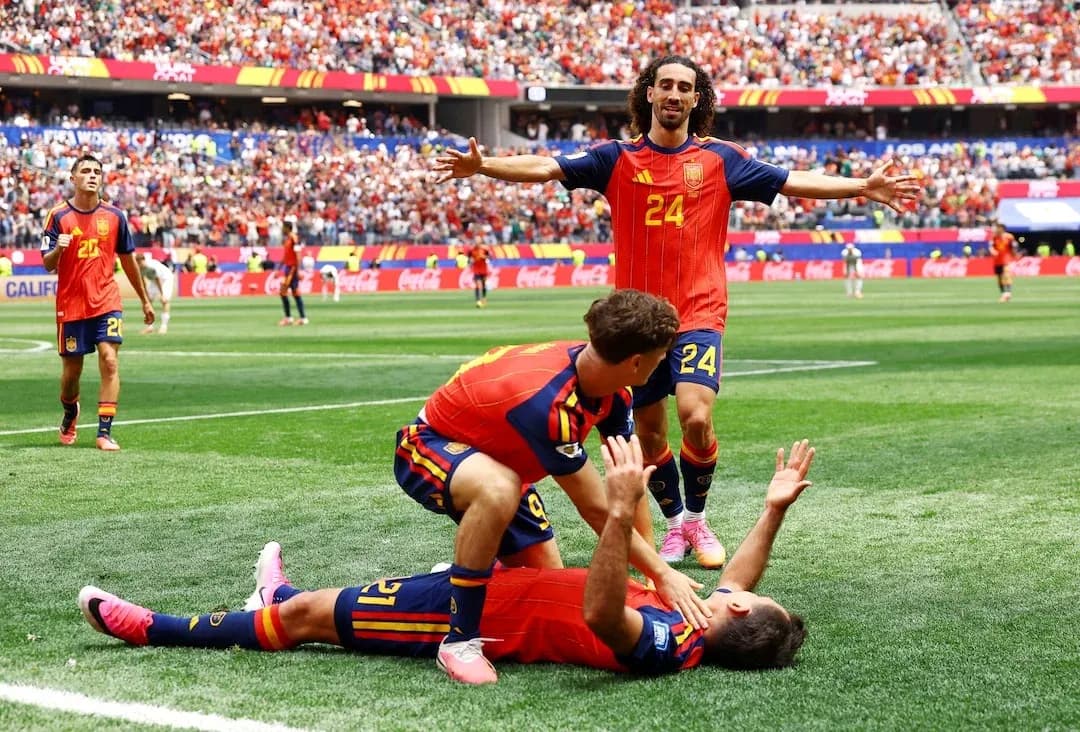
Luis de la Fuente leans into that control with a 4-2-3-1 that is really a shape of dominance rather than mere safety. Unai Simón stands in goal behind a back four of Pedro Porro, Pau Cubarsí, Aymeric Laporte and Marc Cucurella. In front of them, Rodri and Pedri form the double pivot that defines Spain’s rhythm. Ahead, the line of three – Lamine Yamal to the right, Dani Olmo centrally and Álex Baena to the left – feeds Mikel Oyarzabal as the nominal striker.
Oyarzabal is the headline figure in this squad. He arrives as one of the World Cup’s top scorers, with 4 goals and 1 assist in total across 4 appearances, all as a starter. His 15 total shots, 8 of them on target, speak to a player who not only finishes but also constantly tests goalkeepers. A total rating of 7.7 across his minutes reflects more than just poaching; 69 passes with 2 key passes and 73% accuracy show he can drop, combine and link Spain’s positional play with the penalty area.
Around him, Spain’s depth is formidable. From the bench, Luis de la Fuente can turn to Marcos Llorente and Fabián Ruiz to vary the midfield’s passing angles, or Martín Zubimendi and Mikel Merino to harden the structure. Gavi is another high-energy option between the lines. Out wide, Ferran Torres, Yeremy Pino, Nico Williams and V. Muñoz provide different types of directness and one‑v‑one threat, while Alejandro Grimaldo, Eric García and M. Pubill give flexibility in the back line. The squad is so balanced that even when Spain shift between 4‑3‑3 and 4‑2‑3‑1 – they have used each formation twice overall this campaign – their underlying identity barely wavers.
Defensively, the numbers are stark. Spain have kept 4 clean sheets in total from 4 matches, 3 in home-designated fixtures and 1 away. They have not trailed in the competition, and their biggest home win so far, 4‑0, underlines how quickly they can turn control into a rout once they score first. The only small note of caution is that they have failed to score in 1 home-designated match, proof that even this side can occasionally be frustrated if the first goal does not come.
Austria arrive as the disruptors. Their overall record – 1 win, 1 draw and 2 defeats – is less pristine, but it hides a more chaotic attacking threat. In total they have scored 6 goals and conceded 9, a goal difference of −3 that speaks to their open games. At home they have played once, scoring 3 and conceding 1, while on their travels they have played 3 times, scoring 3 and conceding 8. The away average of 1.0 goal scored and 2.7 conceded tells the story of a team that will attack, but can be exposed.
Rangnick also sets Austria up in a 4‑2‑3‑1, but the interpretation is different. Alexander Schlager is the last line, with Stefan Posch, Kevin Danso, David Alaba and Konrad Laimer forming a back four that is asked to defend large spaces. In midfield, Nicolas Seiwald and Xaver Schlager provide the running and pressing triggers, while Romano Schmid, Paul Wanner and Marcel Sabitzer support Michael Gregoritsch up front.
The disciplinary profile of this Austria side hints at how the game might tilt. In total this campaign they have collected a flurry of yellow cards late in matches: 60.00% of their cautions have arrived between 76 and 90 minutes, with earlier bookings split 20.00% between 0–15 and 31–45 minutes. Stefan Posch embodies that edge; across his 4 appearances he has committed 7 fouls, drawn 3, and taken 2 yellow cards. His aggression in duels – 35 contested, 16 won – is vital to Austria’s front‑foot defending, but it also leaves him walking a disciplinary tightrope, especially against a dribbler like Lamine Yamal or a clever mover like Oyarzabal.
Posch’s presence is doubly intriguing because he also appears among the competition’s top red‑card profiles, even though he has not yet been dismissed. That dual listing underlines the sense that officials are watching him closely. Any mis‑timed challenge on the edge of the box against Spain’s intricate combinations could tilt this knockout tie.
Further up the pitch, Austria’s attacking options from the bench – Marko Arnautović, Sasa Kalajdžić and Patrick Wimmer – give Rangnick the tools to turn the match into a more direct battle if Spain’s press suffocates their build‑up. Florian Grillitsch and Dejan Ljubičić can add control or legs in midfield, while a cluster of defenders such as Philipp Lienhart, Patrick Mwene, Maximilian Wöber’s stand‑in M. Svoboda, Andreas Prass, Dario Affengruber and Marco Friedl offer ways to shift into a back three or a more conservative line late on.
From a statistical and tactical standpoint, the “Hunter vs Shield” duel is clear: Oyarzabal, with his 4 total goals, against an Austrian defence that concedes an overall average of 2.3 goals per match, and 2.7 on their travels. Spain’s total xG profile is not given, but their shot volume and perfect defensive record suggest they systematically create better chances than they allow. Austria, by contrast, have already experienced a heaviest away defeat of 3‑0, a scoreline that mirrors the full‑time 3‑0 Spain carry into this fixture.
In the “Engine Room” zone, Rodri and Pedri’s control will test Seiwald and Xaver Schlager’s capacity to press without being played through. If Austria over‑commit, Spain’s wingers and attacking midfielders can exploit the half‑spaces behind their full‑backs. If they sit off, Spain’s patience and passing angles will gradually squeeze them back towards their own box.
Austria’s one perfect detail is from the spot: they have taken 1 penalty in total and scored it, with no misses. If they can turn their pressing into turnovers and draw fouls in dangerous zones, that ruthlessness from twelve yards could be a lifeline.
Yet the broader prognosis leans heavily towards Spain. A side that has not conceded in 4 matches, with 4 clean sheets and a total goal difference of +8, facing an opponent that has yet to keep a single clean sheet and has conceded 9 overall, is statistically favoured. Tactically, Spain’s structured possession and depth across all lines make them built for tournament knockout play. Austria’s chaos can hurt anyone in moments, but over 90 minutes at SoFi Stadium, the numbers and the narrative both suggest that Spain’s shield is more likely to hold than Austria’s press is to break it.