South Africa's Women’s Africa Cup of Nations Fight Continues
South Africa walked out of Casablanca with a point, a pulse, and just enough hope to drag their Women’s Africa Cup of Nations campaign into a final-day shootout.
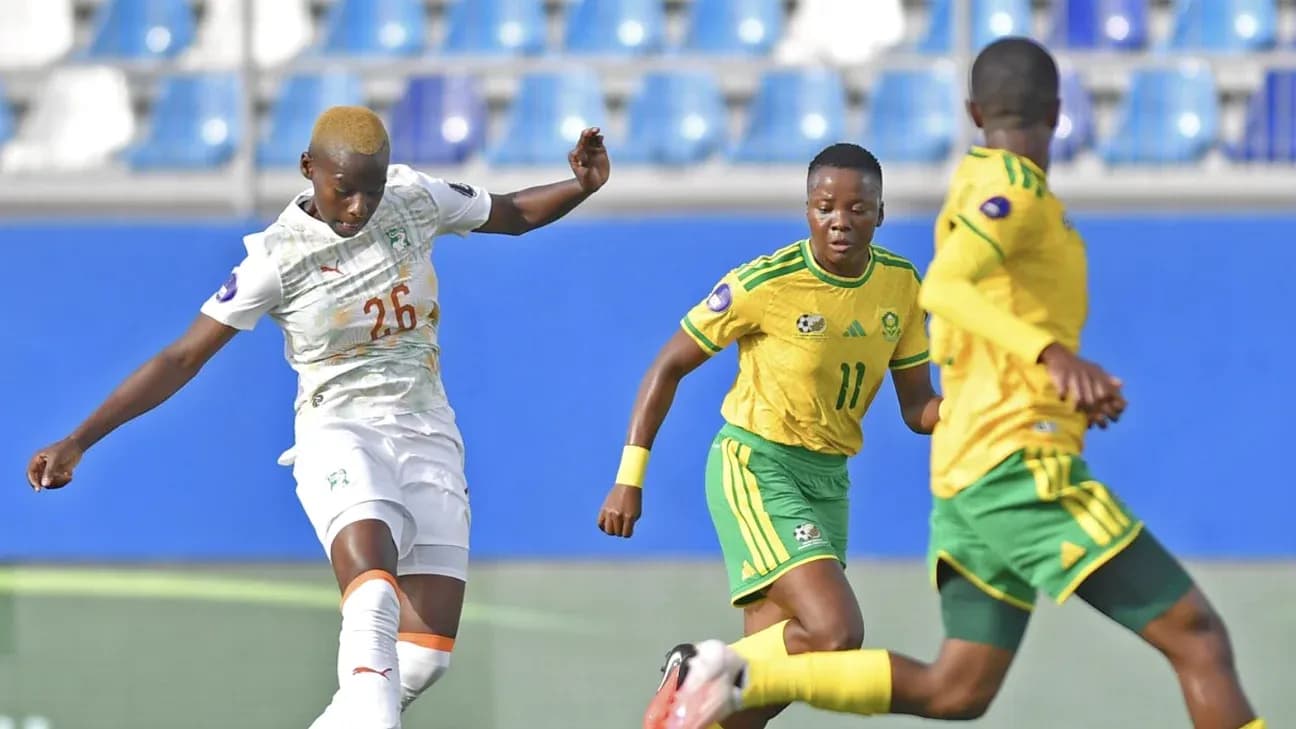
The 2-2 draw with Ivory Coast on Friday was chaotic, flawed, and at times deeply worrying. It also might just be the night when two much-maligned forwards rewrote the conversation.
Torn apart, then dragged back
For 45 minutes, Banyana Banyana looked like a team on the brink.
Ivory Coast needed no invitation to run at them. Twice in the first half, South Africa were sliced open on the counter. Twice, Grace Sery finished the move with ruthless calm — first on 18 minutes, then again on 36. Same pattern, same vulnerability, same stunned looks in the South African backline.
South Africa’s response? Almost nothing.
There was one flash of quality: Linda Motlhalo threading a superb ball through for Thembi Kgatlana, forcing goalkeeper Aramatou Diakité to race out and smother. Beyond that, Banyana offered little. Kgatlana, so often the spark, drifted on the fringes of the game, isolated and anonymous.
For a player whose pedigree is unquestioned but whose recent national-team form has been picked apart, it fed the narrative. Were her best days in Banyana colours gone?
The second half gave a very different answer.
Kgatlana reminds Africa who she is
Kgatlana, now with Tigres UANL, has long thrived when paired with a clever link player. For years that was Jermaine Seoposenwe, whose movement and intelligence unlocked space and allowed Kgatlana to dart into chaos.
Since Seoposenwe’s retirement last year, nobody has truly owned that role. Several have tried. None have convinced. One of the most heavily criticised has been Mamelodi Sundowns striker Ronnel Donnelly, whose limited club minutes have become an easy stick to beat her with.
On Friday night, she came off the bench and showed exactly why Desiree Ellis keeps writing her name on the team sheet.
Donnelly is not Seoposenwe. She doesn’t need to be. Her game is different — more physical, more direct, built on drawing defenders into battles and winning aerial duels. And suddenly, Kgatlana had someone to play off.
With just under 20 minutes plus stoppage time left, Donnelly carved out space for herself in the box. She couldn’t quite get the shot away, but crucially, she didn’t waste the moment. The ball was recycled, found its way to Kgatlana, and this time the veteran forward took control.
She cut inside, picked her spot, and buried it.
One chance. One goal. One reminder that big players do not vanish; they wait for the game to come back to them.
Donnelly’s moment, Magaia’s finish
The goal shifted everything. South Africa suddenly played higher, pressed harder, and looked like a team that understood what was at stake. Ivory Coast, who had largely cruised through the first hour, started to feel the strain.
The clock ticked deep into stoppage time. Banyana still trailed. Their tournament, in all but mathematics, was slipping away.
Then Donnelly climbed.
A long ball came in, and the 22-year-old did what she had been doing since she stepped onto the pitch — she competed. She rose, flicked on a header, and turned a hopeful delivery into a genuine chance.
Hildah Magaia did the rest, smashing home the equaliser to rescue a point that felt, in that moment, like far more.
For Donnelly, it was the payoff for a tireless cameo. For South Africa, it was a lifeline.
Group B on a knife-edge
The draw leaves Group B finely poised.
Ivory Coast sit on four points from two games, with a goal difference of +3 after their 4-1 opening win over Burkina Faso. Tanzania, who beat South Africa 2-1 in their opener, went into their Friday night clash with Burkina Faso on three points and a +1 goal difference.
South Africa now have one point and a goal difference of -1. Burkina Faso remain pointless.
The maths is brutally simple for Banyana: they must beat Burkina Faso on August 4 to have any chance of reaching the quarter-finals. No calculations, no careful managing of a draw — only a win will do.
Head-to-head records will decide ties on points before goal difference comes into play, so every duel in this group carries extra weight. Edges are thin. Mistakes are fatal.
Ellis’ attacking dilemma
Desiree Ellis knows her side cannot tiptoe into that final game. They need goals, they need momentum, and they need to start on the front foot.
On Friday, the combination that changed everything was clear: Donnelly, Kgatlana, Magaia, with Lebogang Ramalepe offering width and energy. When those four clicked, even a strong Ivory Coast defence struggled to contain them.
One option now looms large — start all four.
It would be a bold call, an aggressive one, but the situation demands risk. Banyana’s backs are pressed firmly against the wall. There is no safety-first route out of this group.
The prize is enormous. The four WAFCON semi-finalists will book direct tickets to the 2027 FIFA Women’s World Cup in Brazil. The two best losing quarter-finalists will still have a route via African playoffs to the Inter-Confederation Playoff.
South Africa are not there yet. Far from it. But Friday’s late surge at least proved they are still in this fight.
If they are to go out, their supporters will want them to go out like they finished in Casablanca — swinging, snarling, and refusing to accept the script.