
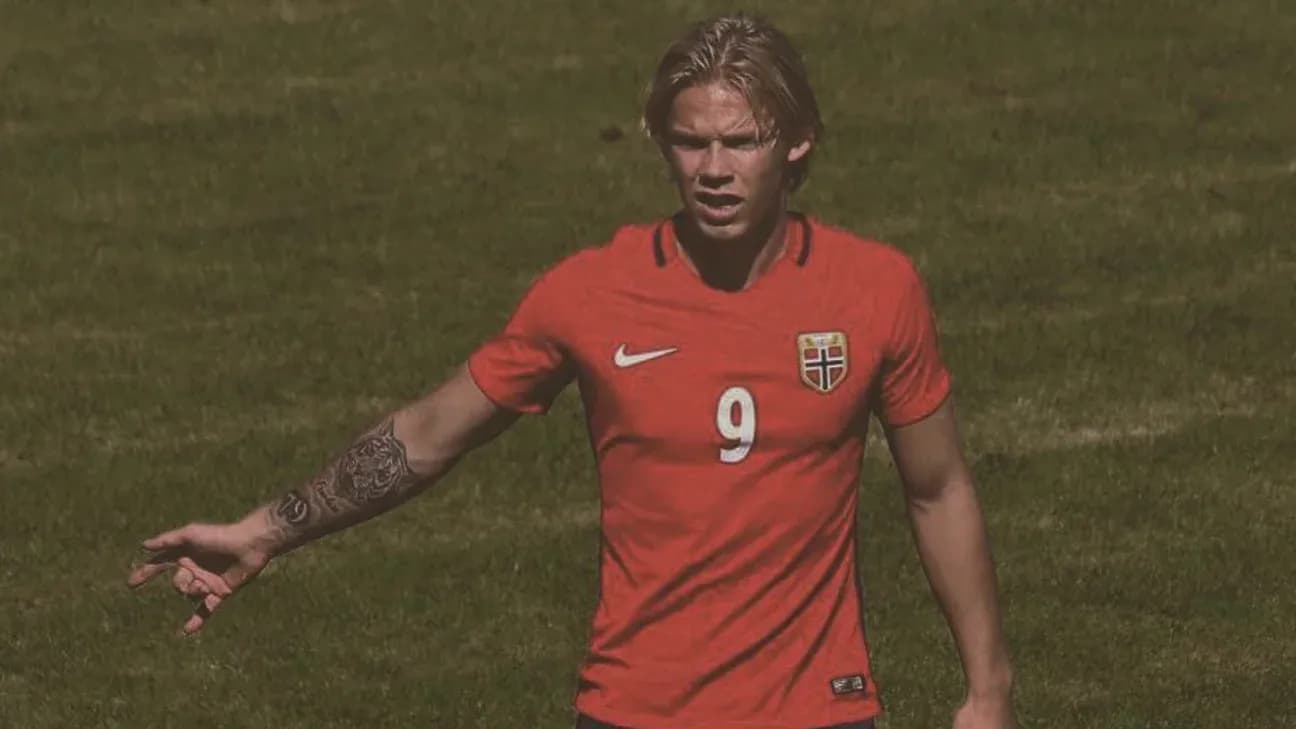
Sebastian Pedersen: Orlando Pirates' New Striker
Erling Haaland’s name was always going to find its way into the conversation. It usually does when a Norwegian striker moves anywhere. This time, the social media joke is that Orlando Pirates’ new signing, Sebastian Pedersen, is his “cousin”. He isn’t. But their careers did cross in a more meaningful way than a meme.
Both came through Norway’s youth ranks at the same time, both wore the same badge, both fought for the same shirt number in the same age groups. On five occasions, according to Transfermarkt, Pedersen and Haaland were named in the same Norway U18 and U19 squads. Three of those matches came in UEFA Euro Under-19 qualifiers.
They were rivals before they were comparisons.
Interestingly, they almost never shared the pitch. One would start, the other would sit. When one came on, the other usually went off. Two young No. 9s, one spot, and a coach forced into a choice that now reads like a sliding-doors moment.
Pirates land their “blonde bomber”
On Sunday, Orlando Pirates finally got the type of striker they’ve been hunting.
“Orlando Pirates Football Club is pleased to announce the signing of striker Sebastian Pedersen from Norwegian side Sogndal Fotball,” the club confirmed on their website, unveiling a two-year deal with an option for a further season.
At 27, Pedersen arrives as more than a prospect. He comes as a finished article in terms of profile: a penalty-box specialist, a one-touch finisher, a man who lives off movement and timing rather than raw power. The club described him as part of one of Norwegian football’s “great talent factories” and dubbed him a “blonde bomber”, a nod to his schooling through Norway’s national youth teams from U15 all the way to U21.
His numbers back up the billing. Across his club career, Pedersen has scored 59 goals and supplied 9 assists in 166 appearances. In his last 117 games alone, he has found the net 51 times. He is not the bulldozer type, not the battering ram centre-forward who wins every aerial duel and flattens centre-backs. He is the striker who arrives at the right time, takes one touch, and makes the goalkeeper pay.
That is exactly the profile Pirates have been missing.
Filling the Mofokeng and Mabasa gaps
Pedersen’s main trade is through the middle, but he can also work the flanks, especially off the left. That versatility theoretically covers two of the three roles that Relebohile Mofokeng occupied before his departure. Yet early indications from the club suggest they see him as a central striker first, not a wide forward.
It’s not hard to see why.
Tshegofatso Mabasa is gone. During the final stretch of his Pirates contract he spent half a season on loan at Stellenbosch, and in his absence the Buccaneers had to improvise. Evidence Makgopa and Yanela Mbuthuma took turns leading the line in a side that still went on to win the Premiership, but the numbers told their own story.
Makgopa’s hold-up play offered structure, Mbuthuma’s tireless work off the ball gave the press some bite. Yet Makgopa finished the season with six goals, Mbuthuma with five. For a club with Pirates’ ambitions, those returns from first-choice strikers felt light.
Pedersen’s arrival looks like a direct response. A specialist to convert territory into goals. A finisher to turn good performances into comfortable wins instead of nervy one-goal margins.
There is, however, a caveat.
Most of his damage has come in Norway’s second-tier OBOS-ligaen. Pedersen has only one goal in 12 Eliteserien appearances, spread over 275 minutes. The step up in quality and intensity in South Africa will be a test, not a formality. Pirates are betting that his instincts in the box will travel well.
The other Marcus Pedersen
His surname has caused confusion, too.
Norway’s 2026 World Cup squad included Torino right-back Marcus Holmgren Pedersen, which led some to assume he was Sebastian’s brother. He isn’t.
Sebastian does have an older brother named Marcus Pedersen, and he did play for Norway, but his time in the national team came much earlier. Between 2013 and 2015, the elder Marcus earned nine caps and scored once. Now 36 and last seen in Norway’s lower leagues, far from the professional spotlight, his international days are a distant memory, yet his career was more than respectable.
A classic journeyman forward, Marcus Pedersen – like Sebastian – could also operate off the left. He turned out for Vitesse in the Netherlands, had a loan spell at Barnsley, and stints with Vålerenga in Norway and Odense Boldklub in Denmark. His most productive football came at Strømsgodset, where two spells between 2009–2010 and 2015–2019 cemented his reputation as a reliable goalscorer in his homeland.
Sebastian now follows in those footsteps, but his path veers south, to Soweto, and into a very different footballing culture.
The missing piece?
So what exactly are Pirates getting?
Not Haaland. No one is pretending otherwise. But they are getting a striker cut from the same youth-system cloth: schooled in movement, fed on chances, judged on goals. A player who has lived his career in the penalty area and built a record that suggests he knows where the net is, even if most of that work came outside the top flight.
For Abdeslam Ouaddou, preparing his squad for a season loaded with expectation, Pedersen looks like the piece that could finally give shape to the attack. A natural finisher to complement Makgopa’s link play and Mbuthuma’s energy. A focal point who thrives on service rather than solo runs from deep.
If the supply lines are right and the adaptation is swift, the “blonde bomber” might turn social media jokes into something far more serious: a Norwegian poacher becoming the new face of Pirates’ front line.





