
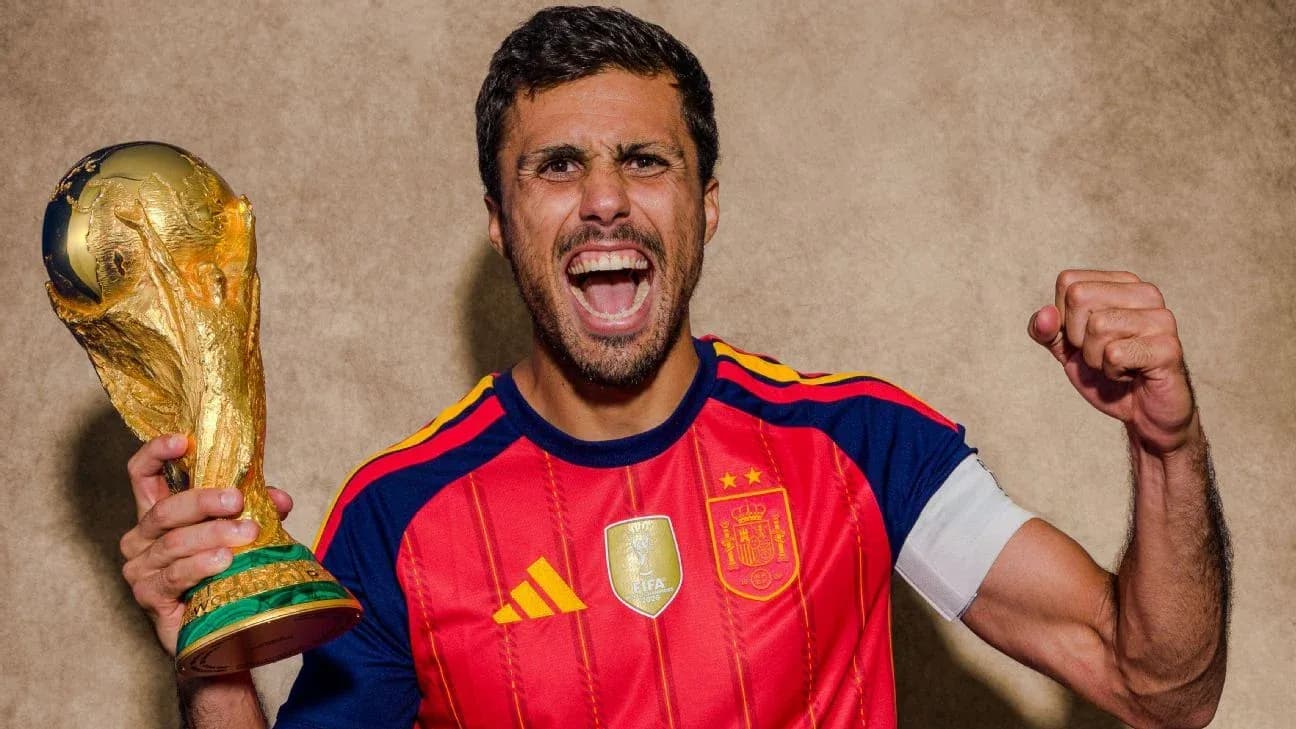
Rodri's Future: Barcelona's Pursuit Amid Madrid's Hesitation
Rodri has spent the summer rewriting history. Now he might be about to redraw the map of European football as well.
World Cup winner. Golden Ball. Captain of a Spain side that has just beaten Lionel Messi’s Argentina in a final, adding the biggest prize in the game to the European Championship he lifted two years earlier. A Ballon d'Or already on the shelf. Thirteen trophies in seven seasons at Manchester City, four Premier League titles, the decisive goal in a Champions League final.
This is not a midfielder on the way down. This is a player at the height of his powers, with one year left on his contract and an entire continent lining up to see where he lands next.
Right now, Barcelona are in front. Real Madrid are nursing regrets. Manchester City are waiting for someone to test their resolve.
Barcelona smell their moment
Barcelona always imagined Rodri as the heir to Sergio Busquets. They just never expected the chance to arrive like this.
When the summer began, Barça were not seriously planning a move. Financial reality and other priorities pushed the idea into the realm of fantasy. Then the market shifted. Frenkie de Jong’s injury opened a gap in midfield, and word filtered through that a deal for Rodri was actually possible.
That changed everything.
Hansi Flick and Deco did not hide their excitement as the picture became clearer. Rodri wanted to return to Spain at some point. Most in the game assumed that meant Real Madrid. Instead, the World Cup changed the chemistry. He had just lifted the trophy alongside eight Barcelona players. He liked Flick’s aggressive, structured style. He listened to the advice of Catalans who had worked at City over the past decade.
Gradually, his compass swung toward Camp Nou.
Club sources now say there is a loose agreement on personal terms. Rodri has given Barcelona priority over Madrid. That alone represents a seismic shift in the Spanish power balance.
The hard part, as always with Barça, is the fee.
City have already rejected an opening offer, but negotiations are active. The final package could climb to around €70 million. Inside the club, there is growing confidence they will get it done, even if nobody dares to call it finished while City are still at the table.
If he comes, Rodri walks into a midfield already loaded with talent: Pedri, Gavi, Marc Bernal, Fermín López, Dani Olmo. Flick and the sporting department believe he would be the piece that turns a promising unit into an elite one, especially in Europe.
LaLiga is under control; back-to-back titles prove that. The obsession now is the Champions League, a trophy Barcelona have not touched since 2015. Internally, they see Rodri as the signing that can push them back into that conversation.
Then comes the next question: what happens to De Jong when he returns? That debate can wait. Barcelona’s priority is clear. They are choosing a world-class holding midfielder over a new centre-back, at least for now, because they believe Rodri can change their ceiling.
They also know this: if they let him slip, he may not come this close again.
Real Madrid: from cool distance to painful near-miss
At Real Madrid, Rodri’s story has taken on the feel of a transfer that got away before it ever truly arrived.
For months, the line from the Bernabéu was consistent. Rodri was admired, of course. How could he not be? Madrid-born, the best in the world in his position, a year left on his deal. On paper, he solved several medium-term issues in one stroke.
But he was not on the summer agenda.
Florentino Pérez had doubts about his injury record, according to club sources. José Mourinho, back on the bench and with strong influence on recruitment, preferred a different profile in midfield. Renewing Aurélien Tchouaméni’s contract signalled faith in the Frenchman as the anchor of the future. Rodri stayed off the shortlist.
Then came the World Cup.
Rodri didn’t just play well; he dominated the tournament. Any lingering concerns about his fitness or form evaporated. Inside the club, opinions began to shift. Director general José Ángel Sánchez and chief scout Juni Calafat opened the door to the idea.
Confidence started to grow. By late July, some in Madrid believed the deal could happen. Rodri wanted to return home. City, though, had their own conditions: they wanted a replacement lined up first. There was no agreement on a fee, but there was no panic either. Madrid had other fronts open — talks over Yan Diomande, Vinícius Júnior’s renewal — and felt time was on their side.
Then the silence hit. Days without movement.
And on a Wednesday night, the mood flipped.
Barcelona were in. Not just watching, not just asking. Really in. Sources described it as 50-50 between Madrid and Barça. Rodri was open to both.
Within 24 hours, the optimism at the Bernabéu had drained away. Madrid believed they were out. Around the club, the message was that Rodri felt their doubts — Pérez’s concerns, Mourinho’s preference for other profiles — had never fully disappeared. Flick, by contrast, had picked up the phone himself to lay out his plan for the player.
Madrid were ready to make one last push. But the sense internally was that they were now chasing a decision that had already been made. Rodri’s camp, some said, were disappointed that Madrid had not moved decisively when they had the chance.
Unless there is a late twist, Madrid are preparing for a future without him. They must choose whether to look for an alternative or back what they already have. Reports around the club suggest Mourinho sees Bernardo Silva as a potential central option alongside Tchouaméni or Federico Valverde.
If Rodri walks out of England for Barcelona, Madrid will have to live with the image of a Madrid-born pivot, in his prime, anchoring their greatest rival.
Manchester City: relaxed on the surface, braced underneath
On the record, Manchester City are clear. Enzo Maresca calls Rodri a key player. The club want him to stay. They want him to sign a new contract.
Behind the scenes, the conversation is far more nuanced.
City have known for a long time that Rodri would eventually want to go back to Spain. That knowledge influenced their decision to bring in Kalvin Phillips from Leeds United in 2022, an experiment that never truly worked. The plan, at least in theory, was to have cover if Rodri ever pushed to leave.
There is another principle at play. Under this ownership, City rarely stand in the way of a player who genuinely wants out. Age, injury history and contract status all matter. Rodri is 30, with some recent fitness issues and only a year left on his deal. Letting that contract run down would mean losing him for nothing in 12 months.
City will not accept a bargain sale. But if Barcelona — or a revived Real Madrid — put more than €70 million on the table, they are likely to sit down and talk.
Any green light to sell would trigger a scramble.
The midfield already needs work. Doubts remain over Tijjani Reijnders and Nico González. Elliot Anderson has arrived from Nottingham Forest. Talks continue with Lille for Ayyoub Bouaddi, Morocco’s breakout World Cup star. Those are smart moves, but they do not replace a player who has been the fulcrum of a treble-winning side.
Maresca is stepping into a dressing room that has lived a decade under Pep Guardiola. That alone makes this a season of transition. Losing Rodri without a clear succession plan would turn a delicate adjustment into a full-scale rebuild.
For now, City are outwardly calm. No acceptable offer has landed. They cannot force Barcelona or Madrid to bid higher. What they can do is prepare. Scouting work on potential replacements is already underway. Inside the Etihad, there is a growing feeling that this might be the summer Rodri actually goes.
If that happens, the club will cash in on a player they elevated to world-class status — and then have to prove, once again, that no one is bigger than the system.
Rodri has already shaped one era at Manchester City and led his country to the top of the world.
His next decision will tell us something else: in a battle between Barcelona’s vision, Madrid’s hesitation and City’s pragmatism, which model of modern football really holds the strongest pull for the game’s ultimate midfielder?





