Red Bull Salzburg's Tactical Control in 1-0 Victory Over Pafos
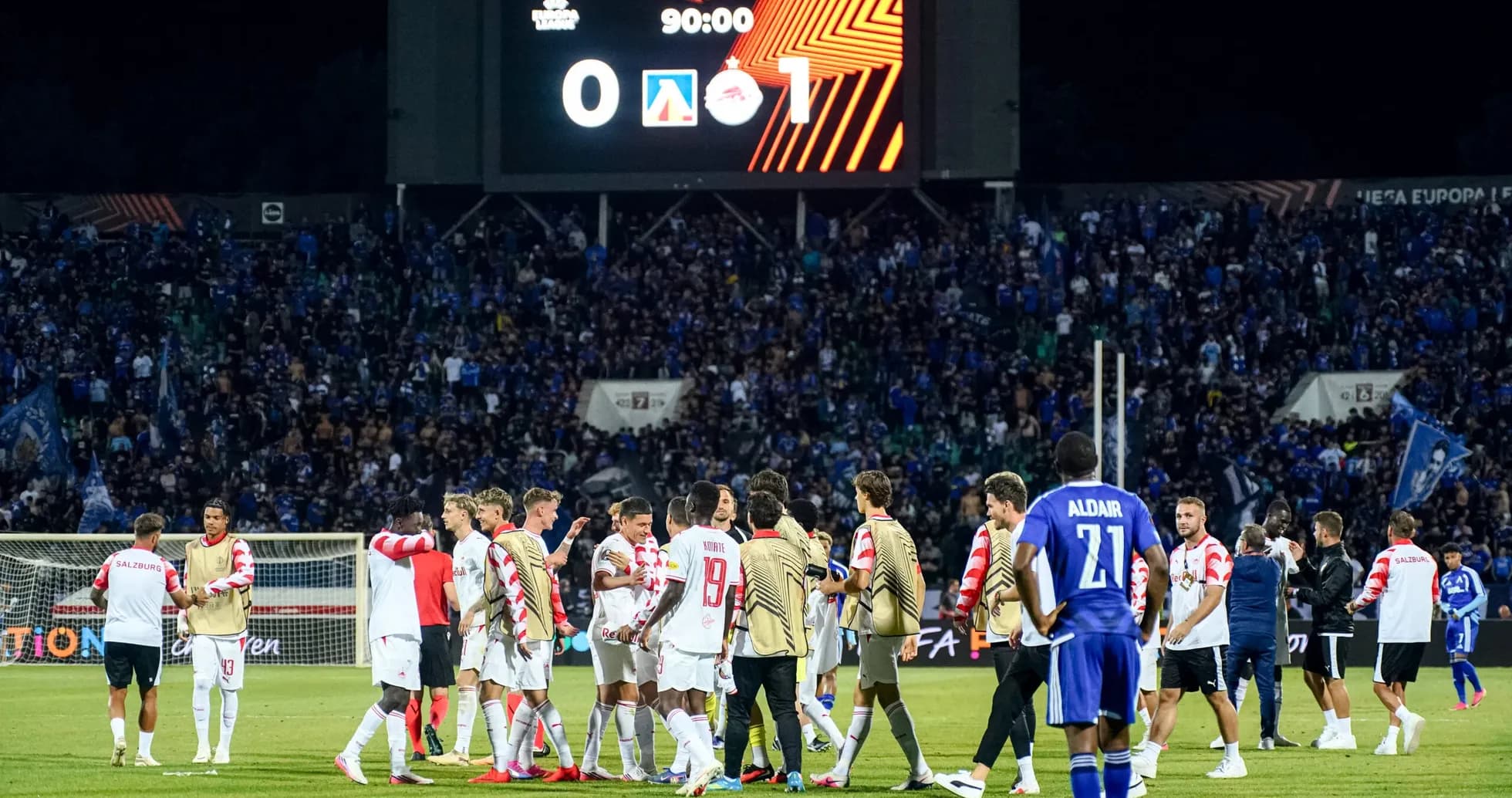
Red Bull Salzburg’s 1-0 win over Pafos at Red Bull Arena was a structurally controlled but hard‑earned result, defined more by territorial dominance and cumulative pressure than by clear‑cut chances. In a 3rd Qualifying Round tie of the UEFA Europa League, Salzburg’s 4-2-3-1 spent long stretches camped in the opposition half, but needed an 88th‑minute strike from substitute H. Tabakovic to finally crack a Pafos side that defended deep in a 3-5-2 and leaned on compactness rather than transitions. The statistical profile – 59% possession, a 13–0 corner count and a 3–1 shots-on-goal edge – underlines Salzburg’s control, while Pafos’ late red card encapsulated their increasingly reactive, last‑ditch approach.
Positional Structure
Salzburg’s positional structure was clear from the outset. With N. Veratschnig and D. Schmid as full-backs in the 4-2-3-1, they could hold a high line and lock Pafos into their own third. The double pivot of S. Diabate and A. Barry provided the platform: Diabate primarily as the first outlet in build-up, Barry more aggressive in stepping into the right half-space to support the band of three behind Y. Vertessen. The trio of E. Baidoo, G. Diakite and D. Redzic tried to overload between the lines, but Pafos’ back three plus a narrow midfield line of five often reduced their receiving zones to crowded pockets, forcing Salzburg into wide circulation and a high volume of crosses and second balls.
The 13 corner kicks Salzburg earned were a direct product of that dynamic. Pafos, with D. Goldar, David Luiz and N. Ioannou as a back three, consistently dropped into their own box, blocking four Salzburg shots and deflecting numerous deliveries behind. This deep block limited Salzburg to just three shots on goal despite frequent territorial superiority. The lack of recorded total passes and passing accuracy numbers prevents a granular passing map, but the possession share and corner differential clearly show Salzburg as the side dictating where the game was played, even if they struggled to convert that into repeated high‑quality chances.
Pafos' Defensive Setup
Pafos’ 3-5-2 was designed to compress central lanes. I. Sunjic anchored midfield, with Guga and A. Brito initially providing shuttling width, while Biel and Lele were tasked with stretching Salzburg’s centre-backs on counters. Yet with only one shot on goal and six shots off target, Pafos’ attacking threat remained sporadic. Their inability to win a single corner reflects how rarely they established sustained pressure in the final third; most of their forays ended in speculative efforts rather than constructed attacks. The 41% share of the ball was less about controlled possession and more about brief relief spells between long defensive sequences.
Second Half Substitutions
The substitution pattern significantly reshaped Salzburg’s attacking texture in the second half. At 58', B. Mazurek (IN) came on for S. Diabate (OUT), subtly changing the double pivot’s profile by adding more forward passing and late-box running. At 64', S. Kitano (IN) replaced D. Redzic (OUT), injecting fresher legs and more vertical movement between the lines. One minute later, at 65', K. Konate (IN) came on for Y. Vertessen (OUT), altering the reference point up front from a more mobile forward to a slightly different attacking presence. The decisive shift came at 70', when H. Tabakovic (IN) replaced E. Baidoo (OUT) and E. Aguilar (IN) came on for G. Diakite (OUT). With Tabakovic as a penalty-box focal point, Salzburg’s earlier accumulation of crosses and set-pieces suddenly had a clearer target.
Winning Goal
The winning goal at 88' was the logical outcome of this reconfiguration. As Salzburg continued to pin Pafos back, Tabakovic’s presence between the centre-backs gave their wide play and second-phase attacks a concrete finishing outlet. While the exact pattern of the goal is not detailed in the data, its timing – after a long spell of substitutions and mounting pressure – suggests Salzburg finally aligned their structure with the type of striker best suited to exploit a tiring, low block. That it came from a substitute underlines Danny Rohl’s willingness to aggressively retool his front line in search of a breakthrough.
Pafos' Tactical Adjustments
Pafos’ changes, by contrast, were more conservative and aimed at freshening the block rather than changing the game’s script. At 43', K. Sema (IN) came on for D. Quina (OUT), adding work rate and defensive coverage on the flank. Later, at 80', M. Mammadov (IN) replaced A. Brito (OUT), and at 88', Pepe (IN) came on for V. Dragomir (OUT), but these adjustments did not materially alter their attacking pattern. With no corners and only one shot on target, Pafos remained largely in survival mode, hoping to ride out the storm and escape with a 0-0.
Discipline and Tactical Balance
Discipline further tilted the tactical balance. Salzburg committed 13 fouls to Pafos’ 11, but the Cypriot side collected three yellow cards and one red, compared to Salzburg’s single booking. The repeated cautions for Ken Sema, culminating in a late red card at 90+3', were emblematic of a side increasingly forced into emergency defending and late challenges as Salzburg’s substitutes drove at a tiring block. Even without detailed reasons for each card, the pattern of bookings and dismissals aligns with a match where one team defended deeper and deeper under sustained pressure.
Statistical Overview
Statistically, the verdict is clear: Salzburg’s 59% possession, 3–1 shots on goal advantage, 4–0 edge in blocked shots and overwhelming 13–0 corner count portray a game they controlled territorially and structurally. The absence of recorded xG and passing breakdowns limits the precision of chance-quality analysis, but the volume and field tilt strongly support the eye-test implied by the numbers: Salzburg were on the front foot, Pafos were in containment mode. The narrow 1-0 scoreline reflects their initial inefficiency in turning dominance into clear chances rather than any real parity in control. From a tactical standpoint, Rohl’s use of his bench – particularly the introduction of Tabakovic – was the key adjustment that finally translated structural superiority into the only goal that mattered.