Benfica Triumphs Over AC Milan in Europa League Opener
Under the San Siro lights, this Europa League League Stage opener unfolded as a clash of ideas as much as of squads. AC Milan, under Ruben Amorim, leaned into a bold 3-4-2-1, while Marco Silva’s Benfica arrived with a well-drilled 4-2-3-1 that already looked road-tested by a deeper European run.
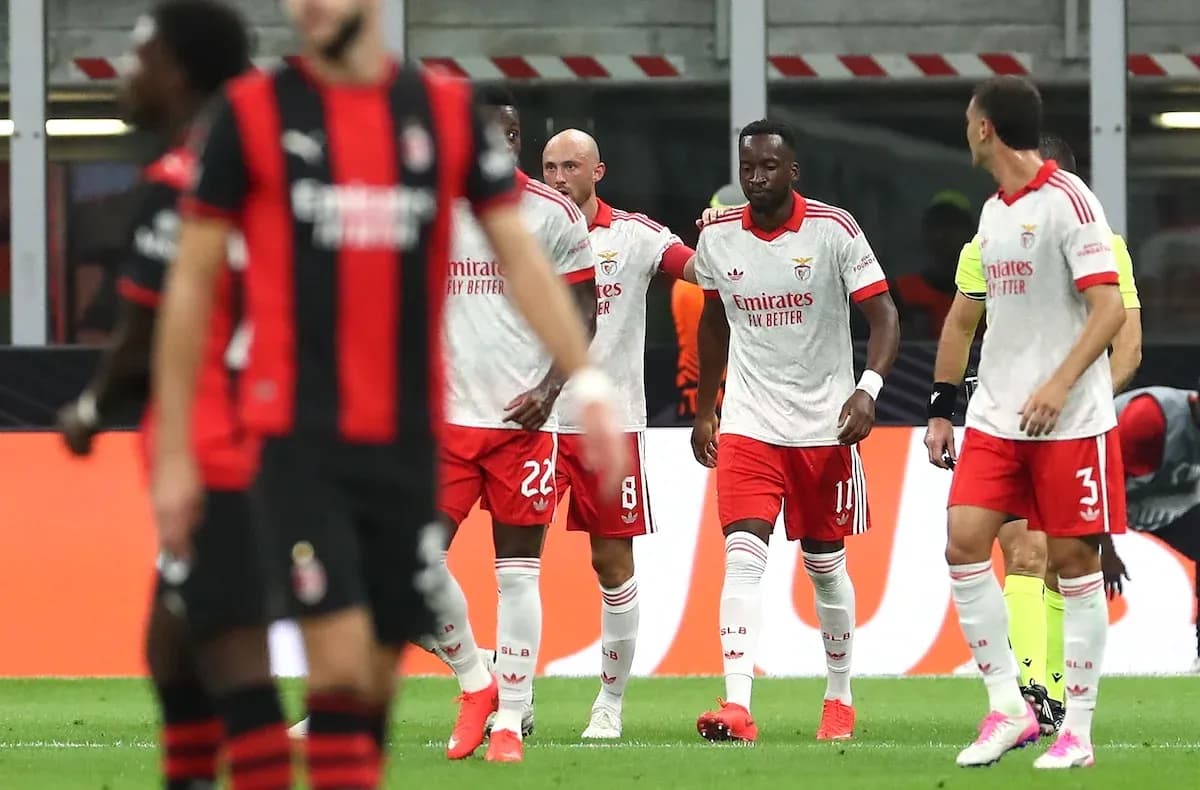
Following this result, the table tells a blunt story. Milan sit 31st with 0 points, a goal difference of -2 from 0 goals scored and 2 conceded overall, their only outing coming at home and ending in defeat. Benfica, by contrast, climb into 7th with 3 points, a goal difference of +2 from 2 goals scored and none conceded overall, their single Europa League match on their travels yielding maximum reward.
I. The Big Picture – Structures and Seasonal DNA
Milan’s choice of a back three – F. Terracciano, K. De Winter and S. Pavlovic in front of M. Maignan – framed everything. The wing zones were entrusted to S. Chukwueze and D. Bartesaghi as nominal midfielders, with A. Jashari and Y. Musah forming the central hinge. Ahead of them, O. Hutchinson and A. Cisse supported G. Ramos as the lone striker.
The shape promised verticality and overloads in the half-spaces, but Milan’s Europa League numbers so far underline the fragility behind the concept. Overall this campaign they have played 1 match, lost 1, and failed to score, with an overall goals-for average of 0.0 and an overall goals-against average of 2.0. At home, that same 0.0 goals-for and 2.0 goals-against average crystallises the issue: they are conceding more than they can create.
Benfica arrived with the confidence of a side already in rhythm. Across 7 Europa League matches overall, they have 5 wins, 1 draw and 1 defeat, scoring 21 and conceding 6, for an overall attacking average of 3.0 goals for and only 0.9 against. On their travels, they have played 4, winning 2, drawing 1 and losing 1, with 7 goals scored and 4 conceded, an away attacking average of 1.8 and away defensive average of 1.0. This is a team comfortable in hostile environments, able to score without sacrificing too much defensive control.
The 4-2-3-1 – D. Banjaqui, A. Circati, T. Araujo and S. El Karouani in front of A. Trubin – was anchored by the double pivot of F. Aursnes and J. Palhinha, with D. Lukebakio, G. Sudakov and J. Kaminski behind J. Duran. It is a structure built for pressing triggers and quick vertical transitions, and it showed.
II. Tactical Voids – Absences and Discipline
Benfica’s only listed absentee, A. Bah, missed the fixture through injury. His absence removed an aggressive, overlapping option on the right, but Banjaqui’s selection suggested Silva preferred defensive stability over high-risk thrusts from full-back in this setting. With Bah also appearing in the Europa League assist charts with 1 assist and 1 yellow card overall, Benfica were deprived of a proven supply line and a combative edge on that flank.
Milan’s disciplinary profile in Europe so far is narrow but revealing: their only yellow card this campaign arrived between 0–15 minutes, meaning 100.00% of their cautions have come in that early window. That hints at a side sometimes overcompensating in the opening exchanges, using fouls to set a physical tone or to extinguish early counterattacks.
Benfica’s yellow-card spread is more layered. Overall this season in the competition, 10.00% of their cautions fall in 0–15, 20.00% in 16–30, another 20.00% in 31–45, 10.00% in 61–75, a pronounced 30.00% in 76–90, and 10.00% in 91–105. This late-game surge of 30.00% between 76–90 minutes suggests a team that defends its leads aggressively, willing to take cards to manage transitions and tempo as the clock runs down.
III. Key Matchups – Hunter vs Shield, Engine Room Battles
The most intriguing attacking axis for Benfica is their band of three behind the striker. J. Kaminski, already among the Europa League’s top scorers and assist providers with 1 goal and 1 assist overall from midfield, offers intelligent movement and end-product. His 30 passes with 3 key passes and 76% accuracy overall in the competition speak to a player who can both knit play and puncture lines. Operating from the left here, he constantly asked questions of Terracciano’s channel and Milan’s left-sided spacing.
On the opposite flank, D. Lukebakio brings a different profile: direct running and duel dominance. Across his Europa League campaign he has 1 goal, 3 shots all on target, and has won 7 of 10 duels overall, supported by 2 successful dribbles from 2 attempts. Against D. Bartesaghi and the right side of Milan’s back three, his ability to isolate and beat a man was a recurring release valve.
In the middle, the “Engine Room” duel was stark. For Milan, Y. Musah and A. Jashari were tasked with both protecting the back three and linking to Hutchinson and Cisse. For Benfica, J. Palhinha and F. Aursnes formed a complementary pairing: Palhinha as the enforcer, Aursnes as the connector. Benfica’s overall defensive record – only 6 goals conceded in 7 matches, with just 0.9 conceded on average – is not just about the back four; it is about how that double pivot strangles central progression.
The front-line duel of G. Ramos against A. Circati and T. Araujo was symbolic. Milan’s striker was often isolated, starved by a midfield that struggled to progress under Benfica’s press. Benfica, by contrast, could feed J. Duran with support from three creators, making their 4-2-3-1 feel like a 4-2-4 in transition.
IV. Statistical Prognosis – What the Numbers Foretell
Following this result, the trends are clear. Milan’s Europa League campaign is built on a fragile base: 1 match played overall, 1 defeat, 0 goals scored, 2 conceded, 0 clean sheets and 1 match where they failed to score. At home, they have played 1, lost 1, scored 0 and conceded 2. The 3-4-2-1 offers theoretical attacking upside, but without goals and with an overall defensive average of 2.0 conceded, the margin for error is minimal.
Benfica’s body of work points the other way. Across 7 matches overall, 21 goals scored, 6 conceded, 2 clean sheets and no fixtures where they have failed to score underline a side with both firepower and balance. On their travels, they have already banked 1 win from 1 in the League Stage, scoring 2 and conceding none.
From a tactical and statistical lens, this match felt less like an anomaly and more like a confirmation. Milan’s structure is still in its embryonic stage in Europe; Benfica’s is mature, rehearsed and ruthless. Unless Milan can translate their back-three ambition into sustained chance creation and tighten the early defensive lapses that already cost them 2 goals at home, nights like this will become a pattern rather than a warning.
Benfica, meanwhile, leave San Siro looking every inch a contender: a team whose 4-2-3-1 can suffocate, spring and, crucially, manage leads with controlled aggression in the final quarter-hour.