
PSG Wins UEFA Champions League Final: A Study on Viewership and Sponsorship
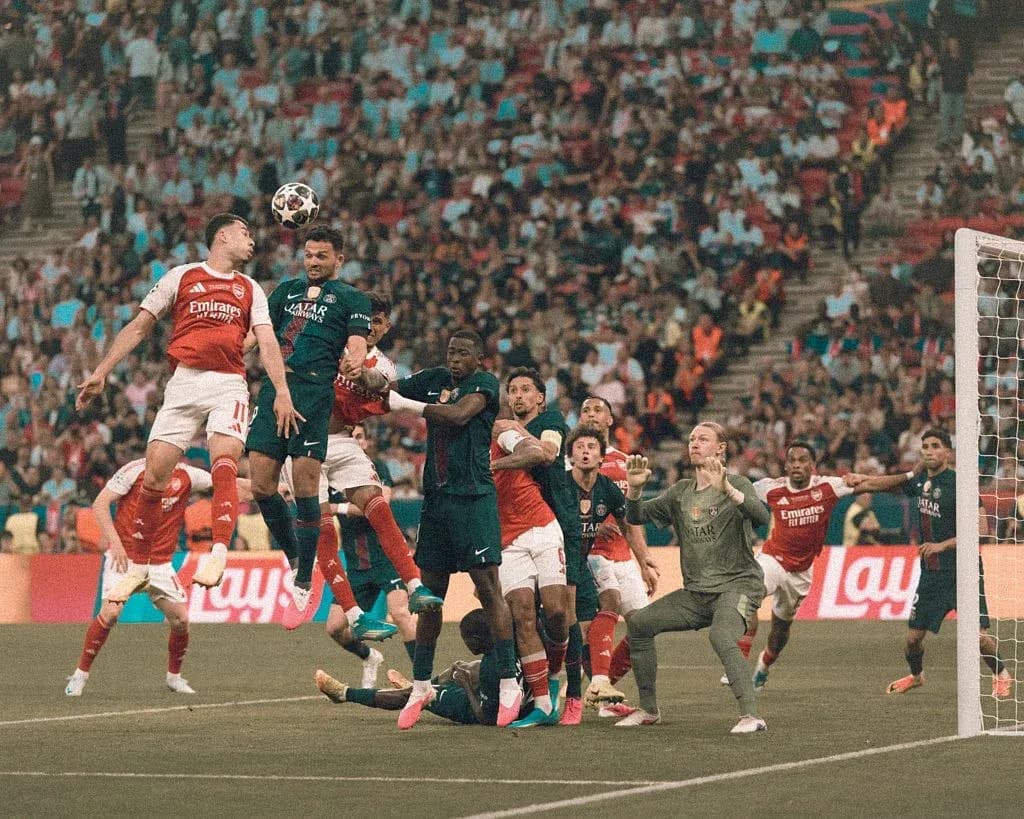
On a late May night in Budapest, PSG kept their hands on the UEFA Champions League trophy, edging Arsenal 4-3 on penalties after a 1-1 draw at the Puskás Aréna. It was a final crackling with tension on the pitch – and quietly rewriting the rules of how the world now watches football off it.
YouGov Sport tracked the audience across four key markets: the UK and France, the finalists’ home territories; Hungary, the host nation; and the United States, where interest in the sport has stayed high during a World Cup summer. Across those countries, the game pulled in a combined audience of 33.7 million.
That headline number, though, wasn’t the real shock. The story lay in how people chose to watch.
Illegal streams eclipse official broadcasters
In the UK, 16.2 million people watched the final via illegal streams. That figure alone outstripped the total audience on official platforms across all four markets, which reached 12.9 million.
The match was not available free-to-air in Britain. Faced with the choice of paying or missing out, millions simply went elsewhere. The UK delivered the largest single-market audience at 19.4 million – but only a small fraction of that came through traditional broadcasters.
Of those 19.4 million viewers, YouGov Sport estimates 16.2 million used illegal streams. Just 3.0 million watched via TNT Sports and HBO Max, while 0.2 million caught the game out of home. France followed with 9.5 million viewers on M6 and Canal+, and the US added 4.8 million across CBS, Univision and Paramount+.
Screens weren’t the only battleground. Profiles data suggests just under 500,000 Arsenal and PSG fans packed into bars and pubs across London and Paris to live every kick together. Inside the Puskás Aréna itself, 61,035 spectators saw PSG’s penalty triumph at close quarters.
The Champions League final has long been a global television event. This one doubled as a stark audit of football’s paywall era.
Arsenal lose the trophy – but their sponsor wins the night
On the scoreboard, Arsenal walked away empty-handed. In the sponsorship game, their front-of-shirt partner did anything but.
YouGov Sport’s Brand Exposure analysis shows Emirates enjoying 2 hours and 52 minutes of on-screen time, with a Brand Impact Score (BIS) of 3.54. PSG’s front-of-shirt sponsor, Qatar Airways, recorded 1 hour and 54 minutes of exposure and a BIS of 3.25.
Those numbers point to a simple truth: Arsenal’s players spent more of the big moments in the camera’s gaze. Attacking moves, last-ditch defending, close-ups of anguish or defiance, slow-motion replays – they all kept the Emirates logo in view.
When the focus tightens, the value rises. Close-ups, replays and prolonged shots of individual players all increase how often and how clearly a sponsor’s branding appears. Across the final, Arsenal’s performance – and the way broadcasters framed it – delivered greater cumulative attention.
Emirates also edged Qatar Airways on exposure quality. Its BIS of 3.54 beat Qatar Airways’ 3.22, driven by a slightly larger logo, stronger prominence on screen, more frequent moments where it appeared alone, and lower levels of surrounding brand clutter. Longer average exposure per appearance added extra weight to each sighting.
Put together, those details meant Emirates’ branding cut through more sharply whenever it appeared. For brands weighing up multi-million shirt deals, that’s a powerful lesson: a compelling, dramatic display from the losing side can still produce richer commercial returns than a low-profile victory.
Forty-two billion impressions: a final that wouldn’t switch off
The noise didn’t fade when the trophy left the podium.
Across just 48 hours – 30 and 31 May – the Champions League final sparked more than 40,500 social media posts, 13,700 videos and 24,500 online articles. That avalanche of content translated into 42 billion potential impressions, 1 billion video views and 10 billion in potential readership.
PSG, fuelled by the glow of victory and a heavier content push, dominated the digital conversation. The French champions generated 8.6 billion impressions and 418.6 million video views across their official social media accounts. Arsenal, beaten but far from ignored, produced 3.7 billion impressions and 49.7 million video views.
PSG’s larger output simply reached further, stretching the impact of their win far beyond Budapest. The club didn’t just lift a trophy; it owned the feeds.
How fans feel about the brands on their shirts
Sponsorship isn’t only about being seen. It’s also about being liked – and recommended.
Using YouGov BrandIndex, analysts compared Recommendation levels for Emirates among Arsenal supporters in the UK and Qatar Airways among PSG supporters in France with those brands’ scores in the general population. In both cases, club fans were significantly more likely to recommend the sponsor than the wider public, underlining how tightly those brands are now woven into club identity.
Around the time of the final, Emirates recorded an increase in Recommendation among Arsenal supporters. The match itself, the run to Budapest, and broader club narratives all play their part, so the uplift can’t be pinned solely on one night. Qatar Airways, by contrast, maintained consistently strong Recommendation levels among PSG supporters across the measured period.
Those shifts matter. Through YouGov Sport’s BIS‑X framework, raw exposure is combined with fan perception and broader brand health to capture how positive sentiment can magnify the value of a sponsorship. The stronger uplift among Arsenal fans suggests Emirates gained not only from superior visibility during the final, but also from intensified fan advocacy – the kind of emotional backing that turns screen time into long-term equity.
Beyond counting eyeballs
This final underlined a hard reality for modern sponsorship: audience totals and logo counts no longer tell the full story.
Illegal streams in record numbers, an official audience spread across pay platforms, a stadium packed to the rafters, pubs overflowing in two capitals, billions of social impressions, and measurable shifts in how fans talk about the brands on their shirts – each piece reveals a different angle of the same night.
For clubs and sponsors, the question is no longer just “How many watched?” It’s “How did they watch, what did they notice, and how did it make them feel?”
In a sport where access is splintering and attention is fought for on every screen, the brands that truly win will be those that can turn a tense 90 minutes – and a nervy penalty shootout – into something that lives on in the data, in the feeds, and in the minds of the fans long after the confetti has been swept away.





