
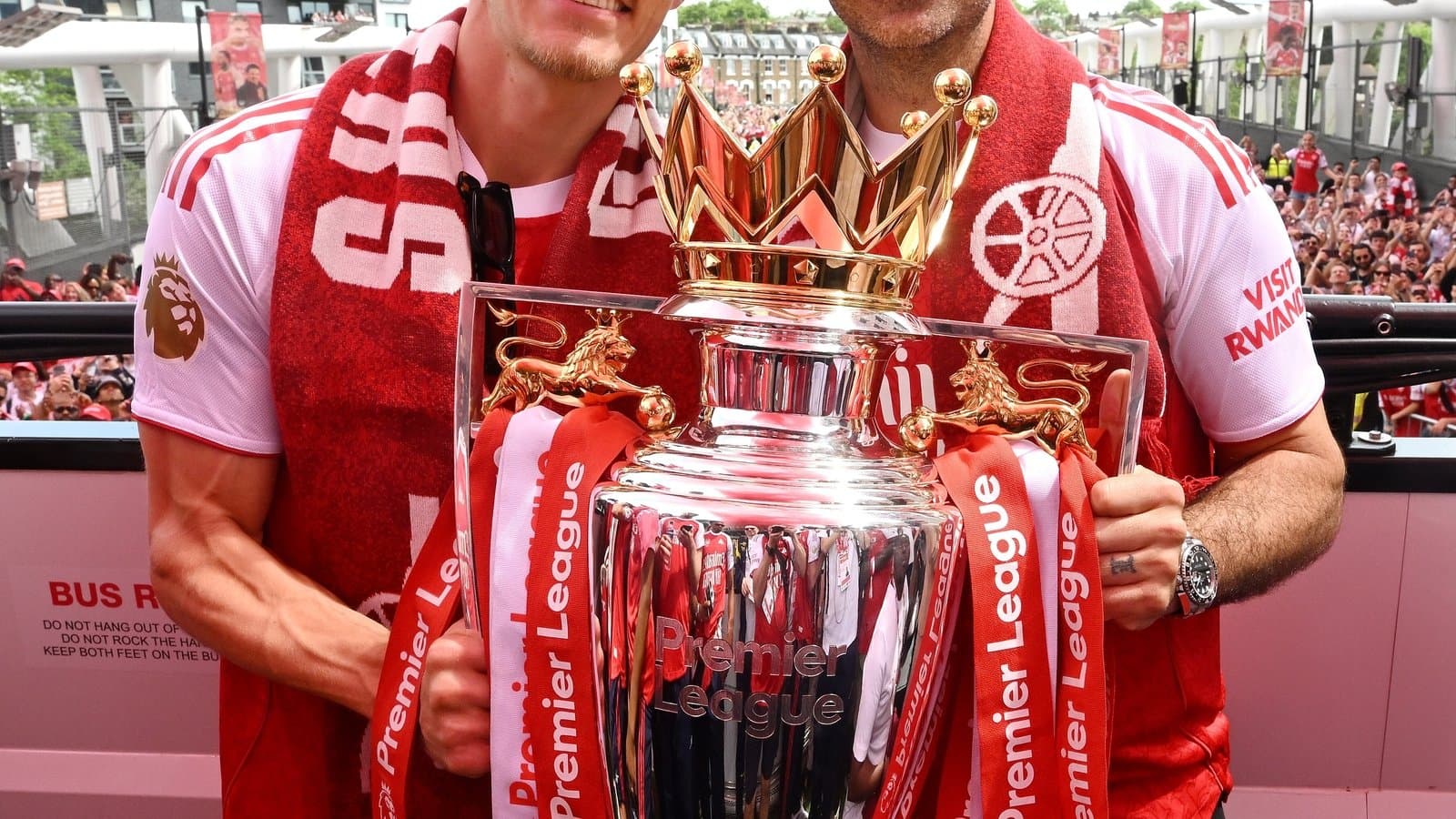
Premier League Trophy: A 22-Year Wait Ends
The Premier League trophy finally belongs to them again, back in their hands after a 22-year wait to finish top of the table. Under the lights at Selhurst Park last month, Martin Ødegaard raised it high, gold glinting against the night as teammates roared around him. Days later, it rolled through the streets on an open-top bus, held out to a sea of supporters who had spent more than two decades imagining that moment.
Now it rests in the club’s cabinet. Heavy. Regal. And full of history.
A trophy with real weight
Every player wanted a turn with it, and you understand why once you know what they were lifting. The Premier League trophy alone comes in at 9.5kg – around 1.4 stone. Enough to feel it in your shoulders when you drive it skywards for the cameras.
Add the engraved base and the load jumps. Together, trophy and base weigh 25.4kg, or 4 stone. No wonder captains often take a deep breath before that iconic lift. It is not just the pressure of the moment. It is the sheer physical heft of English football’s most coveted prize.
Taller than it looks on TV
On television, the trophy can seem almost modest, dwarfed by players and pyrotechnics. Up close, it’s anything but.
From the bottom of its engraved base to the tip of the crown, the Premier League trophy stands 104cm tall – around 3ft 5in. Across, it measures 61cm, or 2ft wide. Broad-shouldered, imposing, built to dominate a podium just as champions dominate a season.
And there is not just one of them.
There are actually two identical Premier League trophies. Both carry the roll call of champions around the bottom of the base. One lives with the reigning title-winners during the campaign. The other stays in the hands of the league, ready for official duties, ceremonies, and that final-day drama when two clubs might still be in contention.
Built like a crown jewel
The base tells the story. Every champion since 1993 is etched into it, a timeline that now stretches all the way to the club’s own triumph in 2025/26. One glance at that ring of names, and you see the eras of dominance, the upsets, the dynasties.
The material itself carries meaning. The base is crafted from malachite, a semi-precious stone sourced from Africa. Its deep green ring around the opaque stone is no accident; it represents the pitch, the field of play where all those titles are won and lost.
Above it, the main body of the trophy is cast by Asprey London, the Crown Jewellers. Solid sterling silver forms its structure. The crowns that sit on top are made from 24-carat silver gilt, giving that unmistakable golden finish that glows under floodlights and flashbulbs.
The design follows a clear theme: “The Three Lions of English Football.” Two golden lions stand proud on either side of the trophy. The third? That’s the captain. In the moment he grips the handles and hoists the trophy into the air, he completes the trio, becoming the living embodiment of English football’s symbol.
How long does it stay?
For now, one of the two trophies belongs to the champions. It will sit in their possession throughout the season – in the stadium, in the museum, on tours, in photos that will define an era.
But it is never theirs forever.
The Premier League requires the trophy to be returned at least three weeks before the final league match of the season. At that point, it goes back into neutral hands, ready for the next coronation, the next captain to step up as the “third lion.”
Until then, it remains where the players and supporters always believed it should be: in their colours, in their cabinet, and at the heart of a title defence that now has a very real, very heavy centrepiece.





