Sturm Graz vs Fenerbahçe Tactical Analysis: 1-0 Win Insights
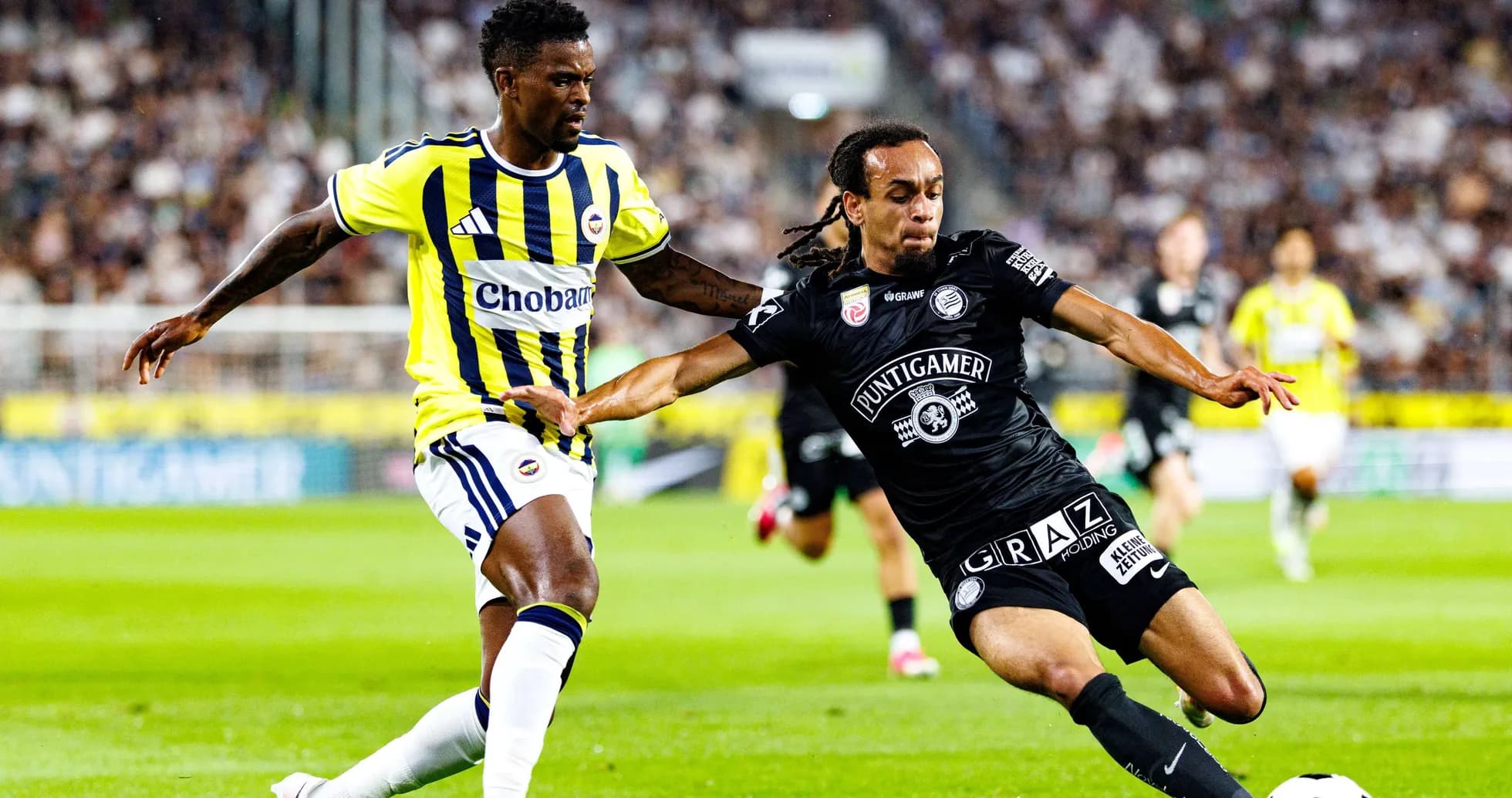
Sturm Graz approached the first leg at Merkur Arena in a proactive 4-4-2, trying to turn territorial parity into volume rather than precision. Their 19 total shots to Fenerbahçe’s 11 underline that intent, but the shot profile exposes the key tactical gap: only 6 of those efforts came from inside the box and just 2 tested the goalkeeper. Fenerbahçe, in a 4-2-3-1, were more selective and structurally stable, generating 8 shots inside the box and 6 on target from a lower overall volume, and ultimately leveraging that efficiency to secure a 1-0 away win via Talisca’s penalty.
Out of Possession
Out of possession, Sturm Graz’s 4-4-2 block was honest but not fully synchronized. The front two, A. Kayombo and S. Jatta, worked to screen Fenerbahçe’s double pivot of N. Kanté and M. Guendouzi, but the visitors’ midfielders were usually able to receive under manageable pressure and circulate. The hosts’ back four—A. Malic, J. Mitchell, P. Petrovic, and E. Soglo—were forced into repeated last-line interventions, reflected in the 9 blocked shots. That number speaks to commitment and compactness around the box, but also to Fenerbahçe’s ability to progress into advanced shooting zones despite equal possession (50%-50%).
On the Ball
On the ball, Sturm Graz tried to build with a balanced passing structure: 383 total passes with 311 accurate (81%) show they were technically clean enough to sustain attacks. The wide midfielders, L. Weinhandl and J. Hödl, along with full-backs Malic and Soglo, were key to stretching Fenerbahçe horizontally, which helped generate 7 corners. Yet the final-third execution lagged behind the approach play. Many of Sturm’s 13 shots from outside the box came from moments when Fenerbahçe’s block refused to break, forcing low-percentage attempts rather than penetrative combinations into the area.
Fenerbahçe’s Control
Fenerbahçe’s 4-2-3-1 was built on control through the spine. N. Kanté and M. Guendouzi formed a disciplined double pivot, screening central spaces and guiding Sturm’s attacks toward the flanks. In front of them, M. Greenwood, M. Asensio, and Kerem Aktürkoğlu supported Talisca, providing both width and interior passing lanes. The visitors’ 397 passes with 318 accurate (80%) and the identical 50% share of possession indicate a match played largely on their terms in terms of tempo: they did not dominate the ball, but they consistently found better positions when they had it.
Penalty and Tactical Advantage
The penalty at 66' was the natural product of Fenerbahçe’s ability to reach the box more cleanly. With 8 shots inside the area against Sturm’s 6, their attacks were more vertical and incisive once the first line was broken. Talisca’s role as the focal point in the 5:1 grid gave them a reliable target between and beyond Sturm’s centre-backs, and the wide trio’s movements—especially Aktürkoğlu’s from the left and Greenwood’s from the right—stretched the back four enough to create isolation and mismatches.
Defensive Aggression
In terms of defensive aggression, the foul count (Sturm Graz 12, Fenerbahçe 13) and card distribution (Sturm 1 yellow, Fenerbahçe 3 yellows) show that the visitors were prepared to disrupt rhythm higher up the pitch. Nélson Semedo and Archie Brown both went into the book for “Foul” before half-time, illustrating how Fenerbahçe’s full-backs were often exposed to one-v-one situations against Sturm’s wide players and accepted tactical fouls to prevent transitions. Kerem Aktürkoğlu’s late yellow, also for “Foul”, underlined the collective commitment to protecting the 1-0 lead in the closing stages. For Sturm, Jeyland Mitchell’s booking, again for “Foul”, reflected the strain on the central defence as they pushed numbers forward and left more space to defend in isolation.
Substitution Patterns
The substitution pattern from minute 61 onward reveals the contrasting game states. Sturm Graz made a triple change at 61', with B. Beganovic (IN) coming on for S. Jatta (OUT), J. Heil (IN) for A. Malic (OUT), and N. Weiper (IN) for A. Kayombo (OUT). Fabio Ingolitsch effectively retooled the front line and right side, seeking more dynamism and fresh legs to chase the game. Later, R. Fosso (IN) replaced J. Gorenc Stankovic (OUT) at 70', and P. Koller (IN) came on for P. Petrovic (OUT) at 79', further tilting the structure toward risk and attacking impetus.
By contrast, Ismail Kartal’s changes were about maintaining balance and energy while preserving structure. At 62', M. Muldur (IN) replaced N. Semedo (OUT), adding defensive solidity at right-back after a booking. Fred (IN) for M. Asensio (OUT) and O. Aydin (IN) for M. Greenwood (OUT) at 63' shifted the attacking midfield line toward more work rate and ball security. I. Yuksek (IN) for N. Kanté (OUT) at 73' refreshed the defensive midfield screen, and V. Muriqi (IN) for Talisca (OUT) at 77' provided a physically robust outlet to help manage the final phase under pressure.
Goalkeeping Performance
In goal, D. Khudyakov (Sturm Graz) registered 5 saves, underscoring Fenerbahçe’s superior shot quality and the number of times they broke into dangerous positions despite not dominating possession. At the other end, M. Günok (Fenerbahçe) needed only 2 saves, a direct reflection of how effectively the Turkish side limited Sturm’s clear chances. Sturm’s 19 shots look imposing on paper, but Fenerbahçe’s compact block and central protection kept most of them from becoming high-probability opportunities.
Overall Analysis
Overall, the tactical story is of a Sturm Graz side that matched Fenerbahçe in possession and passing accuracy, generated more total shots, and defended their box bravely, but lacked the structural tools to consistently access prime scoring zones. Fenerbahçe, with a well-drilled 4-2-3-1, superior box occupation, and intelligent game management through substitutions and controlled fouling, converted a balanced territorial contest into a high-value 1-0 away win in this 3rd Qualifying Round tie.