Premier League Dominance: Champions Arsenal and the Talent Drain
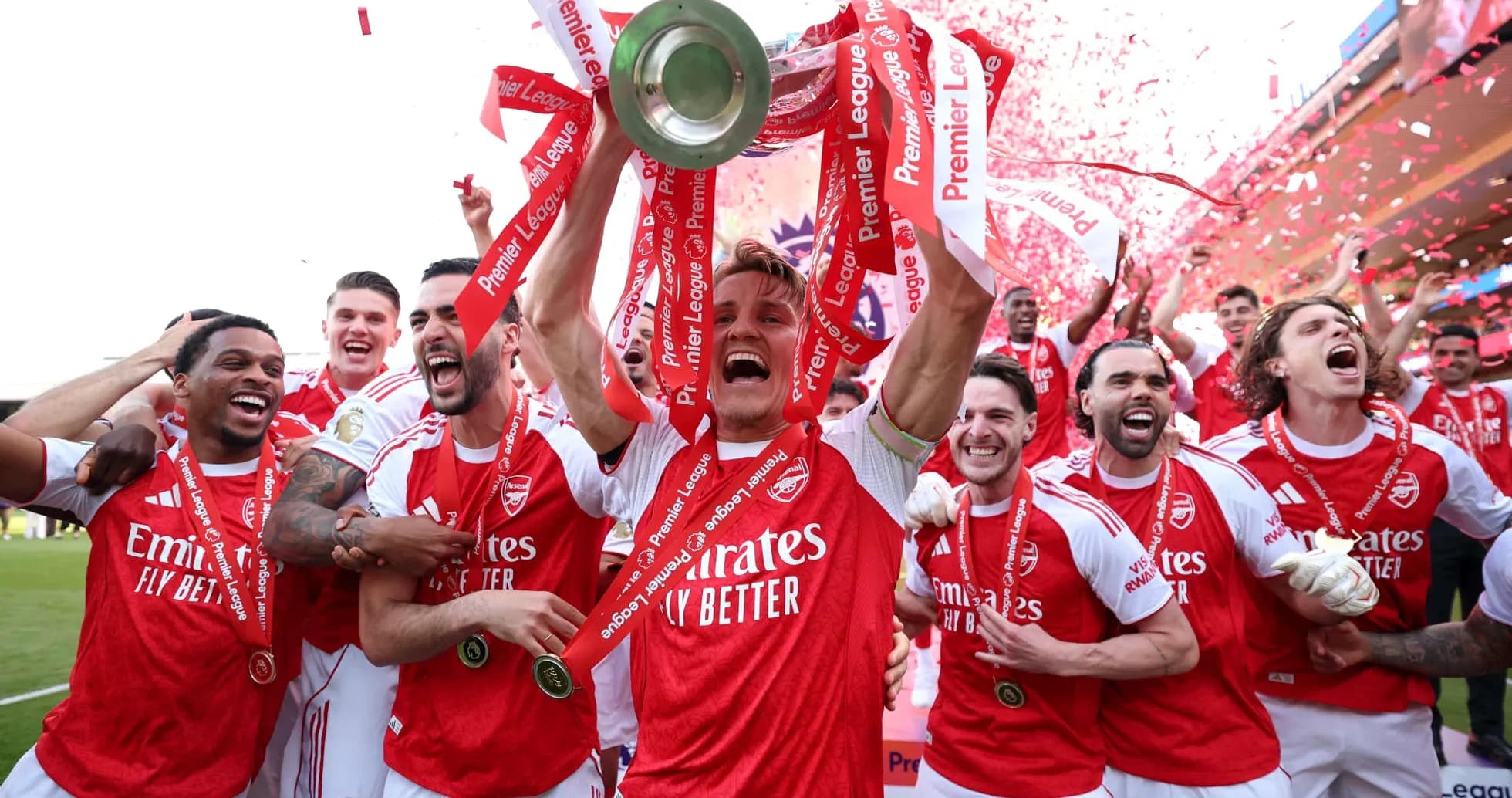
Martin Odegaard hoisted the Premier League trophy into the Selhurst Park sky and, for a moment, English football looked untouchable. Arsenal, champions again after 22 long years, back on top with a 14th league title. A third different winner in three seasons, following Liverpool and Manchester City. A vibrant, rotating cast at the summit.
From the outside, it feels like confirmation of a familiar story: the Premier League as Europe’s unforgiving, irresistible super-league.
The strongest show in town
The numbers back up the swagger. England’s top flight has become the benchmark for competitive balance at the elite end. While Arsenal, Liverpool and City have taken turns with the trophy in the last three campaigns, the rest of Europe’s giants have settled into predictable patterns.
Spain, the next richest league, has been stitched up almost exclusively by Barcelona and Real Madrid. They have claimed 20 of the last 22 titles, a stranglehold that has reduced La Liga’s title race to a two-club argument most seasons.
Germany? Bayern Munich have collected 13 of the last 14 Bundesliga crowns, a run that has defined an era. In France, Paris Saint-Germain have turned Ligue 1 into their private playground, winning eight of the last nine titles.
Only Italy’s Serie A offers anything resembling the Premier League’s churn at the top, with Juventus, Inter Milan, AC Milan and Napoli all taking a turn as champions over the last seven years. There, at least, the crown moves around.
On the European stage, English clubs have matched that domestic strength with trophies. Only a penalty shootout defeat for Arsenal against PSG in last weekend’s Champions League final stopped a clean sweep. Aston Villa and Crystal Palace had already banked the Europa League and Europa Conference League, while Chelsea still hold FIFA’s Club World Cup.
The financial power is just as stark. The Premier League’s broadcast deals, at home and abroad, dwarf those of its rivals. English clubs dominate Deloitte’s latest money rankings, taking half of the top 30 slots by revenue. Even AFC Bournemouth, Brentford and Brighton & Hove Albion – hardly global super-brands – sit among the sport’s financial heavyweights.
On the surface, it looks like an empire in full bloom.
The talent drain behind the gloss
Scratch at that glossy exterior and the picture changes. The league that hoovers up the world’s stars is now losing some of its own. A growing number of England’s leading players are choosing to build their careers abroad.
Harry Kane, the England captain, left for foreign football. Last week, Anthony Gordon departed Newcastle United for Barcelona. With that move, six members of England’s squad for the forthcoming World Cup now play outside the country.
For generations, an English player being wanted by Real Madrid or AC Milan felt like a badge of honour for the domestic game. Now, the volume of departures has started to worry those who watch the sport’s deeper currents.
Martin Samuel of The Times captured that unease. He noted how the national mood has shifted from pride to concern as “almost a quarter of the group” now plays overseas, calling it “a talent drain” and warning that it would be less troubling if equivalent quality were flowing back into the Premier League.
The league still buys big. It still pays big. But the outbound line at the departure gate is longer than it used to be.
Rich league, fragile clubs
The financial story is just as jarring once you step away from the headline numbers. Revenues are enormous, yet profitability is rare. In the most recent season with full accounts available, only four Premier League clubs – Newcastle, Aston Villa, Bournemouth and Liverpool – actually turned a profit.
The rest live closer to the edge than their global branding suggests.
Drop down the pyramid and the picture darkens. A series of clubs have fallen into administration in recent years, including storied institutions such as Derby County and Sheffield Wednesday. These are not obscure outfits on the margins of the game; they are pillars of English football history, pushed into crisis by the modern economics of the sport.
Plenty of clubs now lean on creative accounting to stay within financial fair play rules. Sale-and-leaseback deals on stadiums and training grounds, short-term fixes dressed up as strategy, have become tools to avoid sanctions. The rules are designed to stop a handful of ultra-wealthy owners – including sovereign wealth funds – from inflating transfer fees and wages to unsustainable levels while rivals scramble to keep up.
The intention is competitive balance and financial sanity. The reality is a system that encourages clubs to test the limits.
And the pool of owners willing to play that game might be shrinking.
Relegation’s chill factor
Tottenham Hotspur, one of the six clubs that flirted with the breakaway European Super League in 2021 before a furious supporter backlash killed it, spent this season staring over the edge. They only narrowly avoided relegation.
West Ham United, the Premier League’s eighth-longest serving club and ranked 20th in Deloitte’s Money League, were not so fortunate. They went down.
Those two stories matter far beyond their own fanbases. They send a clear, cold message to potential investors – particularly those from American sports, where the concept of relegation simply does not exist. You can buy into a global brand, pour in capital, grow revenues, and still find yourself in the second tier within a year.
Samuel pointed out that Liverpool, Manchester United, Crystal Palace, Chelsea and Newcastle are all, “in one way or another, all for sale.” Against that backdrop, he argued, prospective owners will “observe the fate of West Ham, and the near-miss at Tottenham, and shiver.”
You suspect the Premier League hierarchy felt that same chill.
The trophy in Odegaard’s hands told one story: a league of drama, depth and rotating champions, backed by unmatched wealth and European success. The balance sheets, the talent drain and the jeopardy of the drop tell another.
How long can English football keep living both stories at once?