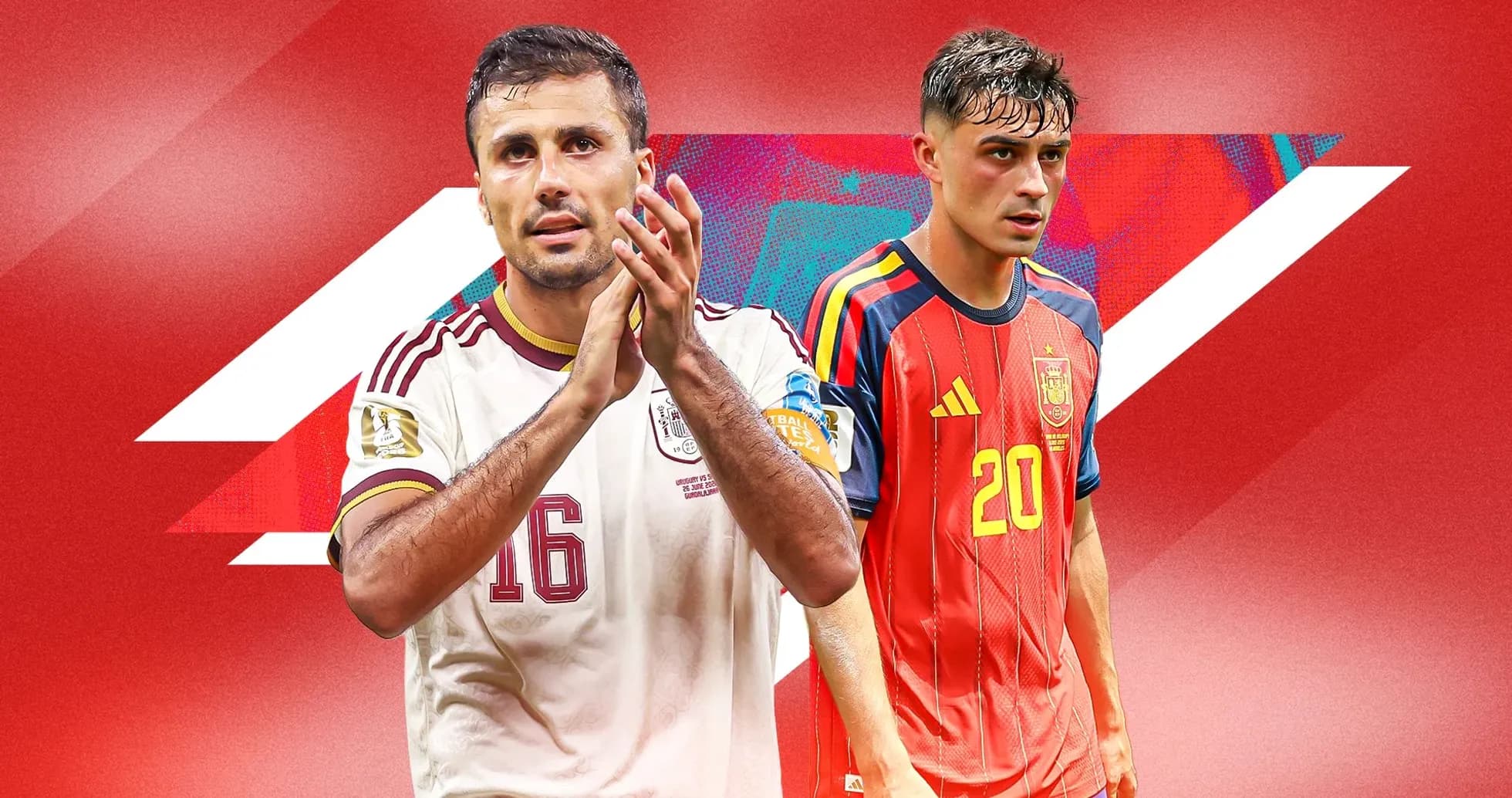
Pedri's World Cup Journey: From Expectations to Reality
Rodri has spent this World Cup reminding everyone why he walked off with the Ballon d'Or. Pedri, the other half of Spain’s supposed dream double act, has spent it under a microscope.
Two years ago in Germany, that central pairing looked like the foundation of an era. Rodri the metronome, Pedri the artist. Put them together, the theory went, and Spain could stack a world title on top of their European crown. In North America, only half of that equation has truly landed.
Pedri’s tournament began with numbers that usually silence critics. Against Cape Verde in Spain’s underwhelming, scoreless opener, the Las Palmas product carved out five chances – more than anyone else on the pitch. On paper, that’s control, creativity, influence. Back home, it was framed as failure. He hadn’t dragged Spain to victory. For a player who has lived with sky‑high expectations since his teenage years, this is the standard now: create the most and still get questioned.
Cape Verde’s subsequent results have softened the glare on that draw, but not on Pedri. The longer the World Cup has gone on, the louder the talk about his lack of goals and assists. No end product, no mercy.
The comparison was inevitable. Jude Bellingham is tearing through this tournament, deciding games with the swagger of a man who owns the stage. Pedri is operating deeper, in a different role, in a different system, yet that nuance has been drowned out by the noise. For many Real Madrid fans, it has been an open goal: their man “lighting up” the World Cup while Barcelona’s chief creator struggles to leave fingerprints on matches.
It is a crude, reductive argument, but the modern game feeds on the bottom line. Bellingham scores and creates. Pedri, so far, does neither.
That is why Luis de la Fuente’s decision to drop Pedri still jolted, even if the logic held. Five consecutive starts at this World Cup, nine in a row stretching back to Qatar, and suddenly he was sitting down. Spain’s coach, though, has a luxury that demands ruthless choices: a midfield overflowing with elite options.
He even pointed out that Mikel Merino had more reason than most to knock on his door. The Arsenal midfielder had been left on the bench again despite scoring a late winner against Portugal in the previous round. Merino did not sulk. He simply came on against Belgium and did it again in a 2-1 victory.
“It’s unfair that Mikel doesn’t play from the start, but it would also be unfair if someone else were left out,” De la Fuente said. “Only 11 can play, and they understand that – the role they have to play at any given moment. When they take to the pitch, they know what they have to do; that’s why it’s a pleasure to be their manager.
“What matters is the team. It doesn’t matter who starts the match. Everyone is important, even those who haven’t played.”
There has been no hint that Pedri has reacted badly to being sacrificed. No sulking, no public frustration. Unai Simon made that clear after the Belgium game.
“He’s taken it well,” the goalkeeper said. “We all want to play but, in the end, there isn’t room for everyone.
“How must David (Raya) and Joan (Garcia) feel knowing they’re world-class goalkeepers? Everyone wants to play, but everyone wants to win the World Cup. So, when it’s your turn to accept that role, you do it.”
The question now is what role Pedri is trusted with against France.
His audition off the bench in Los Angeles did not strengthen his case. Spain had a late breakaway to kill Belgium off; Pedri, usually so precise, misjudged the pass and the chance fizzled out. It was a moment that jarred precisely because he so rarely miscalculates. At the same time, Fabian Ruiz had already seized his opening, scoring Spain’s first goal and delivering the kind of all‑round display that makes it very hard to justify leaving him out.
Simon did not hold back in his assessment of the Paris Saint‑Germain midfielder either, calling him “an immense talent” and reminding everyone that he has “won two Champions Leagues in a row”.
De la Fuente knows what he has in Pedri, though. On his day, the 21‑year‑old is a joy to watch. Few midfielders combine his knack for regaining possession with such clean, incisive distribution. Yet this has not been his World Cup so far, and the coach has hinted at a deeper tactical truth: there is a Spain version of Pedri, and a Barcelona version.
“Pedri is a class player, one of the best in the world, if not the best,” De la Fuente said. “But Fabian is also one of the best players in the world if not the best.
“But Pedri can’t play like he does for Barca, because we play differently. We have similarities, but it’s not the same. We don’t have the same players either.
“We have Rodri, so of course his partner in midfield is different. For me, Pedri could play as a 6, 8, or 10, but we have to make decisions that are always very elaborate, very analysed, very tailored to the opponent.”
France are that opponent now, and the decision in midfield could tilt the semi-final.
One route is bold and familiar: Rodri flanked by both Fabian and Pedri, as in the Cape Verde game. If Spain have a clear edge over Didier Deschamps’ side anywhere, it is in the middle of the pitch. Flooding that zone with three technically supreme midfielders would give La Roja a real chance of hoarding the ball, which remains their most reliable way of dulling the threat of France’s devastating front four.
The trade-off is obvious. Start Pedri and Fabian and Dani Olmo probably sits. The Leipzig man has quietly built a compelling case in the No.10 role since the knockouts began. His final ball is still not as sharp as it could be, but his movement, pressing and ability to connect lines have given Spain a different dimension between the lines.
De la Fuente has called Pedri a “special talent” and has been clear about where he prefers him.
Closer to the opposition box. That is where the feints, flicks and one‑twos inflict the most damage. That is where the Barcelona Pedri lives. The coach has also praised him for “always setting a very good tone, whether he’s in top form or not”, a nod to his capacity to dictate tempo even on quieter nights.
Yet his most telling comment came after Belgium, when he hinted that the current plan is to unleash Pedri later, not sooner.
“Pedri could benefit from Fabian’s work,” De la Fuente said. “It’s essentially teamwork.”
In other words, let Fabian soften opponents, stretch them, run them, and then bring on Pedri when spaces appear and tired legs start to lag. It is a ruthless use of resources, and it underlines what may be Spain’s greatest strength at this tournament: a squad full of players willing to subjugate ego for the collective.
“France have already shown some extraordinary, exceptional potential, but we have too, so I think the game is very open,” De la Fuente said. “It will require fresh, energetic players, and it will require us to be the best version of ourselves.”
The best version of Spain might still involve the best version of Pedri. The question hanging over this semi-final is simple: will the world see the Barcelona Pedri at last, or will his World Cup remain a story of what he could have been to this team rather than what he actually was?