Nottingham Forest vs Bournemouth: Tactical Balance in 1-1 Draw
Nottingham Forest and Bournemouth produced a tactically balanced 1-1 draw at City Ground, a match that neatly reflected their contrasting game plans: Forest’s direct 4-4-2 verticality against Bournemouth’s more controlled 4-2-3-1 possession structure. The result aligned closely with the underlying numbers (Forest 1.87 xG, Bournemouth 1.00 xG), suggesting a contest where Forest created the slightly better chances despite having less of the ball.
Forest, under Vitor Pereira, set up in a classic 4-4-2 with M. Sels in goal, a back four of N. Williams, Morato, N. Milenkovic and Cunha, a midfield line of O. Hutchinson, I. Sangare, E. Anderson and M. Gibbs-White, and a front two of Igor Jesus and C. Wood. The structure was clearly designed to compress central spaces and then break quickly through the wide midfielders and Gibbs-White drifting between the lines. Their 45% possession combined with 15 total shots (10 inside the box) shows a deliberate plan: concede territory, but ensure that when they did attack, they carried real penalty-area threat.
Bournemouth, coached by Andoni Iraola, lined up in a 4-2-3-1 with D. Petrovic in goal, A. Smith, J. Hill, M. Senesi and A. Truffert in defence, a double pivot of A. Toth and T. Adams, and an attacking trio of Rayan, E. J. Kroupi and M. Tavernier behind Evanilson. Their 55% possession, 483 total passes and 84% passing accuracy underline a more patient, circulation-based approach, looking to move Forest’s 4-4-2 block laterally and find pockets for Tavernier and Kroupi. However, with only 6 shots inside the box from 17 attempts, much of their shooting volume came from less dangerous zones, reflected in the lower 1.00 xG.
First Half
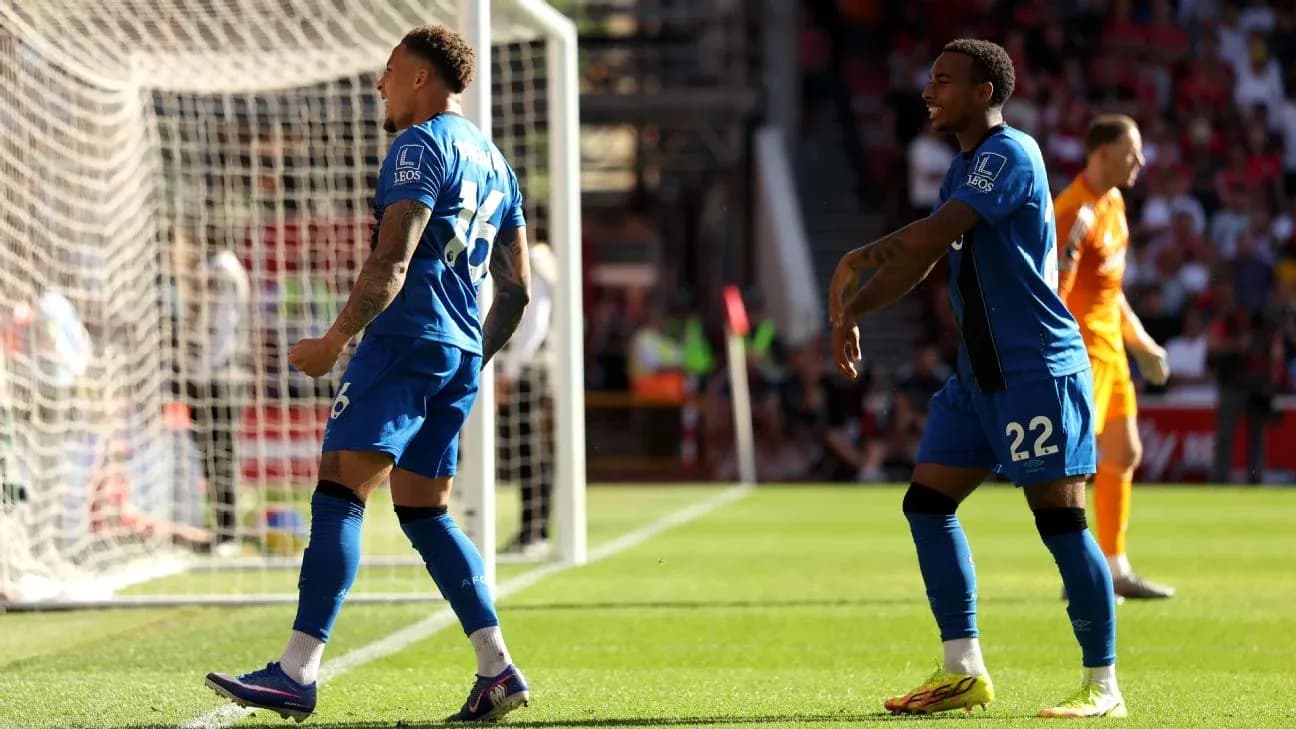
The first half followed Forest’s script. They accepted Bournemouth’s build-up, defended in two compact banks of four, and targeted transitions. The breakthrough at 34' – M. Gibbs-White finishing after an assist from O. Hutchinson – was a direct expression of that plan: Gibbs-White exploiting the half-space from his nominal wide-midfield starting point, Hutchinson attacking from the opposite flank. Forest’s shot profile in the opening period, with a strong concentration inside the area, showed how effectively they used early passes into the front two and late midfield runs rather than long sterile spells of possession.
Out of possession, Forest’s 11 fouls to Bournemouth’s 7 illustrate how aggressively they protected central zones. The 4-4-2 line often narrowed, inviting Bournemouth to play wide and then contesting crosses with the aerial presence of Milenkovic and Morato. The fact that Bournemouth needed 17 shots to reach just 1.00 xG suggests Forest’s defensive line management and box protection were largely effective, even if they did concede the equaliser.
Bournemouth's Attacking Pattern
Bournemouth’s attacking pattern relied heavily on full-back progression and rotations in the left channel. A. Truffert’s involvement is underlined by his assist for M. Tavernier’s 54' goal, a move that typified Bournemouth’s best moments: overload on the flank, pull Forest’s back four across, then find a late-arriving attacker in a better shooting lane. Tavernier’s positioning as the left-sided playmaker in the three behind Evanilson was crucial; he frequently drifted inside to become a second 10, trying to overload Sangare and Anderson between the lines.
Second Half Substitutions
The substitutions around the hour mark subtly shifted the tactical battle. For Forest, T. Awoniyi (IN) came on for C. Wood (OUT) at 62', adding more depth-running and physicality against a Bournemouth defence that preferred to hold a mid-block. Shortly after, L. Netz (IN) for Cunha (OUT) and R. Yates (IN) for E. Anderson (OUT), along with N. Dominguez (IN) for I. Sangare (OUT) at 65', refreshed both the left flank and central midfield. These changes aimed to restore intensity in the press and offer more thrust on the counter after Bournemouth had started to dictate tempo following their equaliser.
On Bournemouth’s side, B. Gannon-Doak (IN) for A. Toth (OUT) at 57' and later E. Unal (IN) for Evanilson (OUT), J. Kluivert (IN) for E. J. Kroupi (OUT), and A. Adli (IN) for Rayan (OUT) at 73' represented a clear shift towards more attacking profiles in the final third. Iraola sacrificed some midfield control to chase more penetration and individual creativity. However, the underlying numbers – 4 shots on goal, 7 blocked – indicate that while Bournemouth increased volume, Forest’s block continued to get bodies in the way, keeping shot quality modest.
Goalkeepers' Performance
In goal, M. Sels (Nottingham Forest) made 3 saves, mirroring D. Petrovic (Bournemouth), who also recorded 3 saves. The symmetry in saves, combined with Forest’s higher xG and Bournemouth’s territorial edge, underlines how both goalkeepers were tested in different ways: Sels facing fewer but relatively concentrated chances, Petrovic dealing with Forest’s more incisive box entries despite their lower possession. The negative goals prevented figure for both teams (-0.5 each) suggests each goalkeeper conceded slightly more than the post-shot models expected, reinforcing the idea that finishing, rather than extraordinary goalkeeping, shaped the 1-1 outcome.
Discipline and Statistics
Discipline played a minor but telling role in the game’s rhythm. James Hill’s yellow card for “Foul” at 33' came just before Forest’s opener, hinting at Bournemouth’s difficulty coping with Forest’s transitional threat down that side. Later, Taiwo Awoniyi’s yellow, also for “Foul” at 67', reflected Forest’s increasing need to disrupt Bournemouth’s growing control after the equaliser. With only one yellow card per side and no reds, neither team’s tactical plan was significantly distorted by disciplinary issues.
Statistically, Forest’s 396 passes, 307 accurate at 78%, underscore their more direct, risk-tolerant approach. They were prepared to play forward quickly, accept lower completion, but turn those possessions into meaningful entries: 10 shots inside the box, 5 on target, and 6 corners. Bournemouth’s 483 passes, 405 accurate at 84%, show cleaner circulation, but the lower box presence (6 shots inside) and fewer corners (3) reveal that their possession did not always translate into high-quality territory.
Conclusion
In tactical terms, the draw feels fair. Forest executed a compact, transition-focused 4-4-2 that maximised the influence of Gibbs-White and Hutchinson, while Bournemouth’s 4-2-3-1 delivered control and a well-crafted equaliser through Truffert and Tavernier. The xG split, the even save counts, and the modest disciplinary profile all point to a finely balanced contest where structure and game plans largely cancelled each other out, leaving both sides with a point that mirrors the tactical equilibrium on the pitch.