
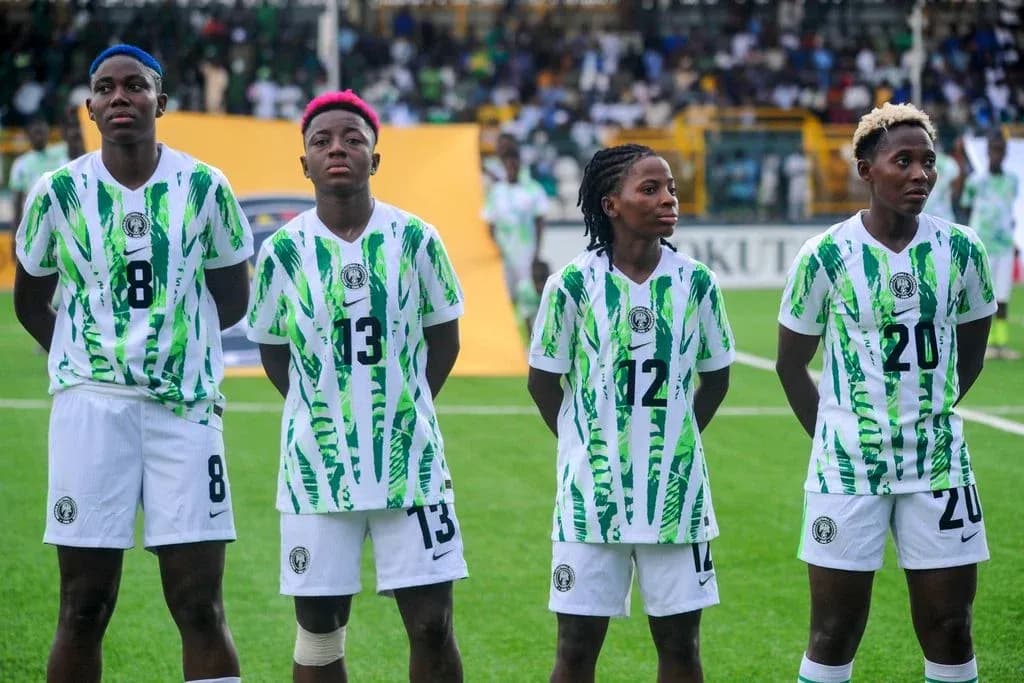
Nigeria’s Super Falcons Unveil WAFCON 2026 Squad
Nigeria’s Super Falcons have drawn back the curtain on their WAFCON 2026 plans, naming a 25-woman squad aimed squarely at extending their dominance over African women’s football.
This is not a rebuild. It is a reload.
Ajibade leads, Oshoala returns, Plumptre misses out
Head coach Justine Madugu, through the Nigeria Football Federation, has gone for a familiar spine with a few fresh edges. Captain Rasheedat Ajibade will carry the armband and much of the creative burden, while six-time African Women’s Player of the Year Asisat Oshoala is back to spearhead the attack.
In goal, there was never much doubt. Chiamaka Nnadozie, outstanding for Brighton & Hove Albion and a consistent match-winner for the national team, remains the undisputed No. 1. She is backed up by Portsmouth Ladies’ Comfort Erhabor and Abia Angels’ Fatima Oloko, a trio that blends European experience with domestic sharpness.
One notable absence jumps off the page. Star defender Ashleigh Plumptre does not make the cut as she continues her recovery from surgery, a significant loss for a back line that has leaned on her composure and distribution in recent years.
A squad built to defend a crown
Nigeria arrive in Morocco as the benchmark. Ten continental titles already, and the reigning champions after edging hosts Morocco 3-2 in the last final. No other side in African women’s football carries that kind of history, or that kind of expectation.
Madugu has gone with balance: three goalkeepers, eight defenders, five midfielders and nine forwards. On paper, it is a squad designed to dominate the ball and overwhelm opponents high up the pitch.
The defence mixes hardened campaigners with emerging talent. Osinachi Ohale and Michelle Alozie bring big-tournament nous, while Oluwatosin Demehin, Rofiat Imuran, Shukurat Oladipo, Glory Ogbonna and Sikiratu Isah add legs and versatility across the back line. Christy Ucheibe, listed among the defenders, offers a physical presence who can step into midfield when needed.
In the engine room, Ajibade is more than just captain; she is now one of Africa’s most influential players, capable of dictating tempo or breaking lines with late runs. Around her, Halimatu Ayinde, Deborah Abiodun, Toni Payne and Jennifer Echegini provide a strong blend of ball-winning, passing range and forward thrust. It is a unit built to control games rather than simply react to them.
Then comes the firepower.
Oshoala headlines a fearsome attacking cast that includes Folashade Ijamilusi, Esther Okoronkwo, Chinwendu Ihezuo, Francisca Ordega, Gift Monday, Uchenna Kanu, Omorinsola Babajide and Joy Omewa. There is pace, aerial threat, one‑v‑one dribblers, penalty-box predators. On their day, this group can shred almost any defence on the continent.
Many of these players arrive from Europe’s top leagues, others from North America, Asia and the Nigerian Women’s Football League. The result is a dressing room steeped in different football cultures but united by a single, familiar demand: win WAFCON. Again.
Group C: Old scars, new dangers
The road to that 11th title begins in Group C, where Nigeria are drawn alongside Zambia, Egypt and Malawi.
The opener looks straightforward on paper. Malawi, making their tournament debut, await at Al Madina Stadium in Rabat on Tuesday, July 28. It will be the first senior competitive meeting between the two nations, a classic clash of pedigree versus ambition. For the Super Falcons, anything less than a statement performance will feel underwhelming.
Then comes the grudge match.
On Saturday, August 1, at the same venue, Nigeria face Zambia. History leans green and white: two wins from three previous meetings. But the most recent chapter still stings. Zambia’s 1-0 victory in the third-place playoff at WAFCON 2022 shifted the dynamic between the sides and injected real edge into this fixture. This time, the Copper Queens will not be in awe. Nigeria, in turn, will be in no mood for another lesson.
The group phase closes against Egypt on Wednesday, August 5, at the Rabat Region Stadium. The only previous WAFCON meeting between the teams ended in a 6-0 demolition by Nigeria back in 1998, at the inaugural African Women’s Championship. That scoreline belongs to another era. Egypt’s women’s programme has grown since then, and while Nigeria remain favourites, complacency is a luxury they cannot afford in a tournament that rarely forgives lapses.
World Cup stakes in play
There is more on the line in Morocco than continental bragging rights. WAFCON 2026 doubles as Africa’s qualifying route to the 2027 FIFA Women’s World Cup in Brazil. Reach the semi-finals, and a ticket to the global stage is secured.
For a team with Nigeria’s history, failing to reach that threshold would be unthinkable. Yet football has a way of punishing entitlement.
Madugu has his squad. The fixtures are set. The mission is clear.
Now the question: can the Super Falcons turn a star-studded list on paper into an 11th African crown and another World Cup journey, or is the rest of the continent finally ready to break their grip?





