
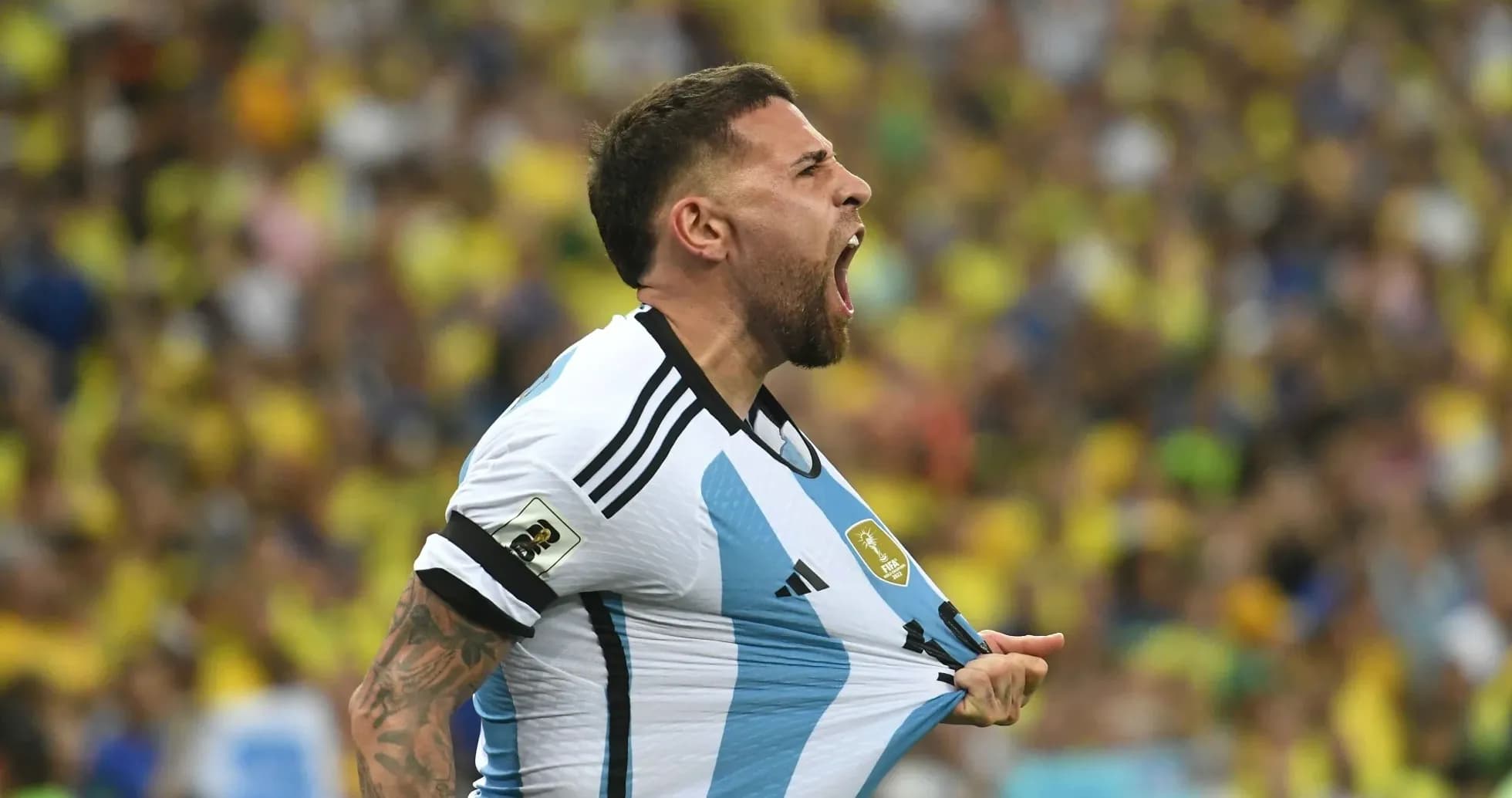
Nicolás Otamendi's Emotional Farewell to Argentina
Nicolás Otamendi waited until the end. Until the last tackle, the last final, the last World Cup. Only then did he let go.
On Wednesday, the 38-year-old defender announced that he will retire from the Argentina national team following the 2026 World Cup, closing the book on one of the most combative and enduring international careers the Albiceleste back line has seen.
He did it in his own way. Not with a press conference, but with a raw, emotional letter on Instagram.
“Today, I’m writing the most difficult words I’ve ever had to,” the former Manchester City and Benfica defender began, framing the message as a farewell to the shirt that defined his life. Wearing Argentina’s colours, he wrote, was “a childhood dream’’ and “the greatest privilege” he had in football.
He stressed that he had defended the jersey “with all my heart, with pride, and with a sense of responsibility, knowing what it means to millions of Argentines.” That line summed up the player perfectly: never the most elegant, rarely the headline act, but always the one throwing himself into danger for the cause.
Regret and peace in equal measure
Otamendi did not hide his pain at how it ended. Argentina’s defeat in the 2026 World Cup final cut deep, and he admitted as much, expressing regret over the result on the biggest stage.
The sting of that loss, though, sits alongside something else. He insisted he leaves “with the peace of mind that comes from giving it all.” For a defender who built his reputation on total commitment, there was no other way to go out.
He reserved special thanks for supporters and family, those who lived every high and low with him, and turned his farewell into a message for the future. He urged the next generation of Argentina players to “never stop believing,” a line that carries extra weight coming from a man who endured heartbreak before finally lifting the World Cup in Qatar.
Then came the final goodbye: “Thank you, Argentina. Thank you for letting me fulfill my dream of becoming a world champion and wearing the most beautiful jersey in the world.”
The dressing room reacts
The response was immediate. His post was flooded with messages from former teammates, fans and colleagues who had shared dressing rooms, battles and trophies with him.
Alexis Mac Allister called him “an exemplar of fight, resilience and love for the shirt,” a neat summary of the qualities coaches leaned on for more than a decade. Germán Pezzella went a step further, describing Otamendi as “a guide for us all,” a nod to the leadership that often went unnoticed outside the inner circle.
Names from different generations weighed in. Paulo Dybala, Marcos Senesi, Mariano Andujar and Gianluca Prestianni all posted their thanks, a roll call that underlined how long Otamendi had been part of the national-team fabric.
Rodrigo De Paul, one of the emotional engines of the current Albiceleste, was the only one so far to dedicate a full message to the vice-captain, sharing a personal story in an Instagram story. He recalled how, from his first day with the national team, Otamendi “opened the door” to his room, and how the rituals they built from that moment never stopped.
“My thanks to you, my brother, are eternal,” De Paul wrote. “You were an example to follow and one of the leaders of the beautiful story this team built. Thanks for everything, I’ll miss you.”
For a player often defined by snarling duels and crunching tackles, it was a revealing glimpse of the figure behind the scenes: the veteran who made space for others, who helped weld together the group that finally delivered Argentina a world title.
From Vélez to world champion
Otamendi’s decision did not shock anyone inside the national setup. At 38, and with a new cycle beginning, the writing had been on the wall.
His path to this point traces a classic Argentine arc. He broke through at Vélez Sarsfield in 2008, quickly establishing himself as a rugged, no-nonsense defender in the Primera División. That edge carried him to Europe and into the heart of the Albiceleste defence, where he would remain, in one form or another, for nearly two decades.
His style never pretended to be subtle. A rugged, uncompromising, abrasive defender, Otamendi thrived on contact. He relished duels, lived for the one-v-one, and treated every aerial ball as if it were the last of his career. At 1.83m, he was not especially tall by international standards, yet he turned that supposed disadvantage into a weapon, timing his jumps, attacking the ball, refusing to be bullied.
The image that captured him best came in Qatar in 2022. Round of 16, Argentina vs Australia. Otamendi rising above 1.98m Harry Souttar, towering over a much bigger man in a crucial aerial duel. A still frame, but a perfect symbol of his stubborn refusal to yield.
Trusted, then replaced, but never discarded
Under Lionel Scaloni, Otamendi became one of the coach’s most trusted lieutenants. In Qatar 2022, he was a nailed-on starter, anchoring the defence alongside Cristian “Cuti” Romero as Argentina marched to the title.
Four years later, the story had shifted. Lisandro Martínez stepped into the starting role next to Romero, and Otamendi’s job changed. He moved from undisputed starter to support act, a backup with a wealth of experience and a powerful voice in the dressing room. It is often a difficult transition for veterans of his stature. He made it look natural.
Even from the bench, his presence carried weight. Younger defenders leaned on him, coaches listened to him, and his standards in training set the tone. That, as much as any sliding tackle, is part of the legacy he leaves.
A place among the greats
Argentina has produced a long line of commanding centre-backs. Daniel Passarella, Oscar Ruggeri, Roberto Ayala – names that echo through the decades. Otamendi now stands in that company.
He does not leave behind a highlight reel of elegant recoveries or sweeping long passes. He leaves something more basic and, in many ways, more valuable: a template of how to compete. Determination. Fierceness. A refusal to take a step back, whether against South American rivals or giants of Europe.
For the next generation of Albiceleste defenders, that is the bar. Not just to win, but to fight as if the shirt weighs more than any individual. Otamendi understood that weight and carried it, sometimes imperfectly, always honestly.
His words on Instagram closed a chapter. His career with Argentina, though, will linger in every centre-back who dares to attack a header they have no right to win and every defender who chooses the hard road over the easy one.
The question now is simple: who will be brave enough to take that mantle and write the next line in Argentina’s defensive lineage?





