Newcastle United's Transformation Under Matthias Jaissle
An era ended at Newcastle United with the lights still on and the engines still running.
On the flight back from a 4-1 pre-season defeat at Bristol City last month, Eddie Howe had his laptop open, replaying the damage. A friendly at Ashton Gate, nothing on the line, but he was still combing through the details, still searching for fixes. Hours later, the man who ended Newcastle’s long wait for silverware was gone.
By the following morning, it was public: a drained Howe had stepped down. He had told the hierarchy weeks earlier, then agreed to stay on until a successor was found. On the surface, the club was still in his image. Underneath, the plates were already shifting.
A new Newcastle, by necessity
Newcastle’s reset has not been born out of comfort. It has been forced.
A bruising domestic campaign, a damaging transfer window last summer and a restrictive settlement after breaching Uefa’s financial rules have all pushed the club into a new reality. The days of simply adding, adding, adding have gone. The club has pivoted towards younger talent from the continent, bolstered its data operation and embraced a trading model that it once hoped to avoid.
That shift has hurt. Sandro Tonali to Tottenham Hotspur. Anthony Gordon to Barcelona. Sales that were reluctantly accepted as the price of reinvestment. The looming departure of captain Bruno Guimaraes to Arsenal cuts even deeper; that was never supposed to be part of the plan.
Newcastle have also lost battles for key targets. Spain winger Victor Munoz chose Liverpool. Switzerland midfielder Johan Manzambi went to Aston Villa. The market has not been kind.
Still, there has been movement. Five new faces have arrived: goalkeepers Lukas Hornicek and Ewen Jaouen, midfielders Aladji Bamba and Sean Steur, and forward Bazoumana Toure. Intriguing, yes. Transformative, not yet. Sporting director Ross Wilson knows the job is far from finished.
“We have to build a model here that can compete, can win,” he said. “But also one that works for us and doesn't lead us to have to sell players we don't want to sell and lead to Uefa sanctions.”
The message is clear: Newcastle must become smarter, leaner, more sustainable – without losing ambition.
Enter Jaissle: intensity as a blueprint
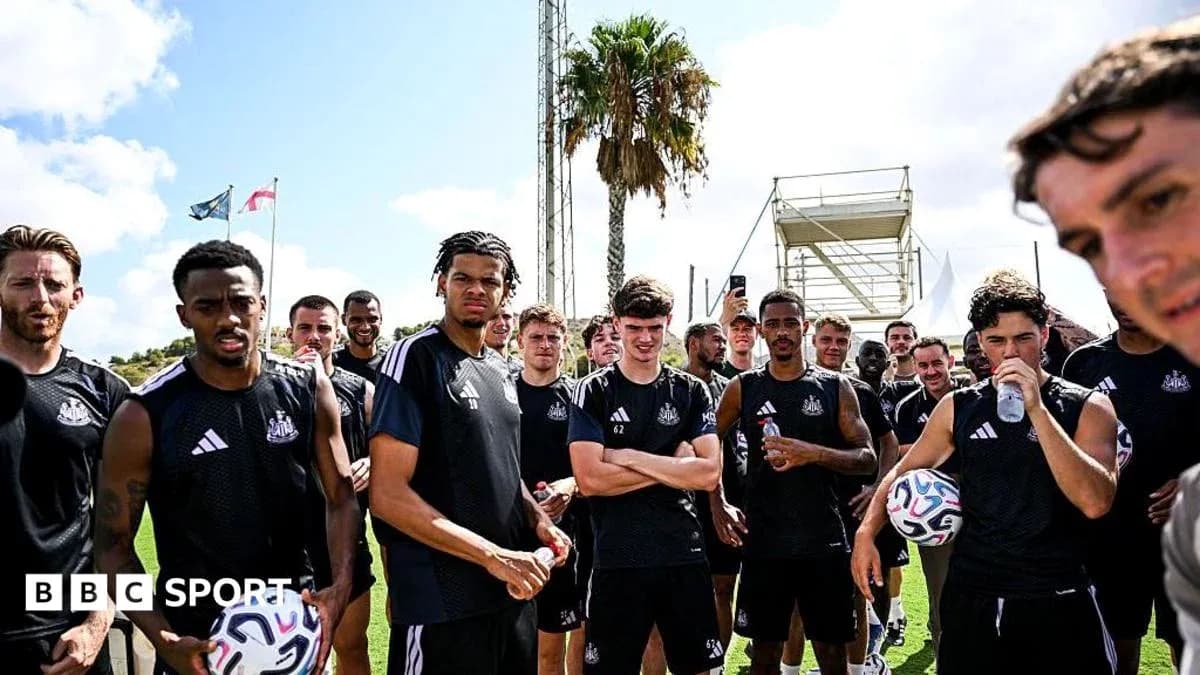
Into this tension walks Matthias Jaissle, 38 years old, fresh from Al-Ahli, dropped into a pre-season camp in Spain with the Premier League opener against Liverpool racing towards him on 23 August.
This is no gentle handover. Performance director James Bunce described it as “speed dating” because every moment matters. The description fits. Jaissle has no luxury of time, no bedding-in period. He has to imprint his identity immediately.
He has done it the only way he knows: through intensity.
Training always spikes when a new manager arrives, but players talk about Jaissle’s double sessions being “off the charts”. Effort is non-negotiable. Like Howe, he demands that players train as they play. Unlike Howe, he brings a track record built inside the Red Bull machine, where high pressing is not a philosophy but a standard.
At RB Salzburg, Jaissle’s side topped the Austrian league for high turnovers per game (9.8) and for possession won in the final third (5.6) on their way to back-to-back titles and a Champions League last-16 appearance. His Al-Ahli team carried the same edge: 8.2 high turnovers per match, 47.6 duels won, and two Asian Champions League titles as he tweaked the style to suit a new environment.
Front-foot, vertical football. Aggression without chaos. That balance will define whether he can survive and thrive in the Premier League.
No surprise, then, that he has already hammered home the importance of clean sheets. One particular session, loaded with relentless recovery runs, left players drained. On Thursday, he eased off, stopwatch hanging from his neck, after deciding the squad’s legs were too “heavy”. He looks calm in front of a microphone; on the grass he is a different figure entirely, charging around, even physically shifting his coaches into position to show the level of intensity he wants.
He has not arrived alone. Assistants Alexander Hauser, Engin Yanova and Florens Koch have followed him, along with coach analysts Maximilian Fischer and Steffen Konrad, plus goalkeeping coach Alexander Bade. Yet his first address made one thing clear: those already inside the building must raise their standards too.
Racing the clock to Liverpool
While Newcastle adjust, Liverpool have had longer to tune themselves to life under Andoni Iraola. That gap in preparation time has sharpened the urgency on Tyneside.
Staff have been working deep into the night on analysis and planning. Every drill, every video clip, every meeting is geared towards compressing months of work into weeks. The speed-dating analogy holds: everyone is trying to learn everyone else, fast.
For some, the adaptation is even more brutal. Hornicek, the new Czech Republic goalkeeper, has been at the club less than a week after his £25.7m move from Braga. He is already being drilled on the Premier League’s unforgiving set-play culture – the sheer physicality, the traffic of towering bodies crashing into his space.
Is he ready for that fight?
“For sure,” Hornicek replied. He will not be allowed any other answer.
The start of a harder road
Newcastle’s summer has stripped away illusions. This is no longer the story of a lavishly funded rise with a straight-line trajectory. It is messier now, more fragile, and more interesting.
The club is younger. The squad is lighter on star power. The margins are tighter. Yet there is a clear idea at the heart of it: an aggressive, data-informed, development-driven model, overseen by a coach who thrives on turning potential into performance.
Howe’s era ended quietly, somewhere between a laptop screen and a long flight home. Jaissle’s begins at full tilt, stopwatch ticking, Liverpool looming, and a young Newcastle side being pushed to find out just how much it can endure.