
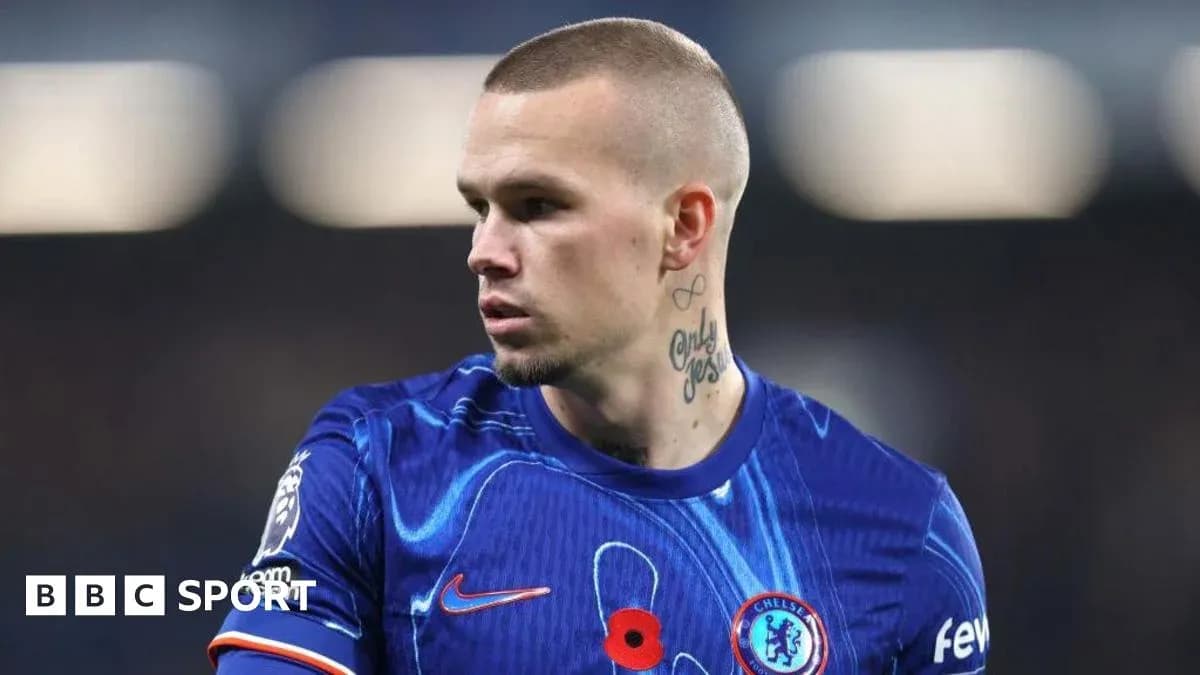
Mykhailo Mudryk Returns to Football After Doping Case
Mykhailo Mudryk has his career back.
After 20 months in limbo, the Chelsea winger has been cleared to return to competition “with immediate effect” as his long-running doping case with the Football Association reaches its conclusion. The cloud that has hung over one of European football’s most scrutinised talents has finally lifted.
From four-year exile to immediate return
Mudryk, 25, has not played a competitive match since November 2024. An out-of-competition test while on international duty with Ukraine in October that year produced an adverse finding for meldonium, a prohibited cardiovascular medication known to boost stamina and respiratory capacity.
The FA charged him in June 2025. In January this year, an independent commission handed down the harshest possible punishment: a four-year suspension. Had that ban stood, Mudryk would not have been eligible to play again until around December 2028. For a player whose game is built on explosive pace and sharpness, it threatened to carve a brutal hole out of his prime.
He appealed to the Court of Arbitration for Sport. That appeal has now ended in a very different outcome.
The FA confirmed on Friday that disciplinary proceedings have been resolved after Mudryk accepted that he broke anti-doping rules, with his suspension set at the time he has already served. In other words, the punishment is effectively over. He can play again.
A case shaped by changing science
Key to the resolution is what the FA revealed about the original test. Mudryk’s sample contained “a low concentration” of meldonium. Since that test, the World Anti-Doping Agency has updated its technical document relating to the substance.
Those changes are not retroactive, so the original charge stood. Yet the FA acknowledged that if Mudryk’s sample had been taken under today’s guidelines, “the concentration of meldonium in the sample would not have been reported” and no adverse finding would have been recorded.
That line matters. It frames the agreed outcome and gives crucial context to a saga that had, until now, been shrouded in confidentiality. The FA’s anti-doping programme is strictly private, and details of Mudryk’s case only emerged when his four-year ban came to light during the appeal process earlier this year.
With WADA’s agreement, the FA and Mudryk have now settled the appeal. The legal fight is over; the football fight starts again.
“The most difficult period” – and the road back
Mudryk described the saga as “the most difficult period” of his career and said he was “grateful” to be able to return. He has consistently maintained he never knowingly or intentionally took a banned substance.
Chelsea, for their part, have walked a tightrope: publicly supportive of the player, publicly respectful of the anti-doping system. The club said it is “pleased that the matter has now reached a conclusion which allows him to return to football with immediate effect”, and stressed it has “always supported Misha throughout this process while fully respecting the integrity of the anti-doping system and the legal process”.
The Blues also pointed directly to the updated testing standards, noting that “no anti-doping rule violation would have resulted” from Mudryk’s sample under current guidelines. In their view, that is “an important part of the context” that allows all parties to move on.
Behind the scenes, that support has been real but necessarily distant. Under the terms of his suspension, Mudryk could not access Chelsea’s training ground or work with club staff. He effectively trained in exile.
He paid for private coaching. He hired goalkeepers for one-to-one sessions. He used a pitch at non-league Uxbridge FC in west London. He organised a training camp in Austria, where footage showed him driving through attacking drills, finishing exercises, trying to replicate the rhythm of elite football without the elite environment.
Those close to him admit there is no substitute for daily work alongside top-level players. They also insist he has done everything possible to be ready. The winger is said to be realistic about the challenge ahead but confident he can climb back to his best.
Chelsea’s puzzle: reintegrate, loan, or sell?
Now comes the football decision.
Mudryk remains under contract at Stamford Bridge until 2031 after his £61m move from Shakhtar Donetsk in 2022, one of the flagship transfers of the new ownership era and a prime example of the club’s strategy of spreading transfer fees over ultra-long deals.
That long contract protected his book value while he sat out, but it also sharpens the question of what happens next. Chelsea are prepared to offer a pathway back into the professional game. What that pathway looks like is still open.
One option is full reintegration into the first-team squad, with pre-season providing a natural re-entry point. Another is a loan move to rebuild rhythm and confidence away from the Premier League glare, with Strasbourg – Chelsea’s sister club – an obvious candidate. A permanent transfer cannot be ruled out either, if the club or player decide a clean break serves both sides.
For now, Chelsea say they are looking forward to helping Mudryk “return to full fitness, back into the squad and back onto the pitch”, and he will join the club’s pre-season tour. The winger has spoken of his “deep gratitude” to everyone at the club and of his excitement for the “next chapter” of his career.
A career back from the brink
This is more than a paperwork victory. Had the original four-year ban survived, the story of Mykhailo Mudryk at Chelsea might have ended as an expensive footnote, remembered more for legal documents than for goals.
Instead, a different narrative is back on the table.
The Ukrainian arrived in one of the most closely watched transfer battles of 2023, a raw, electrifying winger whose pace and potential convinced Chelsea to outbid rivals and commit to a near-decade-long deal. The early months were uneven, flashes of brilliance drowned out at times by the chaos of a club in transition.
Now he returns older, hardened by a fight few footballers ever face, and with something rare for a player still in his mid-twenties: a second chance to write the first draft of his legacy.
The ban is gone. The doubt may linger. The question is simple and unforgiving: what does Mykhailo Mudryk do with the time he has just won back?





