
Mohamed Salah Joins Trabzonspor: A Bold Move in European Football
For months, the question hung over Mohamed Salah’s future like a summer storm. Saudi Arabia or the United States? One last enormous contract in a rising league, or a softer landing in MLS?
The answer arrived in claret and blue.
After the expiry of his Liverpool deal, the 34-year-old has signed a two-year contract with Trabzonspor, ending one of the great Premier League careers and beginning one of the most intriguing late chapters of any modern superstar.
Not Riyadh. Not Miami. Trabzon.
A superstar who refused to leave Europe quietly
On paper, this move should not exist.
Saudi Pro League clubs had identified Salah as a marquee signing for years, with Al-Ittihad making a late push. MLS sides, including Sporting Kansas City, saw him as the kind of global figure who could shift a league’s image overnight. Both paths offered staggering money and a softer competitive landing.
He turned them down.
Salah will earn a huge salary in Turkey – Trabzonspor’s stock exchange statement confirmed £14.5m per season and a 20% share of revenue from Salah-branded merchandise – but this is not the biggest cheque he could have signed. Reports in Turkey also describe a two-year deal until June 2028 worth around £7.3m per season, with bonuses and commercial add-ons. The exact structure varies across briefings, the message does not: he could have earned more elsewhere.
What he gains instead is Europe. Real Europe. The kind with Uefa anthems and away legs that still matter.
Trabzonspor finished third in last season’s Super Lig and head into the Europa League play-offs this month. Win over two legs and they step into the league phase. Lose and they drop into the Conference League. Either way, continental football is guaranteed.
For a player who drove Egypt to the World Cup knockout stages this summer and produced one of the standout individual campaigns of 2024-25, that stage clearly still counts.
He is not ready to drift off the map.
Why Trabzonspor, and why now?
If Salah wanted to stay in Europe, most would have bet on a more familiar badge.
Turkey’s gravitational centres are Galatasaray, Fenerbahce and Besiktas. The Istanbul giants usually hoover up the biggest names, and Besiktas did step forward, only for talks to collapse over the financial structure of the deal.
That misstep opened the door for Trabzonspor, a club that never quite fits the “outsider” tag people lazily attach to them.
They are seven-time Turkish champions. They won the Super Lig as recently as 2021-22. They lifted the Turkish Cup last season. Fatih Tekke’s team finished third again, earning another shot at Europe. This is not a romantic mid-table detour. It is a club with a habit of barging into spaces reserved for the supposed elite.
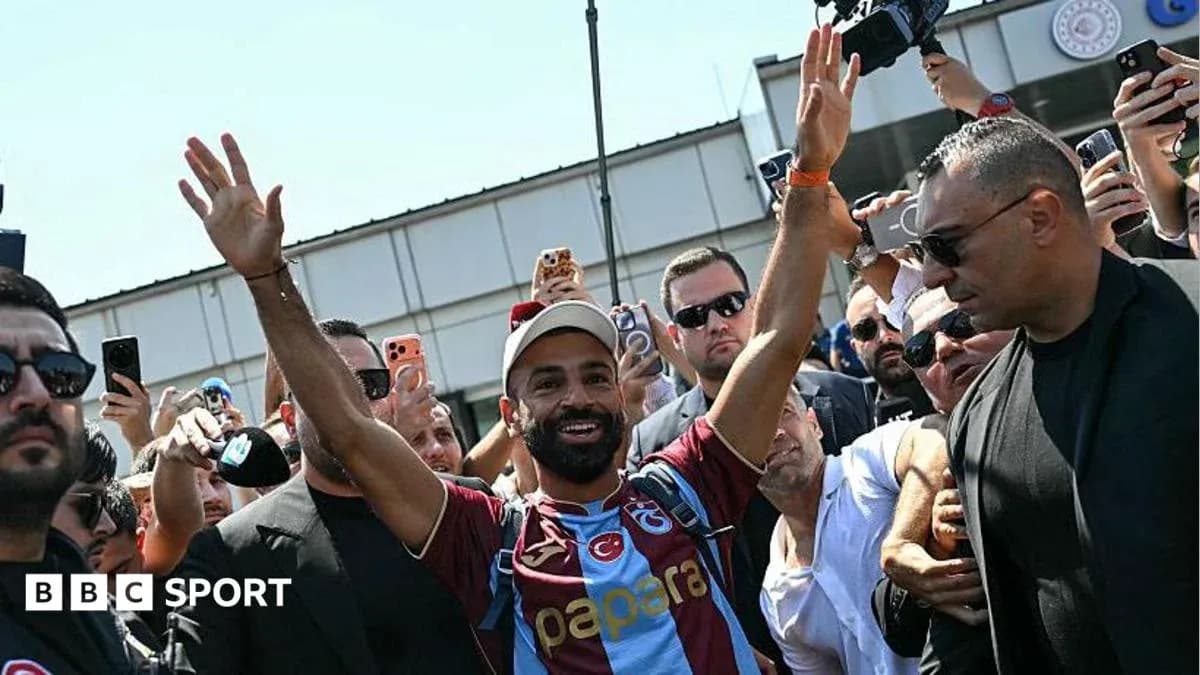
Salah walks in as the biggest signing in their history. The reaction made that obvious.
Hundreds of fans turned out to greet him, a rolling, noisy welcome that felt more like a title parade than an unveiling. For Ryan Jack, the former Rangers midfielder who has spent the past two seasons in Turkey, scenes like that are simply how the country does football.
“The fans are incredibly passionate,” he told BBC Sport. “The big clubs have huge support and they really get behind their teams.”
Trabzonspor live off that energy. They also know how to use symbolism.
During his presentation, Salah briefly pulled on a shirt with the number 61, the city’s vehicle registration code and a number that carries almost mythic weight among supporters. They celebrate the 61st minute of games; they wear it like a badge of identity. For a few minutes, their new star did the same.
From 2026-27, he will wear his preferred number 10, the number he also owns with Egypt. Team-mate Ernest Muci agreed to hand it over, a small but telling sign of the hierarchy that now exists in that dressing room.
A league on the rise – and a strange financial advantage
Salah’s move does not stand alone. It fits a pattern.
The Super Lig has become an increasingly attractive destination for established names. Victor Osimhen, Leroy Sane, Ilkay Gundogan, Nathan Ake and Leandro Trossard are among those now in Turkey. At Trabzonspor specifically, Andre Onana, Ruslan Malinovskyi and Stefan Savic are already in place.
Last summer, the Super Lig posted the third-highest net transfer spend in world football, behind only the Premier League and Saudi Pro League. That is not a coincidence or a sugar rush. It is economics.
Turkey’s biggest clubs earn heavily in euros through Uefa competitions, while many of their domestic costs remain in Turkish lira. Prolonged high inflation has eroded the real value of existing domestic debt, giving clubs more room to manoeuvre than their balance sheets might suggest at first glance.
That unusual cocktail allows them to offer serious salaries, big-city lifestyles and the lure of European football to players in their late prime or beyond. Salah is not the first to see the appeal; he is simply the most famous.
“The league is getting stronger every year and you're seeing more and more big names joining,” Jack said. “Salah is probably the biggest name to move to Turkey in recent years. It shows the league is growing and it might persuade other top players to consider going there. There are great stadiums, great cities and it's a competitive league.”
His own experience only deepened that view.
“I loved it,” he added. “Everyone helps you settle in and the people are really friendly. When foreign players arrive, the clubs do everything they can to help them.”
Passion, profile and the limits of Turkish football
Strip away the noise and the Super Lig still sits below Europe’s elite.
Opta currently ranks it as the 14th strongest domestic league in world football, behind competitions in Denmark and Poland and even England’s Championship. Turkish clubs have struggled to turn occasional surges into sustained European relevance.
Since Galatasaray lifted the Uefa Cup in 2000, only one Turkish side has reached the semi-finals of a major Uefa competition. The gap to the continent’s true heavyweights remains wide.
That context matters. Salah has not signed up for another title race in England or a Champions League campaign with a favourite. He has chosen a compromise: a league that burns hot, a club that can win trophies, and a guarantee that European nights will still be part of his calendar, even if they arrive on Thursdays rather than Tuesdays.
For Trabzonspor, the equation is different. This transfer is about far more than goals and assists.
Salah instantly lifts the club’s global profile. Commercial opportunities multiply. A team that already commands fierce local loyalty now has one of the most marketable footballers of the modern era as its figurehead.
Jack expects the ripple effect to be obvious.
“I think Liverpool fans, and people who love watching Salah, will definitely take notice and start following the league,” he said. “When I moved there, my family and friends started watching games because they didn't really know much about Turkish football before. Salah's move will make people sit up and watch more of the league.”
A new chapter, on his own terms
For Salah, this is not just about money or nostalgia. It is about control.
He remains in Europe. He will fight for domestic honours. He will play in Uefa competitions. He will walk into a dressing room as the undisputed star of one of Turkey’s most historic clubs, in one of the sport’s most fevered environments.
He has turned down the easier script – the late-career cash-out in a league built around spectacle – for something messier, louder and more demanding.
It is not the move anyone predicted when the speculation began. It might be the one that tells us most about what still drives him.
Now comes the real question: how far can Mohamed Salah drag Trabzonspor, and Turkish football with it, towards the level he has occupied for the past decade?





