MLS's Ambitious Growth Post-World Cup
“Thanks world, we’ll take it from here.”
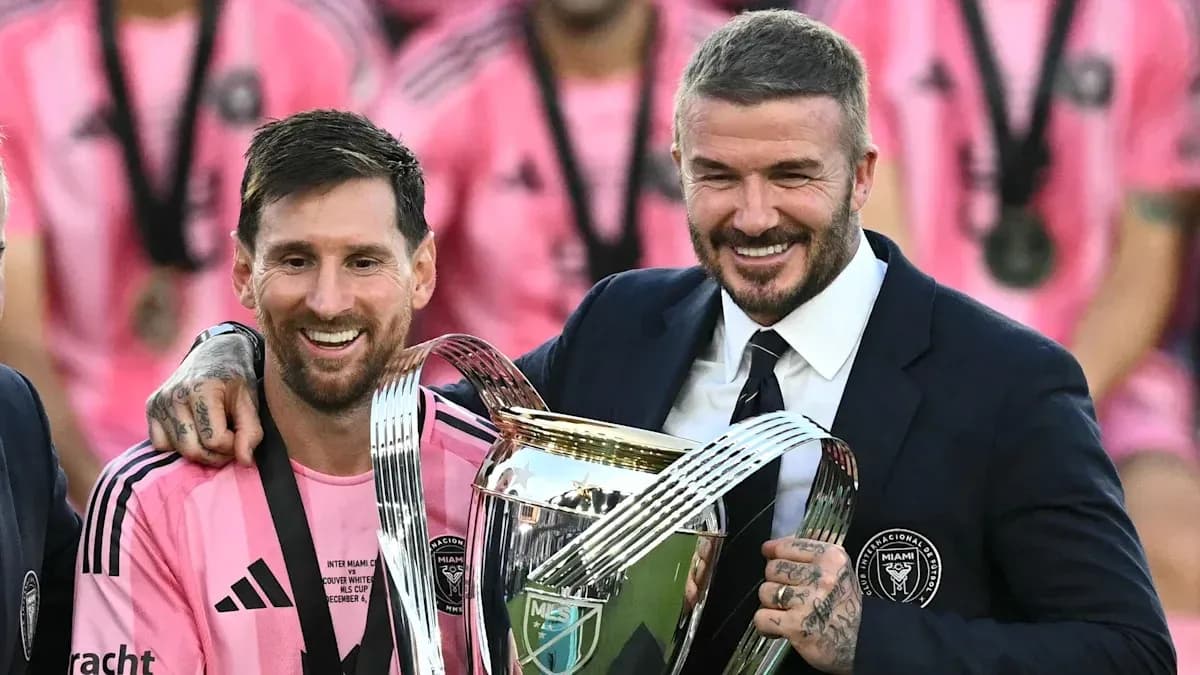
It’s a line delivered with a smile in a glossy advert, but the message is anything but casual. Lionel Messi, Son Heung-min, David Beckham and a cast of Major League Soccer stars stare down the camera and invite the millions swept up by the World Cup to stay with them now the circus has left town.
This is MLS planting its flag.
The film is everywhere: World Cup heroes now wearing MLS badges, telling new fans to follow them as the regular season restarts. The league is even dangling free tickets in front of first-timers. This isn’t a soft sell; it’s a full-on grab for the audience that has just discovered, or rediscovered, the sport.
Dan Courtemanche, an MLS executive since before the first ball was kicked in anger back in 1996, doesn’t bother to hide the ambition.
“The World Cup has now exposed millions of people to Major League Soccer,” he says. “We’re going to continue to capitalise on that momentum.”
The question hangs in the air: could this World Cup be remembered less for what happened on the pitch and more for what it launched in the United States – the moment MLS truly pushed toward the game’s elite?
From World Cup legacy to 30-club behemoth
MLS itself was born from a World Cup promise. When the US bid to host the 1994 tournament, Fifa insisted on a professional league as part of the deal. At the time it sounded almost fanciful.
The league finally kicked off in 1996 with 10 teams and not a single purpose-built stadium. It was a start, nothing more.
Three decades on, the landscape is barely recognisable. MLS now boasts 30 clubs and a near-matching number of football-specific stadiums. The days of cavernous, half-empty NFL venues are largely over. The league has built its own homes and, crucially, its own identity.
This latest World Cup only sharpened that sense of arrival.
Predictions of empty seats and quiet crowds, strangled by high ticket prices, never materialised. Stadiums across the United States were packed. Broadcast numbers were not just respectable; they were historic.
The USA’s last-16 defeat by Belgium drew more than 33 million viewers on Fox alone – the most-watched football match on a single US network. England’s last-16 win over Mexico went even further, pulling a combined 45 million viewers across Fox and Telemundo, the biggest football audience in US history.
Those figures nudge into NFL territory. They don’t yet touch the Super Bowl, but they’re no longer on a different planet.
In 2025, the most-watched Super Bowl ever drew 127.7 million viewers across English and Spanish broadcasts and streaming in the US. Many tuned in for Kendrick Lamar’s half-time show as much as the game itself, but the point stands: that is the benchmark.
MLS believes it can keep moving toward that kind of cultural weight.
“I think we’re looked at as the top, one of the top leagues commercially,” commissioner Don Garber says. “We’ve cracked that code. Now we’ve got to crack the rest of it.”
Retirement league? Not anymore
On the pitch, MLS has already muscled into the global conversation.
Forty-five MLS players featured at the 2026 World Cup, including two in the final for Argentina: Messi and Rodrigo de Paul. The league that once begged for relevance now sends players to the biggest stage and brings some of the game’s biggest names back with it.
The old jibe still lingers – that MLS is a retirement home, a sun-drenched final stop for ageing superstars. Beckham did it. Messi has done it. The reputation stuck.
Courtemanche insists that label no longer fits. The numbers back him up. The average age of new international arrivals in MLS is now 23.8 years. These are players on the way up, not down, even if many still dream of using MLS as a launchpad to Europe.
The league is adjusting to that reality. In 2027, MLS will shift to a summer-to-spring calendar, aligning more closely with Europe and smoothing the path for player movement between continents. It’s a structural change that speaks to a simple truth: MLS wants to be part of the same conversation as the Premier League, La Liga, the Bundesliga and Serie A, not an outlier operating on its own clock.
Behind that, club owners are pouring money into youth development. All MLS sides now run academies. At LA Galaxy’s viewing party for the US win over Bosnia-Herzegovina, the clearest sign of the future wasn’t on the big screen. It was on the three small pitches beside it.
Dozens of children ignored the match and played their own, sprinting back to the giant screen only when a roar went up. These weren’t casual kickabouts in a country famous for over-scheduled childhoods. The quality was high. Some of those kids already belonged to MLS academies.
Eight-year-old Landon – named after US legend Landon Donovan – drifted from goalkeeper to forward with the kind of joy that can’t be coached. His mother, Jen Wing, is a coach herself. Her children attend MLS camps and play on travel teams back home in New Jersey.
Landon doesn’t hesitate when asked about his dream.
“LAFC,” he says.
One child, one club, one dream. Multiply that across a continent and you start to see why MLS believes its future lies in homegrown talent.
The pay-to-play problem
There is, though, a familiar American catch: money.
At the top, MLS academies are free, mirroring the model used by Europe’s biggest clubs. Once you’re in, you don’t pay. The issue is getting noticed in the first place.
Across the US, families routinely pay thousands of dollars for private coaching and travel teams, not just in football but in almost every youth sport. That “pay-to-play” culture has long been criticised as a barrier that locks out talented kids from less affluent backgrounds.
Critics argue MLS cannot truly compete with Europe until it breaks that cycle.
League officials insist the system is evolving. They point to scholarships at every club and constant tweaks to development leagues aimed at widening the net and raising standards. Garber talks about a relentless push to improve, to produce more players for the US men’s national team, and to make them “better, bigger, stronger, faster”.
The ambition is clear: turn youth football from a private luxury into a national pipeline.
Celebrity, money and the lure of Friday nights
If player development is one pillar, star power is another.
Messi is the league’s brightest light, the gravitational force drawing global attention to MLS week after week. But the celebrity effect doesn’t stop at the pitch.
More than two dozen entertainers and athletes now own slices of MLS clubs. Will Ferrell and Magic Johnson at LAFC. Reese Witherspoon in Nashville SC. Matthew McConaughey in Austin FC. The league has become a fashionable investment for Hollywood and the NBA alike.
It has paid off handsomely.
Drew Carey bought into Seattle Sounders when they joined MLS in 2009 for a $30m expansion fee. Today, the Sounders are valued at more than $900m. David Beckham’s landmark 2007 contract with LA Galaxy included an option to buy an expansion team for $25m. That option became Inter Miami CF, now estimated to be worth more than a billion dollars.
Those numbers don’t just signal growth; they scream it.
Yet the league still fights a cultural tide. For all the current football frenzy, many in the US remain convinced that American football will always sit on top of the sporting pyramid.
Brian Udovich sees that tension up close. His 12-year-old son Croil plays in an MLS Next Level league in Southern California. He’s watched talented young players drift away from soccer as they hit their teens, drawn by the pageantry of Friday night lights.
High school American football comes with marching bands, cheerleaders, packed stands and names in lights. Soccer, by contrast, is often played on quiet Saturday mornings, with parents in folding chairs and no soundtrack beyond the whistle and the wind.
“It just means so much more to other cultures than us,” Udovich says, acknowledging the weight of tradition that football enjoys elsewhere and still lacks in the US.
A different kind of football country
Michael Bradley, now head coach of New York Red Bulls, doesn’t deny that cultural gap. He leans into it.
“We don’t have the long, storied football history that other countries do,” he says. For years, that absence bred an inferiority complex, a nagging sense that the sport would never quite stick in the United States.
The World Cup changed that mood. Packed stadiums, record TV numbers, Messi lighting up MLS grounds – all of it has given fans something more solid to hold on to.
Bradley believes the shift is real. Pride has replaced apology. The sport no longer feels like a niche interest fighting for scraps of attention.
“I think we can all unequivocally say in 2026, football is not going anywhere.”
The advert with Messi, Son and Beckham says the same thing in fewer words: thanks, world. We’ve got it from here.
Now MLS has to prove it.