Martin O’Neill Returns as Celtic Manager
Martin O’Neill is poised to complete one of the most remarkable managerial returns in modern Celtic history, with the club expected to confirm the 74-year-old as permanent manager on a one-year deal.
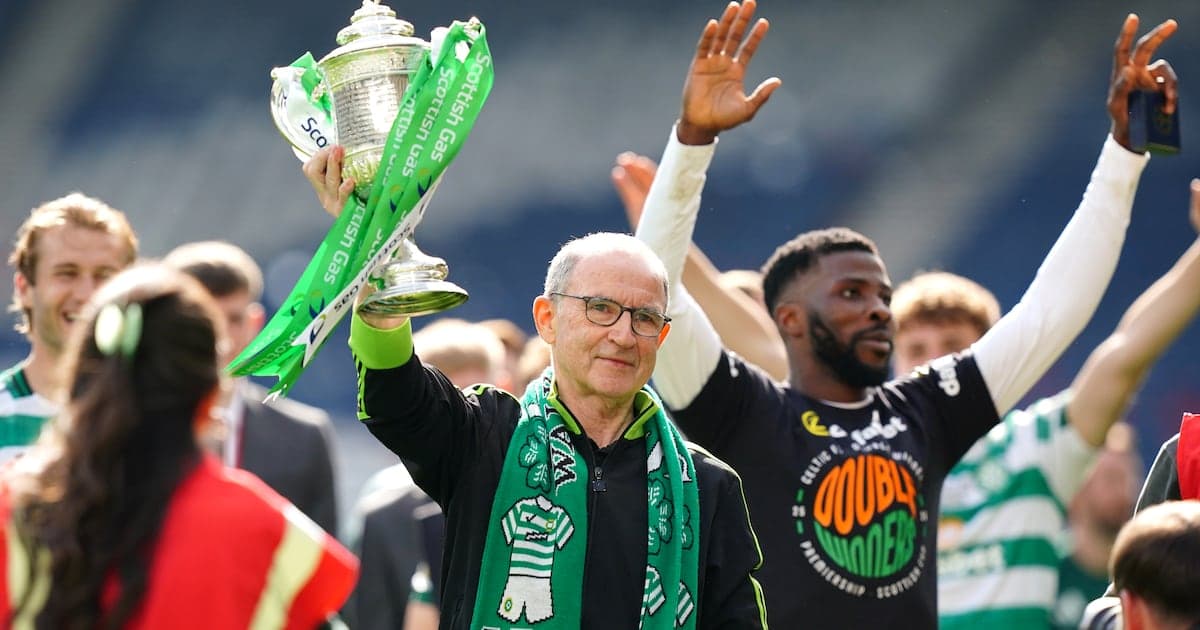
He is not coming back as a sentimental figurehead. He is coming back as the man who just delivered a domestic double in the second of two rescue missions this season, and who has now decided Glasgow is once again where his future lies.
O’Neill chooses Celtic – again
O’Neill took time after the Scottish Cup final win over Dunfermline to weigh up his options, stepping back from the noise as the club’s hierarchy sounded out alternatives. The pause felt sensible; the outcome always felt inevitable. The Northern Irishman wanted the job on more than a caretaker basis, and Celtic wanted the man who had just steadied the ship and kept the title in the east end.
He has agreed a one-year contract, with an option for a second season. It is a short deal on paper, but loaded with symbolism. Twenty-six years after Dermot Desmond first persuaded him to swap Leicester for Celtic, Desmond has gone back to the same well.
The first time, O’Neill changed the club’s trajectory. Three Scottish titles, three Scottish Cups, two Scottish League Cups and a run to the 2003 Uefa Cup final underlined his impact. That Celtic side lost to José Mourinho’s Porto in Seville, but its imprint on the club’s identity has endured.
Now, the architect returns to a structure he helped build.
Keane talk, Keane backlash
The route to O’Neill’s reappointment has not been straightforward. Robbie Keane moved into serious contention this week, holding talks with Desmond and emerging as a live candidate to lead Celtic into a new era.
On paper, Keane offered a different kind of project: younger, with recent experience in Israel at Maccabi Tel Aviv and in Hungary with Ferencvaros, where he resigned at the end of May. Inside the boardroom, his name carried weight. Among a section of the support, it carried something else entirely.
The reaction was fierce. An element of the Celtic fanbase reacted angrily to the idea of Keane’s appointment, objecting in particular to his managerial spell in Israel. The backlash was loud enough to shape the mood around the club’s decision-making.
As the noise around Keane grew more hostile, the calm, familiar option in O’Neill began to look less like a stopgap and more like the obvious answer.
From crisis firefighter to title winner
O’Neill’s second act at Celtic began in chaos. Brendan Rodgers resigned last October, leaving a vacuum that needed a steady hand and a strong personality. O’Neill stepped in on a short-term basis, a veteran entrusted with keeping the season alive while the club searched for a long-term successor.
That search led to Wilfried Nancy. The Frenchman’s reign barely started before it imploded, lasting only eight games and leaving Celtic exposed at a critical point in the campaign. When the experiment failed, the board turned back to O’Neill.
He did what he has so often done in his career: simplified, galvanised, won. Celtic’s Premiership title defence, which had begun to wobble, was dragged back on course. The Scottish Cup followed, and with it the sense that the club had rediscovered its bearings under a manager who understands the demands of the place.
The double gave O’Neill leverage. It also reminded everyone inside Celtic Park what his teams look like when the stakes rise.
A familiar face, a different era
This appointment is not a nostalgia tour. The landscape O’Neill walks into now is very different from the one he dominated in the early 2000s. The financial gap to Europe’s elite has widened, domestic expectations have hardened, and the pressure to refresh and modernise squads is relentless.
Yet the decision to hand him the reins again speaks to trust – in his authority, in his ability to command a dressing room, in his record of delivering trophies under strain. A one-year deal with an option gives Celtic room to reassess without committing to a long rebuild under a manager in his mid-70s, but it also hands O’Neill the chance to shape another chapter.
He returns to a club he knows, in a league he has conquered, with a fanbase that has already sung his name for a generation. The challenge now is different, sharper, more unforgiving.
But as Celtic prepare to announce his appointment, one thing is clear: the man who once transformed the club is back in charge of its immediate future. The question is no longer whether Martin O’Neill can still manage at the top level.
It is how far he can take Celtic, one more time.