
Manchester City Faces Change: Rodri's Future and Tactical Evolution
Manchester City stand on the edge of something unfamiliar. Not decline. Not yet. But change – sharp, structural, unavoidable.
For the first time in a decade, there is no Pep Guardiola on the touchline and no familiar spine to lean on. Four starters from the Treble-winning side of 2022-23 – Manuel Akanji, Nathan Ake, Bernardo Silva and John Stones – have gone in one summer. In their place, City have pushed £116m into Elliot Anderson and rolled the dice on 17-year-old Jeremy Monga.
This is not tinkering. It is surgery.
Rodri, the pillar with an uncertain future
The most delicate operation, though, does not belong to the recruitment department. It belongs to a surgeon on Monday.
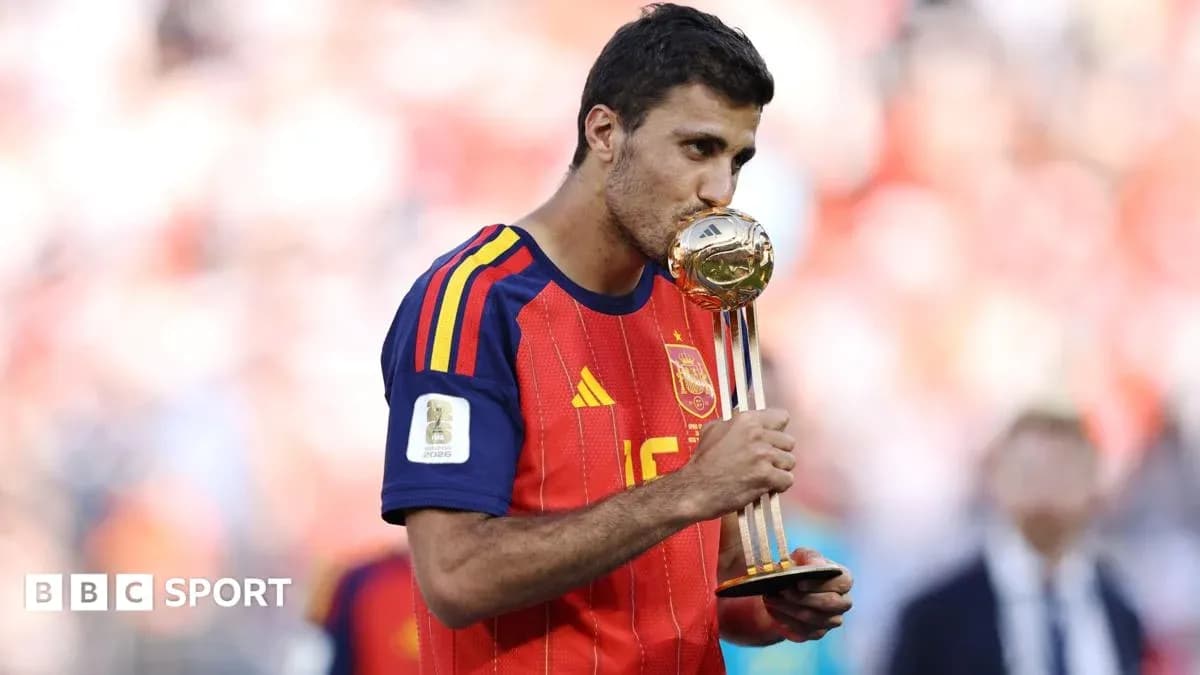
Rodri, fresh from captaining Spain to World Cup glory and collecting the Golden Ball as the tournament’s best player, will undergo back surgery with only a year left on his contract and Real Madrid circling. Reports in Spain suggest Madrid are “operating on the basis” that he will eventually join them. City cannot ignore that noise.
The timeline for his return is unclear. The importance of his presence is not.
New manager Enzo Maresca made his stance plain in his first news conference.
“I think every manager wants to have Rodri because he is a top player,” he said. “But now, surgery on Monday... he needs a holiday... he needs to rest and recover and then he will be back with us.”
That is the plan. Keep him. Build with him. Trust that his body holds and his contract situation bends their way.
But City have lived in elite football long enough to know you do not navigate a season on hope alone. Contingencies must exist.
Maresca’s board, Maresca’s pieces
One of those contingencies is already in the building. Anderson arrives as a major investment, with City also tracking 18-year-old Lille midfielder Ayyoub Bouaddi, who caught the eye for Morocco at the World Cup.
To understand how Rodri, Anderson and possibly Bouaddi might coexist – or how City might cope if Rodri eventually walks away – you have to understand Maresca’s football.
He is a devoted disciple of positional play, a coach who openly likens his work to chess.
“There are a lot of similarities,” Maresca has said. “The most important is positional play and strategy. For a coach, it's important to have the mentality of a chess player: develop a plan, study counter-moves, choose the arrangement of the pieces.”
On the grass, that philosophy usually settles into an on-the-ball shape resembling a 3-2-2-3. It is not the numbers that matter, but the relationships: who steps in, who drops out, who occupies which line when City have the ball.
This is where Rodri becomes priceless.
The master of the middle
At his peak, Rodri has been the best holding midfielder in the world. That is not an exaggeration; it is the level he reached before his anterior cruciate ligament injury, and the level he touched again on the biggest stage with Spain.
When he came back from that ACL lay-off last year, there were inevitable questions. Would he ever return to that Ballon d’Or-winning standard? Guardiola, still in charge at the time, did not flinch. “In the World Cup, he will be the best Rodri, and next season he will be the best Rodri,” he said.
The first part came true. Completely.
For Spain, he showed precisely why a Maresca team with Rodri looks so dangerous. He dropped into the backline when Aymeric Laporte advanced with the ball. He anchored midfield when the game demanded control. When space opened in front, he strode into it with the calm of a man who sees the whole pitch two passes ahead.
In a 3-2-2-3, that elasticity is gold. Rodri can be the extra centre-back, the single pivot, the advanced eight. He is not just a piece on Maresca’s board; he is the hinge that lets others rotate.
Lessons from Stones, Caicedo and Cucurella
Maresca has worked this way before. During City’s Treble season, when he was Guardiola’s assistant, the team defended in a 4-4-2 before morphing into that familiar 3-2-2-3 with the ball. Stones was the key invention. A centre-back on paper, he stepped into midfield to form a double pivot with Rodri, unlocking the structure that suffocated Europe.
At Chelsea, Maresca’s tweaks went even further. Moises Caicedo, signed as a midfielder, often started at right-back. On paper, it looked conservative. On the pitch, it was anything but. Chelsea would defend with a back four, then Caicedo would slide into one of the holding roles as they attacked in a 3-2-2-3.
Marc Cucurella, widely seen as a left-back, found himself used in far more advanced areas, including attacking midfield. It was another example of Maresca’s eye for hidden roles – positions players could occupy but had never fully explored.
That eye will be tested now. If Rodri stays, City’s new manager has the perfect conductor for his positional orchestra. If he goes, Maresca must again find new angles, new step-ins, new hybrids.
Life with – and without – Rodri
With Rodri, City can move quickly towards Maresca’s ideal. He already understands the language of positional play: timing, risk, tempo, when to slow the game, when to split lines. Anderson and any future signings will need time to learn that grammar. Rodri did too, once, under Fernandinho’s guidance.
Without him, the project becomes more volatile, but not necessarily doomed. Maresca has already shown he can reimagine players. Stones into a holding midfielder. Caicedo into a full-back. Cucurella into an attacking presence. The list of experiments is long, and it is not finished.
One key difference from the Guardiola era will help. Where Guardiola preferred a lean squad, trusting a small core and drilling them relentlessly, Maresca is open to having more pieces on the board. More options. More combinations.
That approach will matter whether Rodri signs a new deal or eventually trades Manchester for Madrid. With the squad already reshaped and the tactical model clear, City’s season may come down to a simple question:
Can Maresca find his winning configuration before the rest of Europe works out how to stop him?





