Liverpool and Chelsea Share Points in Tense 1–1 Draw
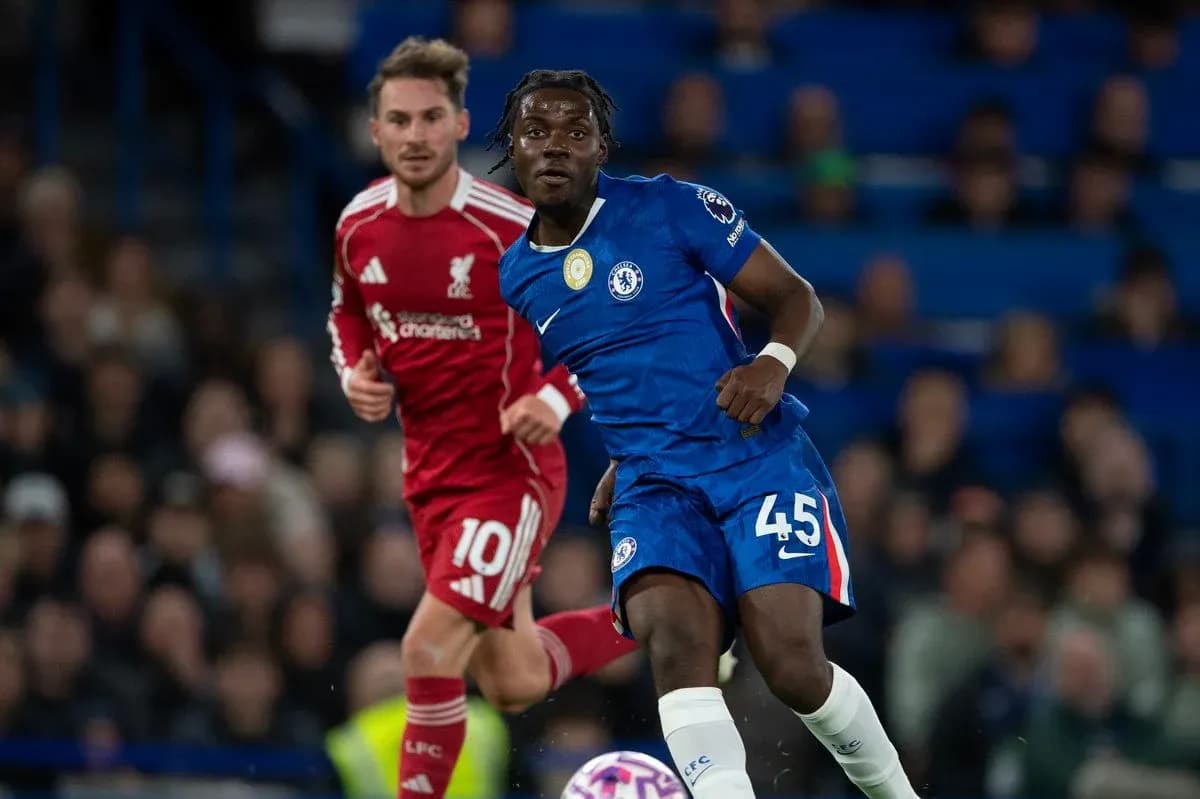
A tense 1–1 draw at Anfield in Premier League Round 36 left both Liverpool and Chelsea with a point that reflected a game of fine margins more than sustained dominance. Ryan Gravenberch’s early strike for Arne Slot’s side was cancelled out before the break by Enzo Fernández, and despite a disallowed goal for Cole Palmer and a flurry of late bookings, neither team could tilt the contest decisively. Chelsea edged possession and passing accuracy, Liverpool carried slightly more shooting volume, and both goalkeepers were largely protected by compact defensive structures rather than called into constant action.
The scoring opened on 6' when Liverpool exploited their right side. Jeremie Frimpong’s advanced positioning and Liverpool’s midfield rotation helped open a lane for Rio Ngumoha, who supplied the assist for Ryan Gravenberch to finish, giving Liverpool an early 1–0 lead and the platform to press higher. Chelsea responded by stabilising their double pivot and gradually increasing control of the ball, culminating in Enzo Fernández’s equaliser on 35', a “Normal Goal” with no registered assist, reflecting Chelsea’s ability to work second balls and late midfield runs into the box.
The key turning point after the interval came on 50'. Cole Palmer found the net for Chelsea, but the effort was ruled out following a VAR intervention recorded as “Goal cancelled”. This preserved the 1–1 scoreline and underlined how narrow the margins were in Chelsea’s more assertive start to the second half.
Substitutions then reshaped the tactical picture. On 63', Andrey Santos (OUT) made way as Reece James (IN) came on for Chelsea, adding width and a more direct crossing threat from right-back. Liverpool answered on 67' with a structural shift in their front line: Rio Ngumoha (OUT) was replaced by Alexander Isak (IN), turning the attack into a more classic centre-forward focal point and asking Chelsea’s centre-backs to defend deeper, more aerial balls. Later, at 77', Cody Gakpo (OUT) was replaced by Federico Chiesa (IN), and Ibrahima Konaté (OUT) was replaced by Joe Gomez (IN), signalling Slot’s intent to refresh both the attacking channels and the right side of his defensive line for the closing phase.
Disciplinary Incidents
Disciplinary incidents escalated as the game tightened. The full card log, in chronological order, is:
- 67' Jorrel Hato (Chelsea) — Foul
- 73' Enzo Fernández (Chelsea) — Foul
- 83' Marc Cucurella (Chelsea) — Foul
- 88' Joe Gomez (Liverpool) — Argument
- 89' Moisés Caicedo (Chelsea) — Handball
- 90+4' Alexis Mac Allister (Liverpool) — Persistent fouling
By team, the locked totals are: Liverpool: 2, Chelsea: 4, Total: 6.
These bookings reveal where the tactical strain appeared. Chelsea’s three “Foul” yellows for Jorrel Hato, Enzo Fernández and Marc Cucurella point to repeated stress on their left and central zones as Liverpool tried to accelerate transitions and isolate defenders. Moisés Caicedo’s late “Handball” card at 89' reflects a desperate defensive intervention as Liverpool pushed for territory in the final minutes. On Liverpool’s side, Joe Gomez’s “Argument” booking at 88' suggests growing frustration with decisions or game state after coming on, while Alexis Mac Allister’s “Persistent fouling” at 90+4' illustrates the cost of his role as Liverpool’s main disruptor against Chelsea’s technical midfield.
Match Statistics
Statistically, the match was almost perfectly balanced in threat. Liverpool produced 8 total shots (3 on goal, 4 off target, 1 blocked) against Chelsea’s 6 (3 on goal, 2 off target, 1 blocked). The expected goals underline how little separated them: Liverpool at 0.56 xG, Chelsea at 0.5 xG. Both sides took 5 of Liverpool’s shots and 4 of Chelsea’s from inside the box, showing that the defences generally restricted clear central chances.
In possession, Chelsea held a slight edge with 52% to Liverpool’s 48%, built on a higher passing volume and accuracy: 515 total passes at 87% completion (446 accurate) versus Liverpool’s 473 passes at 84% (398 accurate). This reflects Chelsea’s more controlled, circulation-heavy approach, especially after weathering the early goal and settling into their midfield rhythm through Enzo Fernández, Moisés Caicedo and Andrey Santos before his withdrawal.
Defensively, both teams were compact rather than expansive. Liverpool committed 17 fouls, matched exactly by Chelsea’s 17, indicating a high-intensity contest with frequent tactical interruptions. The foul symmetry contrasts with the card asymmetry (Liverpool 2 yellows, Chelsea 4), suggesting Chelsea’s infringements were more often in dangerous zones or of a nature that drew referee Craig Pawson’s sanction.
In goal, Giorgi Mamardashvili for Liverpool and Filip Jørgensen for Chelsea each recorded 2 saves. Given the low xG totals, this aligns with defences blocking lanes and limiting shot quality. Notably, both keepers share the same “goals_prevented” value of -0.49, meaning each conceded slightly more than the modelled expectation; in practical terms, neither produced a standout overperformance, and both were beaten once from relatively modest-quality chances.
Overall Form
Liverpool’s overall form in this match was that of a side comfortable without monopolising the ball, leaning on early verticality, wide overloads via Frimpong and Ngumoha, and later the direct presence of Alexander Isak and the dynamism of Federico Chiesa. Their Defensive Index in this single game was mixed: they restricted Chelsea to 6 shots and 0.5 xG, yet conceded a disallowed goal and required persistent fouling from Alexis Mac Allister in stoppage time to manage transitions, as well as tactical fouls across the team.
Chelsea’s overall form profile was that of a possession-oriented side growing into the match. Their Defensive Index is nuanced: they allowed only 0.56 xG and 3 shots on target, but needed four yellow cards to sustain that resistance and were exposed early by Liverpool’s right-sided rotations. The late introduction of Reece James added defensive solidity and crossing threat, but the VAR-cancelled goal for Cole Palmer at 50' remains the symbol of their near-miss; tactically, Chelsea had done enough to engineer that chance, yet the margins of offside or infringement denied them.
The statistical verdict supports the 1–1 outcome as a fair reflection of balance. Liverpool’s slightly higher shot volume and marginally higher xG are offset by Chelsea’s superior possession and passing structure. Both teams’ keepers made 2 saves, both midfields committed 17 fouls, and yet Chelsea’s 4 yellow cards to Liverpool’s 2 show where the tactical strain was more acute. In the context of the season, this fixture reads as a high-level stalemate between a pressing-oriented Liverpool and a ball-dominant Chelsea, with neither side’s overall form or Defensive Index clearly superior on the day.