
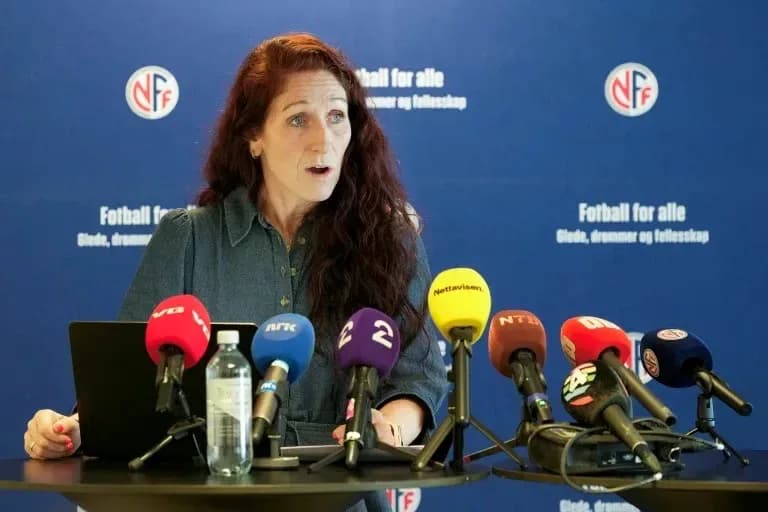
Lise Klaveness: The Reluctant Rebel Challenging FIFA
Lise Klaveness has spent years needling FIFA from the margins of world football politics. Now, with Gianni Infantino under growing fire, the head of the Norwegian federation suddenly finds herself being talked about as something far more dangerous to the status quo: a credible alternative.
She is 45, a lawyer, and a former Norway international with 73 caps. One of the very few women operating at the top of the game. And she has chosen not to play along.
When Infantino swept into power in 2016, promising reform and clean governance, many in football dared to believe him. Klaveness was among those who took note of the rhetoric. Then she watched what followed.
“Things quickly deteriorated,” she told AFP. The distance between FIFA and political power shrank. Independence eroded. Host nations and heads of state loomed ever larger in the background. The reformer’s mask slipped.
Last week, after Infantino’s plan to open FIFA competitions — including the World Cup — to private investors was slapped down, the tension snapped. On Friday, Klaveness openly called for him to resign.
For FIFA, this was not a lone voice in a distant corner of Europe. This was the culmination of a campaign that began years ago.
The first shot: Qatar
Her first major clash with Infantino came in 2022, shortly after she took charge of the Norwegian federation. She went straight to the heart of FIFA’s most sensitive subject: the Qatar World Cup.
Standing in Doha, in the host country’s own backyard, she said what many in football had only whispered. Human rights. Equality. Democracy. None of them, she argued, had made FIFA’s “starting 11” when the tournament was awarded.
It was a direct, public challenge to the way football’s biggest event had been handed out. The message was clear: the game’s values had been benched.
A year later, Norway refused to back Infantino’s re-election. Symbolically, that mattered. A small federation, far from the traditional power blocs, was willing to break ranks and say no.
“She was in a way the first standard-bearer for much of this criticism that many others now share when it comes to the way Infantino runs FIFA,” noted Mina Finsted Berg, a sports commentator for Norwegian channel TV2. Klaveness, she said, is obsessed with one thing: that rules and decisions actually mean something.
Trump, Balogun and a ‘Peace Prize’
If Klaveness sounded alarmed before, recent months have only sharpened her anger.
On the charge sheet: FIFA’s decision to award a “Peace Prize” to US President Donald Trump, a leader with whom Infantino has cultivated a conspicuously close relationship; the lifting of US player Folarin Balogun’s suspension at the 2026 World Cup after an intervention from Trump; and the now-aborted attempt to invite private investors into FIFA’s competitions.
Norway’s response has been unusually direct for a national association. The federation is taking all three issues to FIFA’s Ethics Committee. It is not subtle diplomacy. It is confrontation.
Her influence has grown in step with Norway’s resurgence on the pitch. Long absent from the latter stages of major tournaments, the national team produced a strong run at this year’s World Cup, reaching the quarter-finals before bowing out to England. The timing has given her words more weight. This is not a federation clinging to nostalgia; it is one with a live stake in football’s future.
Internationally, commentators have begun to describe her as having a “strong moral compass”. The phrase has stuck. So has a more provocative idea: if Infantino were to step aside, Klaveness is being talked about as a serious candidate to replace him.
For now, that remains hypothetical. Infantino is standing again next March, seeking a fourth and final term. He is, at present, the only declared candidate.
Yet even one of his most notorious predecessors sees the shift.
“She was the only one who always took a clear stand and did not go along with the mainstream. And at FIFA, the time is right for a woman to take the lead,” former FIFA president Sepp Blatter wrote on X. The irony is obvious: a disgraced ex-leader, forced out in a corruption scandal, now endorsing a reformist critic.
Not a ‘Game of Thrones’, but a battle for control
Klaveness has tried to keep the drama at arm’s length. She refuses to cast this as a personal duel with Infantino or a simple palace intrigue.
“The problems go beyond the person of the president,” she told AFP, stressing that the crisis in world football cannot be reduced to a “Game of Thrones” storyline. For her, the fight is about structures, not personalities. Governance, not grudges.
She also knows the talk around her name is getting louder. She admits she has “registered” that she is being mentioned as a possible successor. Then she shuts the door. “We’re not there yet,” she says when asked directly if she is a candidate.
The hesitation is not just modesty. The path to the FIFA presidency is littered with obstacles.
The ballot box reality
In large parts of the world, Klaveness is not seen as a cautious reformer. She is viewed as radical. Too outspoken. Too willing to challenge the old alliances. And, in many regions, she faces another blunt fact: she is a woman.
That matters in the politics of global football. It counts against her in ways that are rarely spoken aloud but often decisive in backroom calculations.
Even within UEFA, where her ideas might be expected to find the warmest reception, the road has been rough. In 2023, she failed in her attempt to win a seat on the Executive Committee. Only in 2025 did she finally enter that room, and then only as the sole candidate for the seat reserved for women.
The message from the voting blocs was clear: change is tolerated, but only on tightly controlled terms.
“If she already has such a hard time getting elected in Europe, how could she convince Africans and South Americans?” asked Erik Thorstvedt, the former Norway goalkeeper turned commentator. It is a question that cuts to the heart of FIFA’s power map.
For now, Klaveness remains what she has been for years: an unflinching voice on the edge of football’s inner circle, firing shots at the game’s most powerful man while insisting the battle is bigger than either of them.
The next election will reveal whether that voice stays outside the door — or whether world football is finally ready to let someone like her walk through it.





