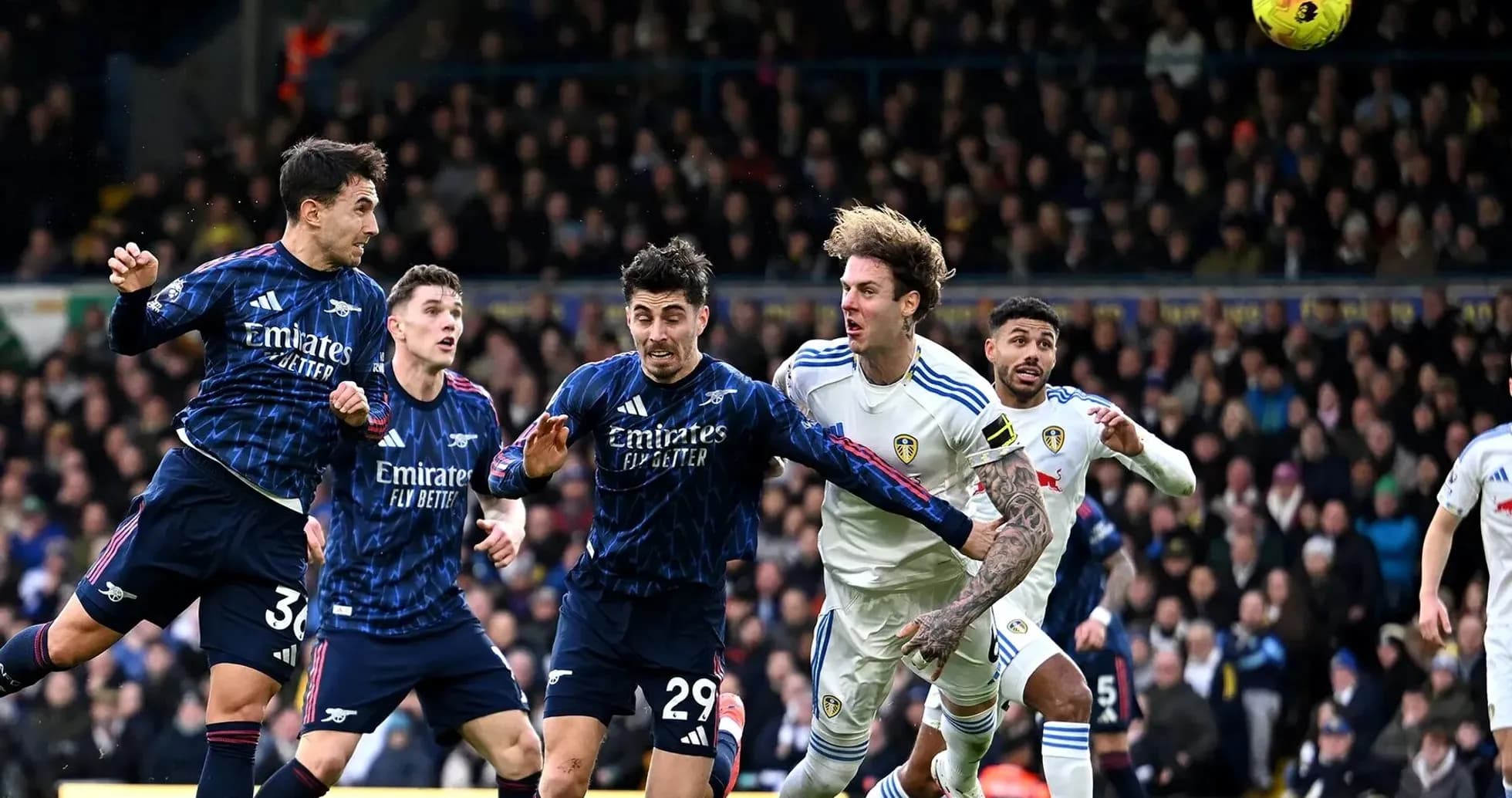
Leeds' Tactical Resilience in 1-0 Victory Over Brighton
Leeds’ 1-0 win over Brighton at Elland Road was a classic low-possession, high-resilience performance, built on a compact 3-5-2 and ruthless late execution. Despite having just 34% of the ball and generating only 0.76 xG, Daniel Farke’s side absorbed sustained pressure from a Brighton team that posted 66% possession, 19 shots and 2.7 xG, then struck on 90 minutes through Dominic Calvert-Lewin. The tactical story is one of structural discipline without the ball, intelligent use of wing-backs and forwards in transition, and a goalkeeper-led defensive unit that bent but did not break against Fabian Hurzeler’s expansive 4-2-3-1.
Section II: Scoring Sequence & Disciplinary Log
The match remained goalless through a first half in which Brighton controlled territory and tempo but could not convert their volume of chances. Leeds’ defensive shape and last-line interventions kept the score at 0-0 at half-time, matching the half-time scoreline in the official record.
The decisive moment arrived at 90'. D. Calvert-Lewin (Leeds) scored a Normal Goal, with no assist recorded in the data. That strike, coming against the run of underlying numbers, sealed a 1-0 full-time score in favour of the home side.
Disciplinary action was minimal but late. There was exactly one card in the match, all for Leeds, total 1. Chronologically:
- 90+7' Dominic Calvert-Lewin (Leeds) — Yellow Card (additionalInfo: null)
No Brighton player was booked, and there were no red cards. The discipline profile reflects Leeds’ controlled aggression and Brighton’s largely unpunished territorial dominance.
Section III: Tactical Breakdown & Personnel
Leeds lined up in a 3-5-2 under Daniel Farke, with K. Darlow in goal behind a back three of S. Bornauw, J. Bijol and J. Rodon. The wing-backs, J. Justin on the left and D. James on the right, formed the outer lanes of a five-man midfield alongside central trio A. Tanaka, E. Ampadu and A. Stach. Up front, B. Aaronson played off D. Calvert-Lewin.
Out of possession, this structure flattened into a 5-3-2, with James and Justin dropping deep to create a line of five against Brighton’s wide and half-space threats. Ampadu anchored the midfield screen, while Tanaka and Stach shuttled laterally to close passing lanes into P. Gross and C. Baleba. The compactness between lines forced Brighton to circulate the ball in front of the block, contributing to their high passing numbers (542 passes, 457 accurate, 84%) but also to a shot profile heavily weighted inside the box (15 shots in the area) that still found resistance at the final moment.
In possession, Leeds were direct and selective. With only 278 passes (186 accurate, 67%), they rarely tried to build slowly against Brighton’s press. Instead, Darlow and the back three looked early for Calvert-Lewin’s runs into the channels and Aaronson’s movement between lines. The wing-backs provided the main width, advancing aggressively when Leeds broke the first line, which helped generate seven total shots despite limited territory.
The substitutions at 60' were a key tactical pivot. W. Gnonto (IN) came on for D. James (OUT), J. Lienou (not used) stayed on the bench, but crucially:
- L. Nmecha (IN) came on for B. Aaronson (OUT) at 60'.
- S. Longstaff (IN) came on for A. Tanaka (OUT) at 60'.
These changes injected fresh legs and a slightly more vertical threat. Gnonto’s pace on the flank and Nmecha’s direct running offered Leeds better outlets on the counter, while Longstaff added energy in midfield to continue disrupting Brighton’s rhythm.
At 74', J. Piroe (IN) came on for A. Stach (OUT), further tilting Leeds’ approach towards having more finishing presence around Calvert-Lewin. The late defensive switch at 90+1', with S. Byram (IN) for S. Bornauw (OUT), was a classic game-management move, freshening the back line to protect the narrow lead.
Brighton’s 4-2-3-1 under Fabian Hurzeler featured B. Verbruggen in goal behind a back four of M. De Cuyper, L. Dunk, J. P. van Hecke and J. Veltman. C. Baleba and P. Gross formed the double pivot, with F. Kadioglu, J. Hinshelwood and Y. Minteh supporting D. Welbeck. Their structure in possession resembled a 2-3-5 at times, with full-backs advancing and Gross orchestrating from deep. The substitutions at 65' (D. Gomez (IN) for J. Veltman (OUT), G. Rutter (IN) for D. Welbeck (OUT)) and 82' (Y. Ayari (IN) for C. Baleba (OUT), C. Kostoulas (IN) for J. Hinshelwood (OUT)) maintained their attacking intent but did not change the fundamental dynamic: Brighton dominated territory but struggled to convert.
Goalkeeper reality was stark. K. Darlow registered 7 Goalkeeper Saves against Brighton’s 2.7 xG and a team goals prevented of -0.01, indicating that while the model suggests he conceded fractionally more chance quality than an average keeper might, his volume of interventions was still central to the clean sheet. At the other end, B. Verbruggen made 1 save, with Brighton’s goals prevented also at -0.01, underlining how little Leeds created outside the decisive moment.
Section IV: The Statistical Verdict
Statistically, this was Brighton’s game in everything but the scoreline. They out-shot Leeds 19-7, with 8 shots on goal to Leeds’ 1, and forced 7 saves from Darlow. Their xG of 2.7 dwarfed Leeds’ 0.76, and their 66% possession with 542 passes (457 accurate, 84%) reflects sustained control and territorial pressure.
Leeds’ 34% possession and 278 passes (186 accurate, 67%) underline a reactive, counter-oriented plan. Yet they matched Brighton in key rest-defence aspects: only 7 fouls to Leeds’ 9, and corners were close (8-7 to Brighton), suggesting Leeds were not simply camped in their box but managed to push play away from the most dangerous zones often enough.
Discipline was clean: Leeds 1 yellow card, Brighton 0, total 1. The absence of multiple cautions supports the picture of a tactically disciplined, rather than desperate, defensive performance from the hosts. Ultimately, the numbers say Brighton should have taken something; the tactical reality is that Leeds executed their low-block and transition plan with enough precision to make one chance count and protect it to the final whistle.