Everton vs Sunderland: Tactical Analysis of a 1-3 Defeat
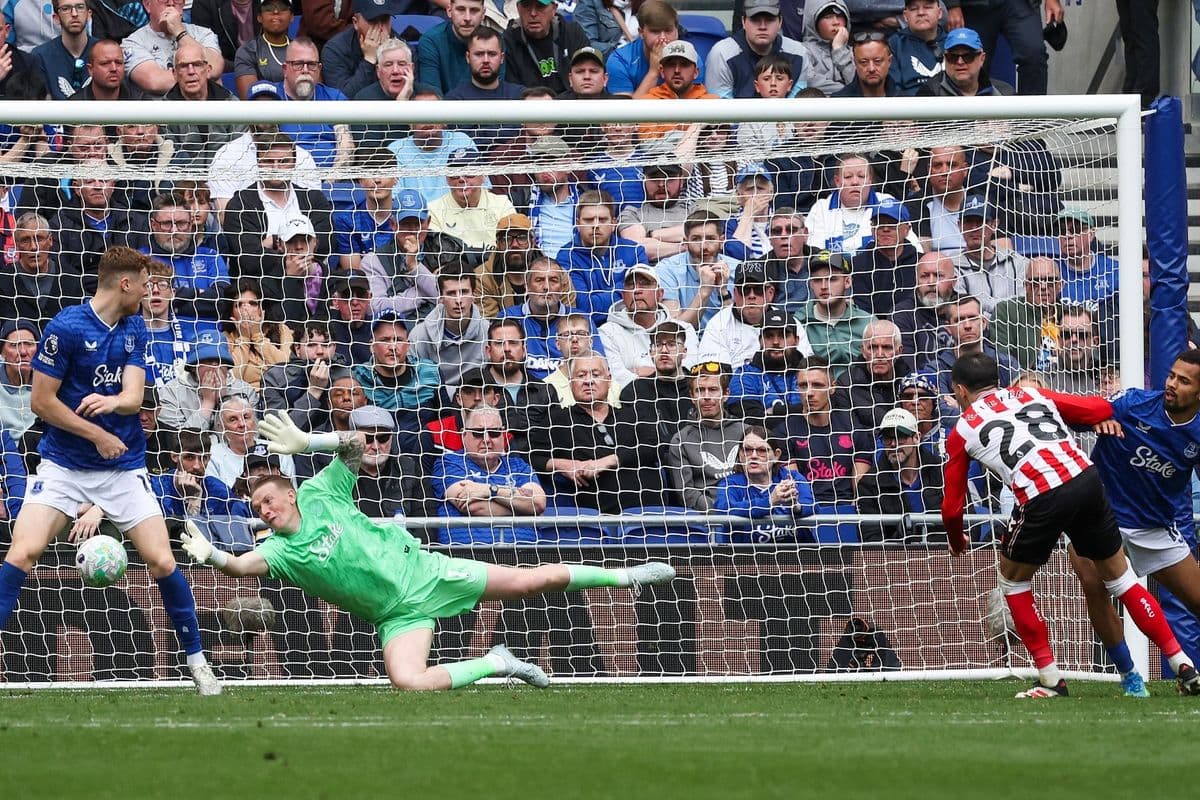
Everton’s 1-3 home defeat to Sunderland at Hill Dickinson Stadium unfolded as a tactical story of control without incision versus compactness and ruthless transition. Both sides lined up in a 4-2-3-1, but the way they interpreted the shape diverged sharply after half-time, flipping a 1-0 Everton lead into a Sunderland comeback win in this Premier League Regular Season - 37 fixture.
Everton’s structure under Leighton Baines was clear: Jordan Pickford behind a back four of Jake O’Brien, James Tarkowski, Michael Keane and Vitaliy Mykolenko, with Tim Iroegbunam and James Garner as the double pivot. Ahead, a fluid band of three – Marcel Rohl central, Kiernan Dewsbury-Hall left, Iliman Ndiaye right – worked off Beto as the lone striker. In possession, this resembled a 2-3-2-3: the full-backs pushed, one pivot (often Iroegbunam) dropped between the centre-backs, and Rohl stepped into the half-spaces to connect.
That pattern underpinned Everton’s early control. They finished with 49% possession but a strong passing base – 406 passes, 346 accurate (85%) – showing a deliberate, short-passing build. Their 10 total shots (4 on target, 2 blocked) came largely from structured attacks rather than chaos. The breakthrough on 43 minutes encapsulated the plan: M. Rohl timed his movement into the final third, combining with M. Keane, whose assist from deeper defensive territory highlighted Everton’s intent to use the centre-backs as playmakers. Rohl’s goal for 1-0 rewarded Everton’s territorial tilt and their willingness to commit the No. 10 beyond Beto.
Out of possession, however, the same 4-2-3-1 showed its fragility. Iroegbunam’s early yellow card on 25 minutes for “Foul” constrained his ability to break up play aggressively. With Garner also tasked with progression, the double pivot often got stretched horizontally by Sunderland’s midfield rotations, particularly as Granit Xhaka and N. Sadiki alternated dropping and stepping on. Everton’s 14 Fouls and three late yellows (Iroegbunam 25', Jake O’Brien 47', James Garner 90+6', all “Foul”) spoke to a team increasingly reacting rather than dictating defensively.
Sunderland, under Regis Le Bris, mirrored the 4-2-3-1 on paper but leaned far more into verticality and transition. R. Roefs in goal sat behind a back four of Lutsharel Geertruida, Nordi Mukiele, O. Alderete and Reinildo Mandava, with Xhaka and Sadiki as the screening pair. The line of three – Trai Hume right, Enzo Le Fee central, N. Angulo left – supported B. Brobbey up front. Sunderland’s 51% possession and 430 passes (365 accurate, 85%) show they were comfortable on the ball, but their real edge came from how quickly they converted regained possession into direct attacks.
The first significant tactical adjustment came as early as 23 minutes, when O. Alderete (OUT) made way for L. O’Nien (IN). This early defensive change hinted at either an issue with Alderete or a desire for a different profile in the back line, possibly to improve Sunderland’s build-up angles or mobility against Beto. It did not immediately alter the scoreline, but it stabilised Sunderland’s back four and gave them more confidence to hold a slightly higher line.
Everton’s second-half problems began with the game-state. At 1-0 up, they tried to manage rather than press, yet their press triggers became half-hearted. Sunderland exploited this on 59 minutes: B. Brobbey’s equaliser, assisted by E. Le Fee, came from Sunderland’s ability to play through the first line and then attack the spaces between Everton’s midfield and defence. Le Fee’s positioning as a classic No. 10, finding pockets between Garner and the centre-backs, repeatedly pulled Tarkowski and Keane into uncomfortable decisions.
Immediately after the leveller, Sunderland doubled down on their attacking intent. On 60 minutes, T. Hume (OUT) was replaced by C. Talbi (IN), a substitution that freshened the attacking midfield band and added more direct running. The decisive tactical swing, however, came in the triple change at 77 minutes: N. Angulo (OUT) for C. Rigg (IN), N. Sadiki (OUT) for H. Diarra (IN), and B. Brobbey (OUT) for W. Isidor (IN). Le Bris effectively re-armed his front four with energy and pace, turning the shape into a more aggressive, counter-attacking 4-2-3-1.
These changes directly fed the 81st-minute goal. E. Le Fee, now with fresher runners around him, struck Sunderland’s second, assisted by C. Rigg. The pattern mirrored the equaliser: Sunderland breaking lines centrally, then exploiting Everton’s retreating back four with late runs from midfield. Everton’s response – a double change at 73 minutes, with T. Iroegbunam (OUT) for T. George (IN) and Beto (OUT) for T. Barry (IN), followed by J. O’Brien (OUT) for S. Coleman (IN) and M. Rohl (OUT) for D. McNeil (IN) at 88 minutes – was more reactive than strategic. Removing both the starting pivot (Iroegbunam) and focal striker (Beto) diluted their structure: George offered energy but less positional discipline, Barry a different type of movement but not the same hold-up play.
By the time Everton’s reshaped front line tried to chase the game, Sunderland had settled into a compact mid-block, springing forward when opportunities arose. The final blow at 90 minutes, W. Isidor scoring Sunderland’s third from an H. Diarra assist, was the purest expression of their transition plan: fresh forwards isolating Everton’s tiring defenders, exploiting the spaces left by a home side pushing bodies on.
Statistically, the match underlines the tactical narrative. Everton generated 1.07 xG from 10 shots, Sunderland 0.73 xG from just 7 shots. Sunderland’s clinical edge – three goals from three shots on target – combined with R. Roefs’ 3 Goalkeeper Saves and 0.02 goals prevented to tilt the outcome. By contrast, Pickford registered 0 Goalkeeper Saves, with 0.02 goals prevented, underlining that Sunderland’s on-target efforts were either high quality or poorly contested.
Everton’s Overall Form template of structured possession and controlled passing was visible, but their Defensive Index in this match sagged: 14 Fouls, three yellow cards and no meaningful protection of the central lane once legs and concentration faded. Sunderland, with only 9 Fouls and no cards, managed the game-state with greater composure. In a match where both teams passed accurately and shared possession almost evenly, it was Sunderland’s superior in-game tactical adjustments and exploitation of transitions that turned a balanced contest into a 1-3 away win.