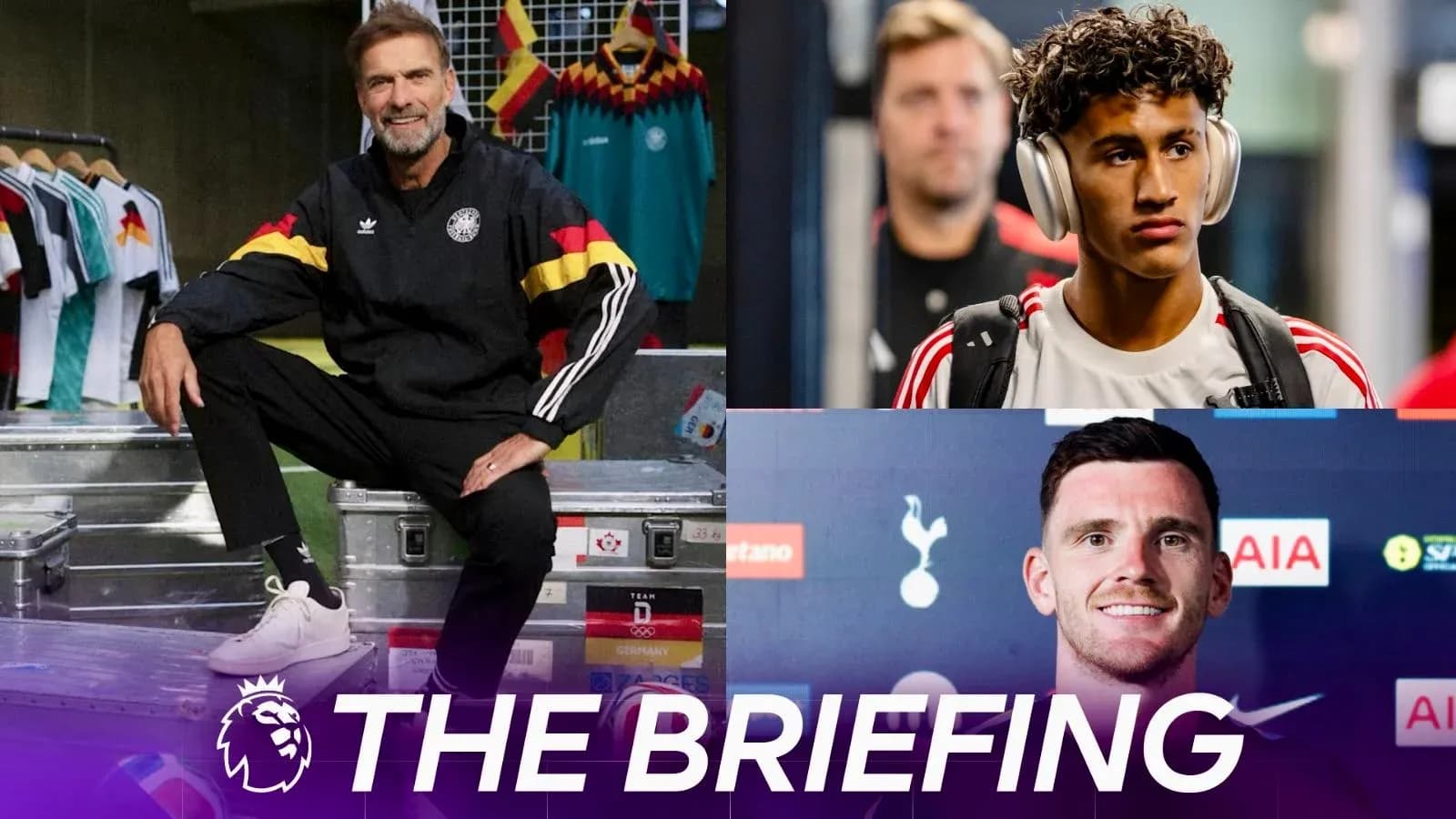
Klopp Takes Germany Job Ahead of 2030 World Cup
Jurgen Klopp is back. Not in a dugout in Liverpool or Dortmund, but in the one job that always felt like the final act of his career: head coach of Germany.
The 57-year-old has been confirmed as the new national team boss on a contract running through to the end of the 2030 FIFA World Cup, marking his return to frontline management for the first time since he walked away from Liverpool in 2024 citing sheer exhaustion after nine relentless years.
At Anfield he collected almost everything: a Premier League title, a UEFA Champions League, a FIFA Club World Cup, and a stack of domestic and European near-misses that only underlined how consistently his Liverpool sides lived at the sharp end of the game. Then he stopped. “Fatigue” was the word he chose, and it showed. The break felt permanent.
Now he steps into one of the most pressurised roles in world football, at a time when German football is licking its wounds.
A fallen giant, a seismic appointment
Germany are at one of their lowest ebbs in the modern era. Julian Nagelsmann resigned last month after a dismal round-of-32 exit to Paraguay, a result that crystallised years of drift and self-doubt.
The German Football Federation has responded by handing the keys to the most charismatic, transformative coach of his generation. Klopp will lead Germany through the next UEFA European Championship and on into the 2030 World Cup, with a brief that goes far beyond tactics or team selection. This is about identity.
He knows it. He felt it. And he admitted as much.
“Over the last few days it was almost like a movie happening to myself," said Klopp, who had been serving as Red Bull’s global head of soccer since late 2024. The role kept him in the game, but at arm’s length. This is different. This is the spotlight.
“I have always surmised the job of Germany head coach is really big, but now it is really dawning on me what being the national team head coach is all about.
“For many, many years it was unimaginable for me to assume this position. As the years went by, it became more or less evident that sooner or later I would be asked to do this job. Now I think the time is right.”
The words are classic Klopp: reflective, but decisive. He has never hidden his emotional pull towards the national team, he just never felt the moment was right. Until now.
Familiar faces, new power structure
Klopp will not walk into the DFB alone. He is bringing his trusted lieutenants with him.
Pep Lijnders and Peter Krawietz, long-time assistants at Liverpool, will once again form the core of his coaching team. Their presence means Germany are not just hiring a head coach; they are importing a fully formed technical operation that has already proved it can build and sustain an elite side.
There is change above him too. Per Mertesacker, the former Germany centre-back and World Cup winner, will become the DFB’s new sporting director in January. Mertesacker leaves his role overseeing Arsenal’s academy after the 2025/26 season, stepping into a job that will shape the national team’s pathway from youth to senior level.
A rebuilt hierarchy, a new coaching brain trust, a squad in need of direction. The scale of the reset is obvious.
A first test with a familiar face
Klopp’s first game in charge could hardly be more symbolic. Germany will face the Netherlands in September, captained by Virgil van Dijk – the defender who became the cornerstone of Klopp’s Liverpool.
The reunion adds a human twist to an already heavyweight fixture. For German fans, though, the intrigue runs deeper: how quickly will Klopp’s fingerprints appear on this side? Will the pressing return, the aggression, the emotional connection with the stands?
The questions will start in September. The judgment will run all the way to 2030.
In Trondheim this week, Manchester United supporters may get their first live look at a name they have been whispering about for months: JJ Gabriel.
The 15-year-old forward has been included in the senior squad for the first time for Friday’s pre-season friendly against Rosenborg, part of a 25-man travelling party that hints at how highly United rate him.
Gabriel dominated the Under-18 Premier League last season despite starting the campaign at just 14. He finished as the competition’s standout player, officially named Under-18 Premier League player of the season.
The rules kept him out of the limelight. Academy players must have turned 15 before the end of August to be eligible for that Premier League season, so he was barred from senior squads.
It barely slowed him down.
Numbers that demand attention
Gabriel scored 29 goals in 32 appearances for United’s Under-18s, driving the team to the FA Youth Cup final and the Premier League Under-18 Cup final. The output was ruthless, the performances mature.
Naturally a winger, he spent much of last season operating through the middle, learning how to occupy centre-backs and lead the line. Around Carrington, he became a regular sight at first-team training, even if he could not be named in senior matchday squads.
The club’s history hangs over him. The youngest player ever to feature in a competitive match for United remains David Gaskell, who debuted in 1956 as a 16-year-old goalkeeper, 16 years and 19 days old. Gabriel will not turn 16 until October.
His manager knows the stakes.
“JJ’s a big talent,” Michael Carrick said last season. “It’s pretty obvious to know that. And he’s had a really good season for the Under-18s. We obviously think an awful lot of him, but patience is important in managing everything that comes with working with him.”
The excitement is real. So is the caution. Trondheim is not a coronation, but it is a first glimpse of what might be coming next at Old Trafford.
Newcastle United’s recruitment strategy is becoming impossible to ignore. They are not just signing young players; they are building a squad whose average age is tumbling window by window.
The latest arrival is Aladji Bamba, a 20-year-old central midfielder who only made his professional debut for Monaco last season. Newcastle have moved quickly, seeing opportunity where others saw inexperience.
Bamba’s signing drags the average age of Newcastle’s summer arrivals down to 19.5. He joins goalkeeper Ewen Jaouen (20) from Reims, winger Bazoumana Toure (20) from Hoffenheim and central midfielder Sean Steur (18) from Ajax in a window that has been defined by youth.
The backdrop is stark. Sandro Tonali has gone to Tottenham Hotspur. Anthony Gordon has departed for Barcelona. Two pillars of Eddie Howe’s side have left, forcing Newcastle to think long-term rather than plug gaps with short-term fixes.
A profile built for the Premier League
Bamba might prove central to that rebuild. Although capable of playing higher up the pitch, he is naturally more defensive-minded and could grow into a long-term successor to Tonali at the base of midfield.
The numbers from his first Ligue 1 season are striking. Among midfielders who played at least 500 minutes, Bamba ranked in the top five for duels won (9.1 per game on average), tackles (3.6), successful take-ons (1.6) and aerial duels won (1.9).
Those are the metrics of a player who relishes contact, covers ground and can break lines with the ball as well as without it. For a Newcastle side looking to refresh without losing intensity, it is a calculated bet on potential and profile rather than reputation.
The risk is obvious. So is the upside.
Andy Robertson has not even kicked a ball for Tottenham Hotspur yet, but he has already made a decision that will resonate with the club’s supporters.
The Scotland captain, signed this summer after a nine-year spell at Liverpool, has chosen not to wear his traditional No 26 shirt out of respect for Spurs legend Ledley King. Instead, he will take the No 3.
Robertson has worn 26 throughout most of his domestic career – at Dundee United, Hull City and Liverpool – yet at Spurs that number carries a different weight. No player has worn 26 since King, the former captain and now club ambassador, retired in 2012.
“From my point of view, I wanted to respect that,” Robertson said. “He was an unbelievable player and has done so many good things for this football club.
“Number 3 means a lot to me – that’s my national team number, I’ve had so many good memories as number 3 for Scotland so when I knew 3 was going to become available, it was a no-brainer for me."
It is a small gesture, but a telling one. A new signing walking into a dressing room shaped by a different generation, acknowledging the history before writing his own chapter.
New shirt, new tour, same edge
Robertson is expected to make his Spurs debut on the club’s pre-season tour of New Zealand and Australia, with potential first appearances coming against Auckland, Sydney FC or Chelsea.
The left-back has already settled into the squad dynamic, at least if social media is any guide. After Robertson revealed that James Maddison is his closest friend in the group, Maddison posted a photo of the Scot looking distinctly unimpressed on the long-haul flight to New Zealand, captioned: “He better liven up if he’s my company for this 26 hour flight.”
Twenty-two hours later, Maddison followed up with another picture. This time Robertson was smiling.
New coaches reshaping nations, teenagers breaking through at giants, ambitious clubs betting on youth, a Champions League winner changing numbers to honour a club icon. The season has not even started, yet the storylines are already stacking up.