Just Fontaine's Unmatched World Cup Legacy
Just Fontaine scored 13 goals at a single World Cup. That number alone sounds absurd in the age of data, xG and defensive structures. Then you remember he did it in six games, in borrowed boots, and was not even meant to start.
He did not leave Sweden in 1958 with a Golden Boot trophy. A Swedish newspaper handed him an air rifle instead, a tongue-in-cheek prize for a “sharp shooter”. The official recognition came later. The myth, strangely, did not.
Every four years his name is dusted off, polished for a few weeks and held up as the yardstick for the latest generation of scorers. Then it slips back into the realm of pub quiz questions and football anoraks.
Yet here, at the 2026 World Cup, his shadow feels unusually long.
Lionel Messi, Kylian Mbappe, Erling Haaland and Harry Kane are locked in a Golden Boot shootout that feels like a crossover of eras. Since 1970, only three World Cup top scorers have gone beyond six goals. Mbappe already has eight. Messi and Haaland sit on seven. Kane and Jude Bellingham lurk one behind.
The expanded 48‑team format gives them an extra helping hand. Sides that reach the semi-finals now play eight matches, not seven. More minutes, more penalties, more chances to chase a ghost.
Yet even with that cushion, they are still staring up at Fontaine, the man who did it in six.
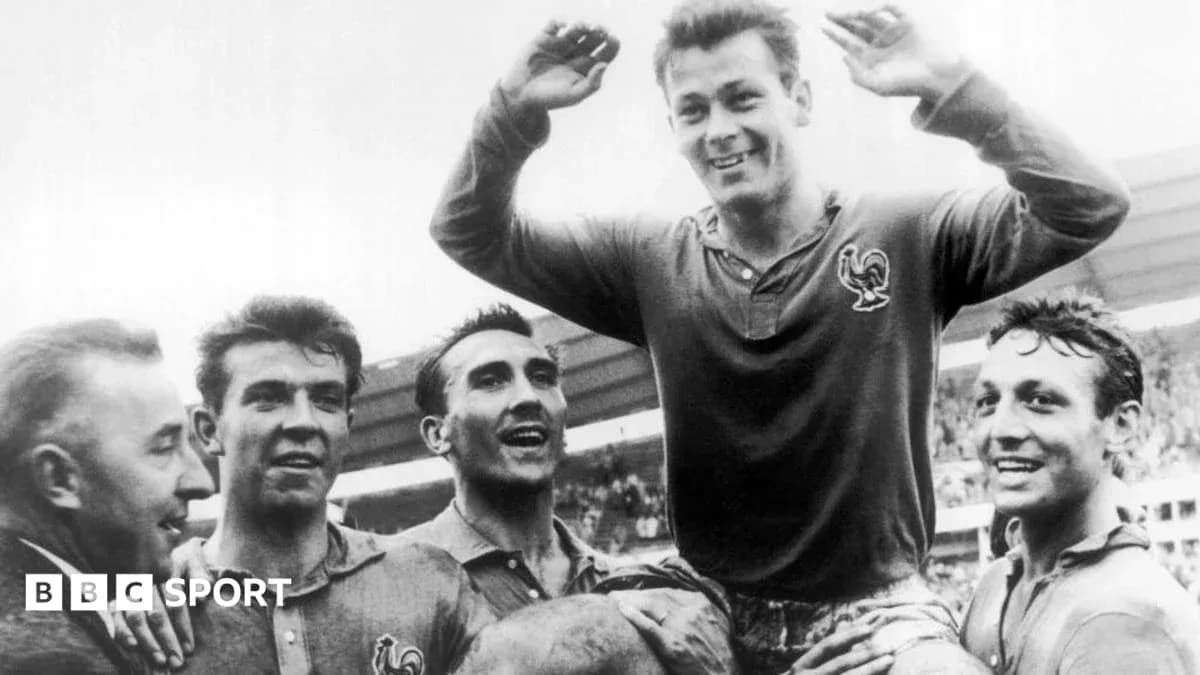
To younger audiences, Fontaine is almost an abstraction. Pele, Messi and their peers live in endless video clips and marketing campaigns. Fontaine, for many, is a number and a black-and-white photograph. Trivia, not legend.
That sells him desperately short.
A World Cup derby he never imagined
The quarter-final between France and Morocco in 2026 carried his name without him being there to see it. The Just Fontaine derby. A neat label for a life that never fit neatly into anything.
He was born in Marrakesh in August 1933, when Morocco was still a French protectorate. By the time Morocco gained independence, two years before the 1958 World Cup, Fontaine was already an established striker in French football. The choice was made for him. He would wear blue, not red and green.
Les Bleus gained a ruthless finisher. Morocco lost the man who might have been their first global superstar.
And even then, France did not plan to build the team around him in Sweden.
“He was not actually first choice – a team-mate [Rene Bliard] got injured in a warm-up game,” sports journalist and historian Philip Barker told BBC Sport. The change came so late Fontaine did not have boots that fit. He borrowed a pair from Stephane Bruey for the opening game.
Imagine that now. A World Cup record about to be set in someone else’s shoes.
Fontaine had undergone knee surgery on his meniscus during the season. His place at the tournament was in doubt. The operation left him fresher than most by the time the World Cup kicked off. While others dragged tired legs into Sweden, Fontaine arrived with energy – and something to prove.
He had only five caps when manager Albert Batteux promoted him to the starting XI. But he was hardly a mystery.
At club level he was already a star. Fontaine played for Reims, who completed a league and cup double in 1957-58. It was one of four Ligue 1 titles he won – one with Nice, three with Reims. A year after the World Cup, he would drive Reims all the way to the European Cup final, scoring 10 goals to finish as the competition’s top scorer, only to run into Real Madrid’s juggernaut.
Inside the French camp, respect was instant. Raymond Kopa, the team’s leading light and soon-to-be 1958 Ballon d’Or winner, rated him highly. Fontaine finished third in that Ballon d’Or voting, a reminder that his peers knew exactly how good he was.
“Fontaine shared a room with Kopa on international duty, this legendary player for Real Madrid,” Barker said. “They spoke about their understanding of the game. So he came into the team, and took to it like a duck to water.”
No pressure, just goals
The world did not descend on players then as it does now. Speaking to the BBC in 2002, Fontaine remembered a far lighter atmosphere.
“In those days there was not so much pressure on us,” he said. “Only two journalists followed the team around.
“Our team bosses were so convinced we would be knocked out that they only gave us three shirts each, so we were totally free from pressure.
“My mind was not on the goals record at all. I even turned down the chance to take a penalty in the third-place game!”
He went to Sweden not as a man chasing immortality, but as a striker chasing chances.
The first game lit the fuse. France beat Paraguay 7-3 in Group Two, Fontaine scoring a hat-trick. From there, he never stopped. He scored in every match, including the semi-final defeat to Brazil, when a 17-year-old Pele announced himself to the world and France were beaten 5-2 by a side that would go down as one of the greatest of all time.
The third-place play-off against West Germany offered Fontaine one last swing. He responded with four more goals in a 6-3 win. Thirteen in total. One tournament. One man.
The scale is extraordinary. The style might be even more striking.
A striker built for any era
This was the age of heavy leather balls and flimsy protection for goalkeepers, when forwards could crash into keepers with near impunity. Yet Fontaine did not bully his way to the record. Watch the footage and he looks like a striker lifted from a modern Champions League tie.
Against Paraguay, he times late runs into the box, bends his movement to break the offside trap and passes the ball into corners rather than simply thrashing it. There is pace, but also calm. A sense that he always knows where the space will open.
“Fontaine looks like a modern striker, he has so much pace,” Barker said. “He was a leader of the attack in the English style, said L’Equipe – courageous, combative, stubborn.
“Then scoring a hat-trick in your first game of the tournament, that must give you so much confidence.”
His third goal against West Germany stands out. He collects the ball near halfway, surges beyond defenders and slides his finish into the far corner. For those of a different generation, it calls to mind Michael Owen’s famous run and finish against Argentina in 1998. Same idea, different boots.
Fontaine’s avalanche of goals also suited the tournament. The 1958 World Cup produced 126 goals, the second-highest tally in a 16-team edition after 1954. France were the competition’s most prolific side with 23.
With Fontaine and Kopa at the heart of it, Barker believes that French team deserves to stand alongside the country’s more celebrated vintages.
“The 1958 tournament was the last real goal-fest tournament. You had the emerging Brazil team with Pele, but also the French team were all-time greats,” he said.
“We talk about the 1998 and 2018 teams, but this was the first great French team. The front five scored 22 goals, that shows how powerful they were.
“Yes, the defences are a bit slow, but the way France move the ball, they would score against any team. Fontaine was also setting up goals for Kopa, they are such a slick team.
“France were only stopped by 1958 Brazil, one of the greatest teams of all time. We are not talking school five-a-side, these are real standards.”
France never got the chance to build on that platform with Fontaine at the World Cup. Injury cut his international career short. He never returned to the biggest stage. It is hard not to wonder what France might have achieved in 1962 or 1966 with that kind of finisher still leading the line.
Beyond the goals
Fontaine did not drift away when the goals stopped. He helped shape the modern game in quieter ways.
He co-founded the French players’ union, the UNFP, in 1961 and became its first president, fighting for players at a time when their rights were limited and their careers fragile. He moved into management too, taking charge of France for two games in 1967, later coaching PSG and Toulouse, before returning to his birthplace for a two-year spell with Morocco.
“He set up the union, he coached, he ran a couple of sports shops,” Barker said. “From time to time, people would ask who the World Cup record holder was, and he would still relish the fact people would remember him.
“Fontaine used to joke that if he came back in 200 years, his record would still be going. L’Equipe called it ‘unbeatable’.”
He lived long enough to see France win two World Cups and to watch Mbappe emerge as the new spearhead of the French attack. He saw his country lift the trophy in 1998 and 2018, saw Mbappe tear through the 2018 and 2022 tournaments, and saw the conversation return again and again to that number: 13.
Fontaine died on 1 March 2023, aged 89. He left behind a record that has survived tactical revolutions, rule changes and generations of forwards.
Now Mbappe, Messi, Haaland, Kane and Bellingham are edging closer than anyone has for decades. The numbers are stacking up. The games are running out.
“How appropriate it would be if Mbappe beats him?” Barker wondered.
If someone does finally climb past 13, the record will fall. The story will not. The man who borrowed boots and walked into history will still be there, waiting at the heart of every future World Cup goals race, daring the next great striker to match him.