
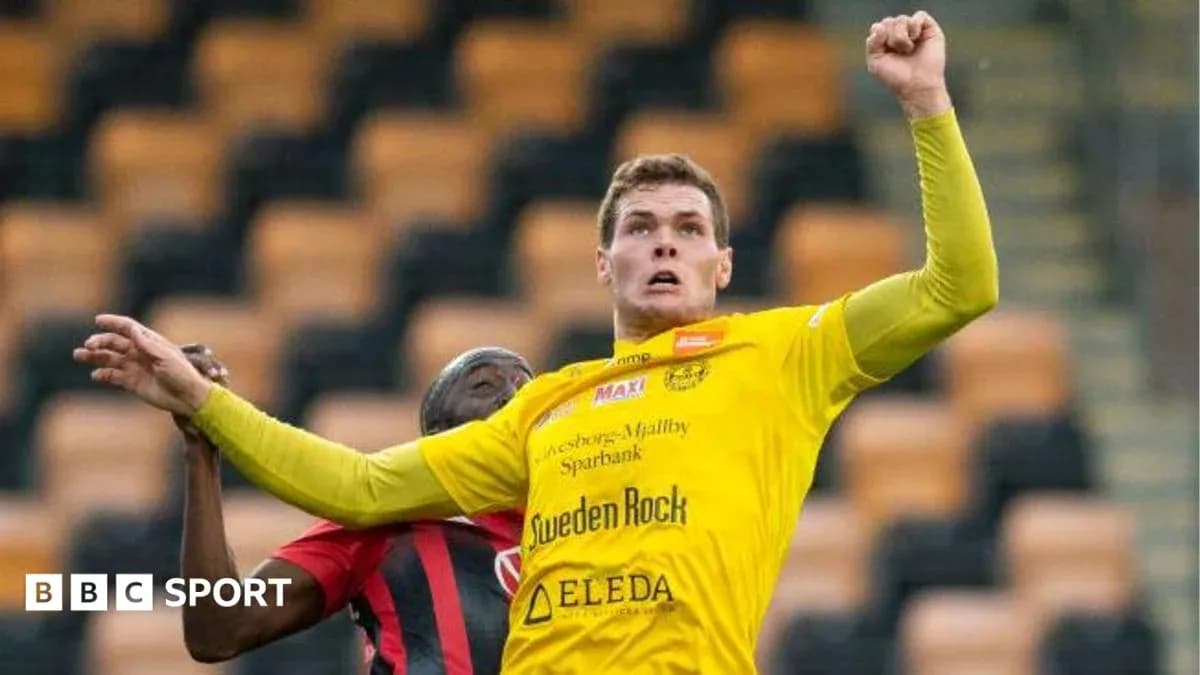
Jacob Bergström: From Amateur to Swedish Champion
Jacob Bergström parks his bike, not a sports car, outside Strandvallen.
The air smells of salt from the Baltic Sea and grilled sausages from the kiosk. A jazz band is warming up, yellow-and-black flags whip in the coastal breeze, and 3,500 people squeeze into a ground tucked between woods, a campsite and an outdoor pool.
This is not where Champions League dreams are supposed to live. Yet here is a 31-year-old former Subway worker from Blekinge, trading challenges with Yaya Touré’s Slovan Bratislava.
From sandwich counter to Swedish champion
Bergström’s route to this stage looks nothing like the polished academy pathway that usually feeds Europe’s elite.
He never made it into a youth academy. At 22, he was still playing amateur football. At 24, he was still making sandwiches to pay the bills, even after signing for Mjällby in 2018. Professional football was a late promotion, not a birthright.
“When I first came here, we were in the third division,” he tells BBC Sport. “I was so happy to sign. It was so big to me then.”
The scale has changed. The feeling hasn’t.
Over the past year, the burly 6ft 3in striker has helped Mjällby pull off the greatest season in their 87-year history: a first Swedish championship and a first Swedish Cup. A club from a village of fewer than 1,000 residents, suddenly standing on the summit of the domestic game.
Then came Europe. Bergström scored on his Champions League debut. The man who once worried about clocking in for a shift now worries about how to get past a midfield coached by a former Barcelona and Manchester City star.
“I never dreamed of anything like this,” he says. “For me to be here now is crazy, and to do it with Mjällby as well is amazing.”
A village on the edge of Europe
Mjällby’s story is stitched into its setting.
The club sits in Hällevik, a sleepy fishing village in southern Sweden. In winter, it is quiet, almost austere. In summer, holidaymakers pour in and the population multiplies fourfold. Strandvallen is only 100 metres from the Baltic, a ground you can almost smell before you see.
You don’t just drive past Hällevik. You go there on purpose.
As the strongest team in Blekinge County, Mjällby draw fans from across the region, averaging home crowds of around 5,000 last season. For European nights, it feels like the entire county squeezes into the stands or down to the marina.
When Bergström returned in 2023 after a short stint with Djurgården in Stockholm, he and his wife didn’t just rejoin a club; they relocated their lives. The couple and their two children moved to Hällevik. This is home now.
He cycles to games and training. Locals see him on the road, then see him lead the line.
“You have the ocean and the people,” he says. “It’s so beautiful by the water and the beach. In the winter there’s not many people here, so it doesn’t fit for everyone, but it fits for us.”
The underdog with a megaphone
On the pitch, Bergström has become the physical embodiment of Mjällby’s edge. A classic target man with a street-fighter streak.
He once scored and celebrated in front of Malmö fans, standing firm as plastic cups of beer rained down. Later he joked that “it tasted very good.” After a win against the same big-city rivals last season, he grabbed a megaphone and led a chant of “whoever doesn’t jump is a Malmö pig.”
In a region defined by rural communities and a sense of being overlooked, that kind of defiance travels well. Bergström grew up an hour north in Karlskrona, Blekinge’s naval capital, where handball and ice hockey usually dominate the sporting conversation. Football, and especially Mjällby, had to fight for space.
Now he is the one leading the fight.
The fans have claimed him as one of their own. He still cycles to the ground. He still pops into the local supermarket, where supporters can bump into him the day after a Champions League qualifier, just as BBC Sport did.
The gap between star striker and neighbour is almost non-existent. That’s exactly how they like it.
A carnival on the Baltic
Mjällby’s first European tie, against Lincoln Red Imps of Gibraltar, turned Hällevik into something it had never been before: a Champions League village.
At Strandvallen, 3,500 fans packed in for the home leg. A jazz band soundtracked the build-up. Down at the marina, another 2,300 people unfolded deckchairs and opened cool boxes to watch on a big screen, yellow-and-black shirts lining the water’s edge.
“[Playing in Europe] is special for the whole village and for everyone here at the club,” Bergström says.
“Every time I take my bike to the game, I see all the people in their yellow and black shirts. Everyone has flags in their garden. It’s so fun to see everyone get together. They are so proud to be part of this journey we’ve made together.”
A 0-0 draw in Gibraltar was enough to push Mjällby into the third qualifying round. The reward: Slovan Bratislava and a dugout occupied by Yaya Touré, a man who once lifted the Champions League trophy with Barcelona in Rome.
The contrast could hardly be starker. Touré, 43, has walked out at the Stadio Olimpico. On Tuesday, he will walk out at Strandvallen, where away teams arrive after a long drive through farmland, passing tractors flying Mjällby flags.
Many visiting sides hate it. The journey feels endless, the surroundings modest, the atmosphere anything but. For European nights, the most vocal home supporters are moved into the largest seated stand, concentrating the noise and turning a compact ground into a cauldron.
Touré has already admitted that Mjällby possess “something that other teams don’t have.” He will find out exactly what that looks and sounds like when the whistle blows.
The next chapter of the fairytale
Slovan Bratislava, 24-time champions of Slovakia, arrive with the weight of expectation and the budget to match. Mjällby arrive with a village, a coastline and a centre-forward who knows what it means to work a shift away from football.
The prize is a place in the Champions League play-offs. The safety net is already there: even if they fall short against Slovan, Mjällby are guaranteed a place in this season’s Conference League.
For Bergström, that means more European nights, more stars to face, more stories that would have felt impossible when he was making sandwiches and playing amateur football.
He never planned for any of this. He never dared to. But as he wheels his bike towards another Champions League tie on the edge of the Baltic, the question is no longer how far he has come.
It’s how much further this unlikely journey can go.





