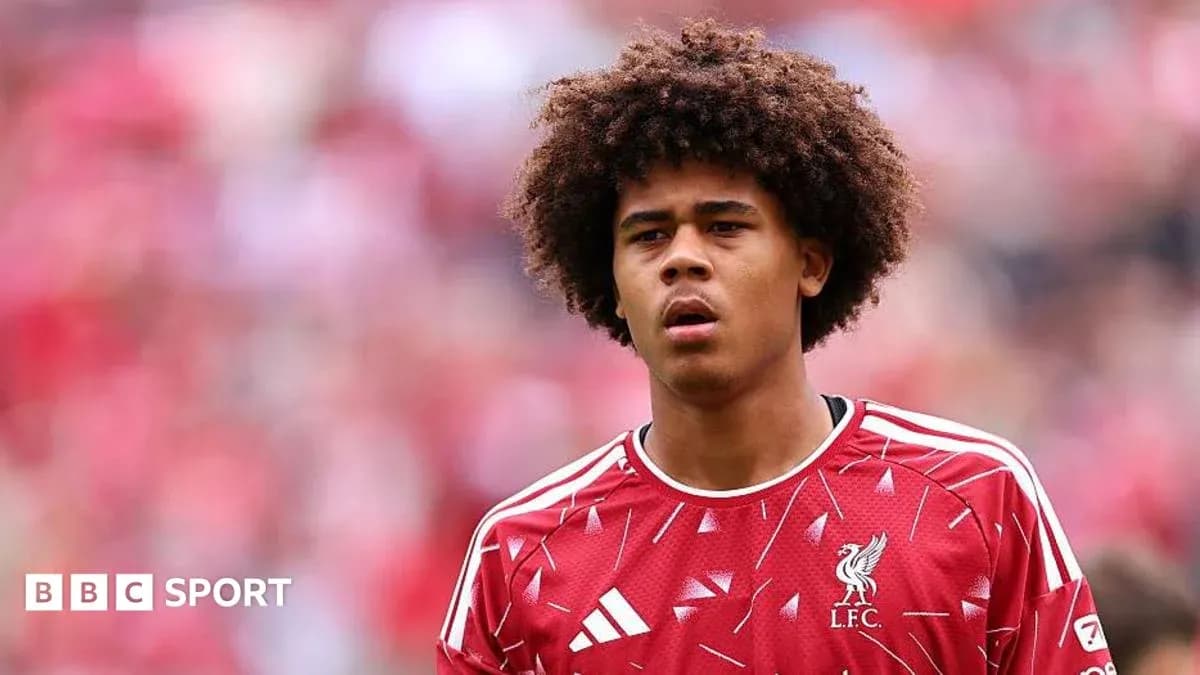
Ifeanyi Ndukwe: Liverpool's 18-Year-Old Centre-Back Surprise
Liverpool’s new era under Andoni Iraola has already thrown up enough questions, but one unexpected answer has come in the shape of an 18-year-old centre-back who shouldn’t, by rights, even be part of the conversation.
Ifeanyi Ndukwe has been one of the standout stories of Liverpool’s pre-season. And yet, because of post-Brexit regulations, he cannot play a single competitive minute for the club in 2026.
A towering surprise in a thin defence
Liverpool’s summer has been messy at the back. Joe Gomez limped out of the first pre-season game. £60m signing Jeremy Jacquet has been stuck on the sidelines with a persistent knee problem. Giovanni Leoni is still working his way back from a serious knee injury.
So Iraola turned to a teenager from Austria Vienna’s academy who only officially became a Liverpool player this summer.
Ndukwe has responded with the calm of a seasoned professional. Two full 90-minute outings, another 80-minute shift, and then a start at Anfield on Sunday against Monaco alongside Virgil van Dijk.
It took him only a few minutes to win the crowd.
A 6ft 6in (1.98m) frame usually hints at raw power, not subtlety. Yet early on, Ndukwe produced a neat backheel that completely wrong-footed Monaco forward Mika Biereth. Gasps from the stands. Then came the other side of his game: strong in duels, dominant in the air, unflustered on the ball.
In a back line stripped of Ibrahima Konate and short on obvious partners for Van Dijk ahead of the Premier League opener against Newcastle, Ndukwe has looked like a solution.
He cannot be one.
The talent Liverpool cannot use
The problem is not football. It is paperwork.
Post-Brexit, the UK’s points-based system for overseas players has turned squad planning into a spreadsheet exercise. To play competitive football in England, a foreign player must earn enough points to secure a Governing Body Endorsement (GBE), which then allows a work visa.
Ndukwe doesn’t have the required total.
He is an Austria youth international, developed at Austria Vienna, where he moved from academy prospect to reserve-team regular and made a single senior appearance. His performances at the Under-17 World Cup last November caught Liverpool’s eye, and the club agreed a £2.6m deal in January, activated once he turned 18 this summer.
The talent is obvious. The points are not.
Without a GBE, he cannot feature in competitive fixtures. Pre-season friendlies are fine. The Premier League is off limits.
There is a second route: the Elite Significant Contribution (ESC) slots. These are special exemptions reserved for foreign players who don’t meet the standard GBE threshold but are deemed significant prospects.
Premier League and Championship clubs can have up to four such players. But there’s a catch: the number of ESC slots depends on how many minutes the club gave to England Qualified Players (EQP) in the previous season.
Hit 35% EQP minutes and you can use four ESC places. Fall below that and the allocation shrinks.
Liverpool’s percentage last season leaves them with only one ESC slot. It has already gone to 18-year-old Senegalese forward Mor Talla Ndiaye.
So Ndukwe, despite his pre-season surge, is locked out.
A system that bites back
The numbers tell a story of their own. Last season, only Freddie Woodman, Gomez, Rhys Williams, Curtis Jones, Trey Nyoni and Rio Ngumoha represented the English core in Liverpool’s squad, combining for 83 Premier League appearances.
This followed the departure of Trent Alexander-Arnold, Jarell Quansah and Tyler Morton, and the loan of Harvey Elliott. The EQP minutes dropped. The ESC flexibility vanished. And a club that has unearthed and developed young talent as well as anyone in Europe now finds itself unable to field one of its most intriguing prospects.
So Liverpool must send Ndukwe out on loan. Not because he isn’t ready to learn in-house, but because he needs to tick boxes in a system that rewards appearances in stronger leagues with more points.
The higher the level, the faster he climbs towards the magic number: 15 points, which would give him an automatic route to a visa.
Pick the right club, in the right competition, and that total could be reached as early as January. At that point, Liverpool would have a decision to make – recall him mid-season and integrate him, or leave him to continue his development elsewhere.
For any club taking him on loan, that possibility of a winter recall is part of the negotiation. A blessing and a complication.
Van Dijk’s verdict and the next step
On the pitch, the endorsement has already arrived from the man whose position Ndukwe aspires to share.
Van Dijk played alongside him in the first half against Monaco and did not hold back in his assessment, calling him a “big talent”. The Liverpool captain spoke of watching Ndukwe’s earlier pre-season games, of a “big guy” who wants to learn, of brief but pointed conversations in recent days.
The message was clear: progress, go on loan, come back better – and come back ready to stay.
Ndukwe will get at least one more chance to impress the Liverpool support in person when Como visit Anfield for the final friendly on 16 August. After that, the focus turns fully to his destination.
His agent, Georg Lederer, outlined the plan back in July, telling Sky Sports Austria that a loan club would be found where Ndukwe could gain experience “at a very high level”, and stressing that the situation remained a “great opportunity” despite the obvious frustration. Several top international clubs, he said, had already shown concrete interest.
Speaking to BBC Sport on Monday, Lederer confirmed that the decision on where Ndukwe goes in Europe is still being worked through. Liverpool expect clarity within the next fortnight.
Wherever he lands, the brief is simple: play, grow, collect points, come back eligible.
A modern football paradox
Ndukwe’s case is a sharp illustration of the modern Premier League contradiction. Clubs scour the globe for teenage potential, invest millions, then find themselves unable to use those players in competitive games because of regulations that treat development and opportunity as separate currencies.
For Liverpool, it has created a strange dynamic. One of the standout performers in Iraola’s first pre-season cannot help him when the real football starts.
For Ndukwe, it is both obstacle and opportunity. If the next move is right, he could return to Merseyside as early as the turn of the year, taller in reputation as well as stature, and finally eligible to compete for the role he has already teased in friendlies.
The crowd at Anfield has seen the glimpse. The question now is not whether he is good enough to belong at this level.
It is how quickly the game’s bureaucracy will let him prove it.