Ibrahim Mbaye: Senegal's Youngest World Cup Scorer
There is a version of 16 June 2026 that history will never bother to tell.
France 3, Senegal 0. Eighty-five minutes gone at MetLife Stadium, the noise thinning, the cameras already framing this as a routine powerhouse win. Then a teenager steps off the bench for a beaten side and refuses to play his assigned role.
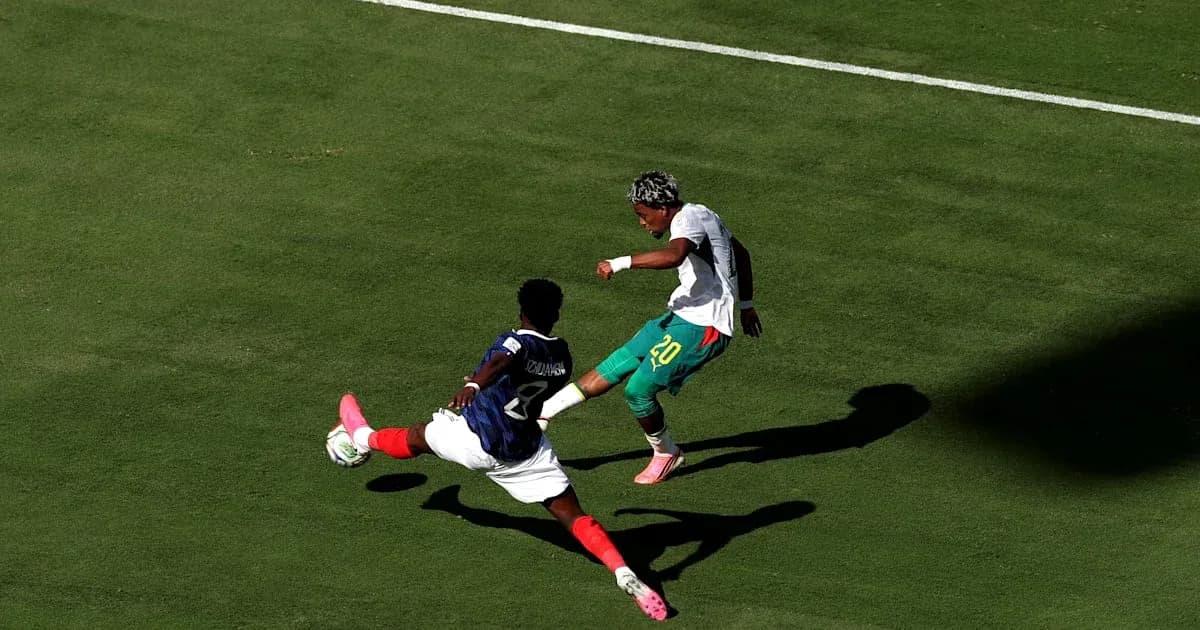
Ibrahim Mbaye collects the ball on the right. One touch to square up Théo Hernandez, a feint, a roll of the foot that sends the full-back sliding the wrong way, and a low, ruthless drive past Mike Maignan. Stoppage time, minute 95. France 3, Senegal 1.
On the scoreboard, a consolation. In the record books, a rupture.
At 18 years and 143 days, Mbaye becomes the youngest African ever to score at a FIFA World Cup, taking a record from his compatriot Moussa Wagué, set in 2018. Step back and the names around him get heavier: Pelé, Mexico’s Manuel Rosas, Spain’s Gavi and Lamine Yamal. Only that quartet struck younger on this stage.
C’est du sérieux. And Mbaye has been serious for a long time.
Books before Ballon d’Or
Rewind ten months.
Paris Saint-Germain are flying to Marseille for a Ligue 1 fixture. One of their brightest prospects is not on the plane. While his team-mates stretch out on charter seats, Mbaye, 17, is sitting the baccalauréat — the exam that turns French teenagers into officially educated adults.
PSG arrange a separate trip. He finishes his paper, trades the exam hall for a dressing room, and joins the squad in time for an 8pm kick-off, his warm-up replaced by algebra and essays.
For most players, that story would define a career. For Mbaye, it barely qualifies as a subplot.
Inside PSG’s academy, where Warren Zaïre-Emery and Senny Mayulu have already been fast-tracked to the first team, the classroom carries the same weight as the training pitch. Director Yohan Cabaye points to a 95 per cent baccalauréat pass rate among the club’s youngsters and treats academic discipline as part of a player’s tactical toolkit, not an optional extra.
In Mbaye, that philosophy has its sharpest proof. The nutmeg and finish against France was not a flash of chaos, but a problem solved under pressure, the kind of calm, logical execution you expect from someone who treats a 95th-minute World Cup chance like another question on an exam sheet.
The boy from Trappes who said no to Les Bleus
Mbaye’s story starts in Trappes, a Paris suburb that knows how to build footballers. Nicolas Anelka came from here. So did a long line of French internationals who never had to think twice when the national team called.
Mbaye’s roots are more tangled. A Senegalese father, a Moroccan mother, and a football education that runs straight through France’s youth system. He wore the blue shirt all the way up, and inside the French set-up, nobody really believed he would ever leave.
Then November 2025 arrived. He chose Senegal.
No stand-off. No ultimatum. His decision, his alone.
“I will never regret choosing to play for Senegal because it was a decision from the heart,” he told Senegalese broadcaster RTS after lifting the Africa Cup of Nations trophy in January, a teenager carrying himself among veterans twice his age. Months later, when asked again, he stripped away any doubt: “If only you knew… it’s the best decision I’ve ever made in my life. The Senegalese have such huge hearts; it’s incredible.”
That is what gave the goal against France its sting, and its poetry. A boy raised in the Paris suburbs, trained in the country’s most storied academy, scoring his first World Cup goal against the very nation that formed him — but doing it in the green of Senegal.
Quelle histoire. A script so neat most writers would throw it out.
Numbers that belong to another age
Strip away the romance and the numbers still look unreal.
Mbaye made his Ligue 1 debut at 16 years, 6 months and 23 days, becoming PSG’s youngest-ever league starter and taking a record from Zaïre-Emery. He signed his first professional contract in February 2025, scored his first senior goal within weeks, and by August had become the youngest Frenchman to appear in a UEFA Super Cup, nudging aside a mark set by Ryan Giggs back in 1987.
In May 2026, away at Lens, he added something more concrete: a stoppage-time strike that sealed PSG’s 14th Ligue 1 title. Not just a cameo, but a decisive act in a championship race.
Senegal’s timeline is just as compressed. Debut against Brazil in November 2025. A goal three days later on his second cap. Then the youngest player ever to feature at the Africa Cup of Nations in December, and, in January, the youngest AFCON goalscorer in Senegal’s history — a record he broke himself as the tournament rolled on, before CAF later ruled to award the victory to Morocco.
Whatever the legal footnote, his four goals in twelve caps before turning 19 barely need context. The comparisons with Kylian Mbappé do not feel lazy; they feel inevitable.
Coaches talk less about his speed or his tricks and more about his choices. When to carry, when to pass, when to slow a game that is racing around him. His decision-making lives years ahead of his birth certificate.
Mbaye does not demand twenty touches to leave a mark. Often, he needs one.
“Mbaye is world class, and he is ours, he did not choose France – he chose Gaindeyi,” Senegalese journalist Wahany Johnson Sambou told Olympics.com in January, using the Wolof name for the national team. “He’ll do great things, just watch.”
Dakar, LA and the next Olympic chapter
Senegal’s story with Olympic football is still in its early pages. One appearance in the men’s tournament so far — London 2012 — but what an introduction: a platform for Sadio Mané, Idrissa Gueye and Cheikhou Kouyaté, who all used that stage as a springboard.
They have not been back since.
That may be about to change. This October, Dakar will host the Youth Olympic Games, the first time the event lands on African soil. The country’s sporting gaze will tilt inward, and football, as always in Senegal, will sit near the centre.
Mbaye will be 20 when LA 2028 arrives, perfectly placed for an Under-23 tournament that has carried Lionel Messi, Neymar and Mohamed Salah into new orbits. Olympics.com has already singled him out as one of Africa’s brightest prospects for those Games. You do not need a scouting badge to see why.
The medals and records make the headlines. The temperament stitches it all together. This is the same teenager who spent a matchday afternoon wrestling with the baccalauréat, then flew out to play under the lights. The same player who walked into a World Cup opener, looked up at France, and finished like he was back in an exam hall, working through the final question.
For now, Mbaye keeps moving in the only way he knows: quietly, efficiently, ahead of schedule. Turning up to football’s biggest moments a couple of years before anyone pencilled his name in.
The rest of the world is catching up. Senegal already knows exactly what it has.