
Henrik Larsson: The King of Kings at Celtic
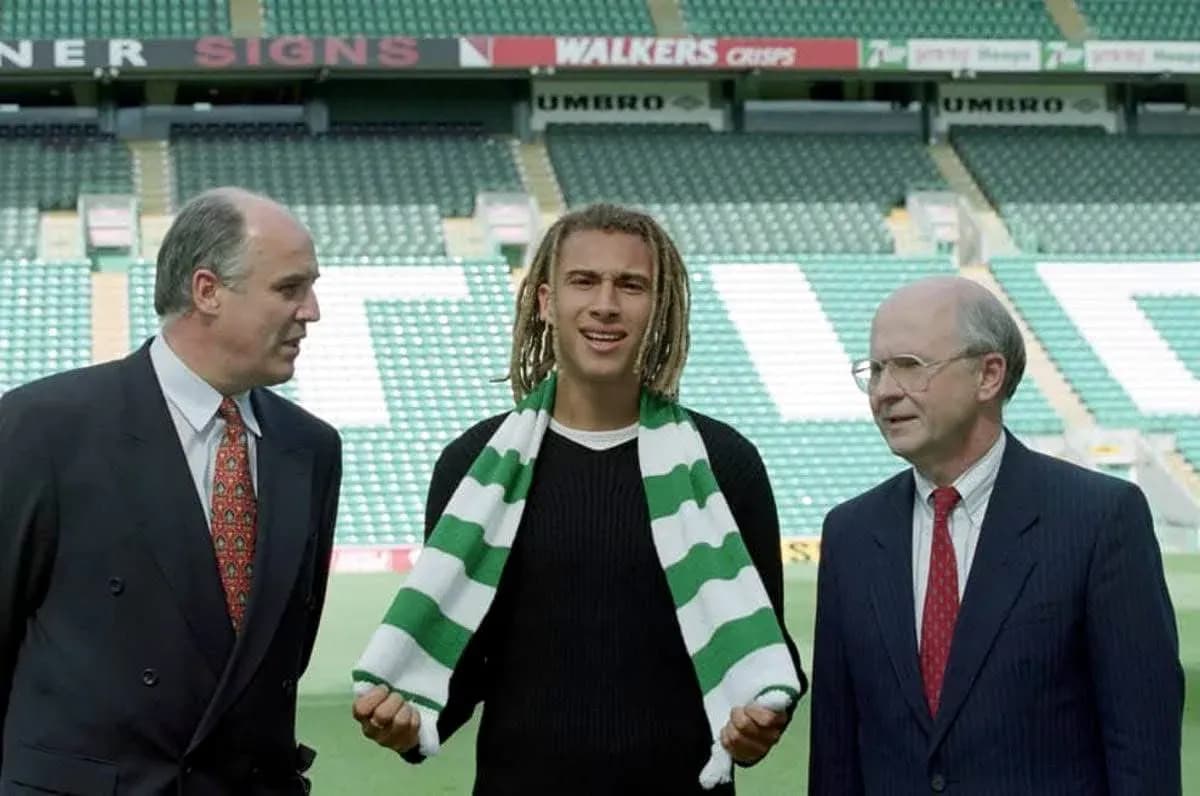
On a warm July day in 1997, a slim, dreadlocked Swede in a Hoops top and denim jeans stepped onto the Celtic Park turf. No fan inside that stadium truly knew what they were about to witness over the next seven years. They just knew his name: Henrik Larsson.
He would leave as the King of Kings.
A Bargain That Changed Everything
Celtic paid £650,000 to Feyenoord for Larsson, a fee that even then felt modest. It was a deal born of insight rather than luck. New manager Wim Jansen had already signed Larsson once before in the Netherlands and understood the clause in his contract that made the move possible. Celtic didn’t just pick up a forward; they stole a legend in waiting.
He didn’t start like one.
Larsson’s debut was bruising in the worst way. An errant pass contributed to an opening-day defeat at Hibernian, and for a moment the doubts surfaced. Was this skinny Swede really the man to help topple Rangers and end the suffocating dominance across the city?
The answer arrived quickly, one game at a time.
From Slow Start to Talisman
Larsson’s response was ruthless. He played, he scored, he created, and he worked. Gradually, then suddenly, Celtic supporters fell for him. The dreadlocks, the swagger, the relentless movement in the box – it all clicked. The man who had stumbled out of the blocks became the heartbeat of a side desperate to reclaim its identity.
By the end of that first season, his importance was beyond dispute. A League Cup triumph and, more significantly, the club’s first league title in ten years – stopping Rangers’ bid for ten in a row – turned him from promising signing into undisputed talisman. Larsson didn’t just contribute; he defined the campaign.
Then he raised the bar again.
Under Dr Jozef Venglos, Larsson developed into the complete striker. He scored 38 goals in his second season, a total that underlined his evolution. He could finish with his head, either foot, from distance, from a yard out. He linked play, bullied centre-backs, and still found the energy to press from the front. Celtic had seen great forwards before. This felt different.
The Break, the Comeback, the Statement
His rise, though, met a brutal interruption. In Lyon, a horrific leg break threatened to derail everything. The images were hard to watch. For many players, that kind of injury closes a chapter. For Larsson, it opened a new one.
He came back stronger. Sharper. More ruthless.
That absence hurt Celtic badly and played its part in the rapid unravelling of John Barnes’ time in charge. The team lost its cutting edge without its leader in attack. When Larsson returned, he did so with the kind of mentality that separates the very good from the truly great. He didn’t just recover; he reasserted himself as the focal point of the club.
O’Neill, Sutton and a Treble for the Ages
Then came Martin O’Neill, and with him, lift-off.
O’Neill paired Larsson with Chris Sutton and built a ferocious attacking partnership. Sutton’s physicality and intelligence meshed perfectly with Larsson’s movement and finishing. The result was devastating. In O’Neill’s first season, Celtic swept to a domestic treble – the club’s first clean sweep in 32 years.
Larsson scored 53 goals that year.
Fifty-three.
It was a number that belonged to another era, yet he did it in a modern, unforgiving game, under the pressure of expectation and the glare of a title race. Every week, every competition, he delivered. Headers, volleys, chips, tap-ins, solo runs – he emptied the striker’s playbook.
Europe Takes Notice
Domestically, Larsson had already become a giant. Europe soon felt the full force of his talent.
Celtic’s run to the UEFA Cup Final owed everything to his goals. He dragged the team through tight nights and big moments, proving he was far more than a flat-track bully. On the biggest stage of his Celtic career, against Porto in Seville, he produced two world-class finishes in a draining extra-time defeat.
The result hurt. His performance did not.
Those goals, rising above defenders and planting precise headers into the net, underlined his class to the continent. For Celtic supporters, they simply confirmed what they already knew: their No.7 belonged at the very top table of European forwards.
Numbers, Legacy, and the Debate
By the time he walked away from Celtic in 2004, Larsson had scored 242 goals in 313 appearances. Third on the club’s all-time scoring list. A ratio that speaks for itself. A legacy that doesn’t need embellishment.
He was more than the numbers, though. He was the player fans trusted when everything was on the line. The one they believed in when a chance dropped in the 90th minute. The one who made children copy his celebrations and teenagers dream of the No.7 shirt.
Older generations will always, and rightly, invoke Jimmy Johnstone and the Lisbon Lions when the conversation turns to greatness. Those who lived through the 1970s will point to Kenny Dalglish, another king who later became Liverpool’s greatest. Those names carry weight, history, and emotion.
Yet for a huge share of Celtic supporters alive today, Henrik Larsson stands alone.
He is the best they have ever seen in the Hoops. The player who arrived quietly in jeans and a replica shirt and left as the King of Kings, his image etched into the club’s unbroken story.
Twenty-nine years on from that first walk across the Celtic Park grass, the question isn’t whether he was worth £650,000.
It’s whether Celtic will ever see his like again.





