Harry Kane: Bayern Munich's Best Transfer Ever
Uli Hoeness has never been shy with a superlative, so when he walked out of the DFB-Pokal final and called Harry Kane the best transfer Bayern Munich had ever made, it sounded like another flourish from a man who deals in big statements. A month on, with the confetti swept away and tempers cooled, nobody at Bayern is rolling their eyes.
“He absolutely is the best we’ve had,” says one senior figure at the club. No hesitation. No caveats.
From nearly man to centrepiece
Kane’s reinvention in Munich feels all the more striking when you remember the mood around him not so long ago. Euro 2024 had painted a picture of a great striker stuck on the wrong side of his peak, still trophyless, still carrying the weight of near-misses with club and country. Outside England, his Golden Boot from Russia 2018 was often dismissed as padded by group-stage goals. Le Journal du Dimanche sniffed that he was top scorer “despite not having scored from the quarter-finals on.”
The implication was clear: a tireless worker, a fine finisher, but perhaps a man whose best years had already been spent in vain pursuit.
Now look where he stands. When Time assembled the faces of this World Cup – Lionel Messi, Cristiano Ronaldo, Neymar, Kylian Mbappé, Lamine Yamal, Jude Bellingham – Kane’s inclusion felt, at last, inevitable rather than aspirational. He is no longer the outsider looking in on football’s elite. He is one of the pillars.
Hoeness remembers the moment Bayern stepped into that territory. “When we bought him for more than €100m, that was new territory for us and a crazy risk,” he said. “But he’s paid back every single euro. Not just because he scores so many goals, but because he is a role model in the dressing room.”
Leader without a word of German
The stories from inside Säbener Straße all sound the same. Kane talking to youngsters after training. Kane putting an arm around those who have had a bad week. Kane staying behind to work on details others would treat as routine.
He still isn’t fluent in German – lessons are written into his contract – but it hardly matters. A core of the squad operates comfortably in English and Vincent Kompany runs the dressing room in it. The language Kane speaks best is the one defenders understand least: relentless, physical, uncompromising centre-forward play.
Hoeness, a World Cup winner from 1974 and no stranger to robust tackling, has watched the treatment Kane receives in the Bundesliga with a veteran’s wince. The kicks come from every angle. Kane keeps getting up. “I think you’d have to cut off his head or his arm to stop him playing,” Hoeness said. It sounds theatrical. It also feels accurate.
Those who see the dynamic up close compare his influence only to Manuel Neuer and Thomas Müller in their prime. Both are Bayern to the bone, club legends with a decade of silverware behind them. Kane walked into that room as the newcomer and, in less than two years, has become one of its reference points.
The Englishman who actually settled
When the Kane family delayed their full move to Munich, old clichés surfaced. The British player abroad. The Ian Rush stereotype, immortalised – incorrectly – as saying life at Juventus was “like living in a foreign country.”
This one has played out differently. Kane and his wife, Kate, now live in a picturesque rural home once owned by Lucas Hernández, close to the plush suburb of Grünwald. Listen to Kane talk about his family and you hear the detail that matters most to him: Kate and the children – Ivy, 9, Vivienne, 7, Louis, 5, and Henry, 4 – have thrown themselves into Bavarian life. Skiing trips in winter. Alpine excursions to Garmisch. He is banned from the slopes, of course, but he is there, present, settled.
The connection with Bavaria has been more than a photo opportunity. At a fan day in Kirchweidach, a village of 2,000 near the Austrian border, Kane stirred soup in a local wedding tradition symbolising his “marriage” to the region. He played a rustic version of skittles using litre beer steins. He called it all “a bit crazy” with typically dry understatement, yet he dived into the occasion. Bayern wanted a superstar. They also got someone willing to season the soup.
A striker reborn
Bayern knew they were buying a world-class forward. They did not expect this level of domination. Since finally breaking his personal trophy drought with the Bundesliga title in 2025 – and then backing it up with another league crown and a DFB-Pokal – Kane has somehow found another gear.
He looks leaner. Quicker. Sharper in every movement. His goal against Atalanta in the Champions League still plays on a loop in the minds of Bayern fans: a drag-back, a swivel that erased two defenders, and a finish hit so cleanly it almost seemed inevitable.
The second goal of his DFB-Pokal final hat-trick might be the truest snapshot of the player he has become. A vicious curling strike from outside the box crashed off the bar. Most strikers would still be admiring the shot. Kane was already alive to the rebound, dragging the ball back, spinning in the area he had created for himself, and burying the chance. That is no longer the work of a pure penalty-box poacher. That is a complete forward manufacturing his own destiny.
The numbers are absurd. With 61 goals for Bayern, he is the only player in Europe’s major leagues matching the volume of Messi and Ronaldo in their imperial years, with Erling Haaland the only modern rival in that statistical stratosphere. Ronaldo once scored 66 in a season without a summer tournament. Messi hit 73.
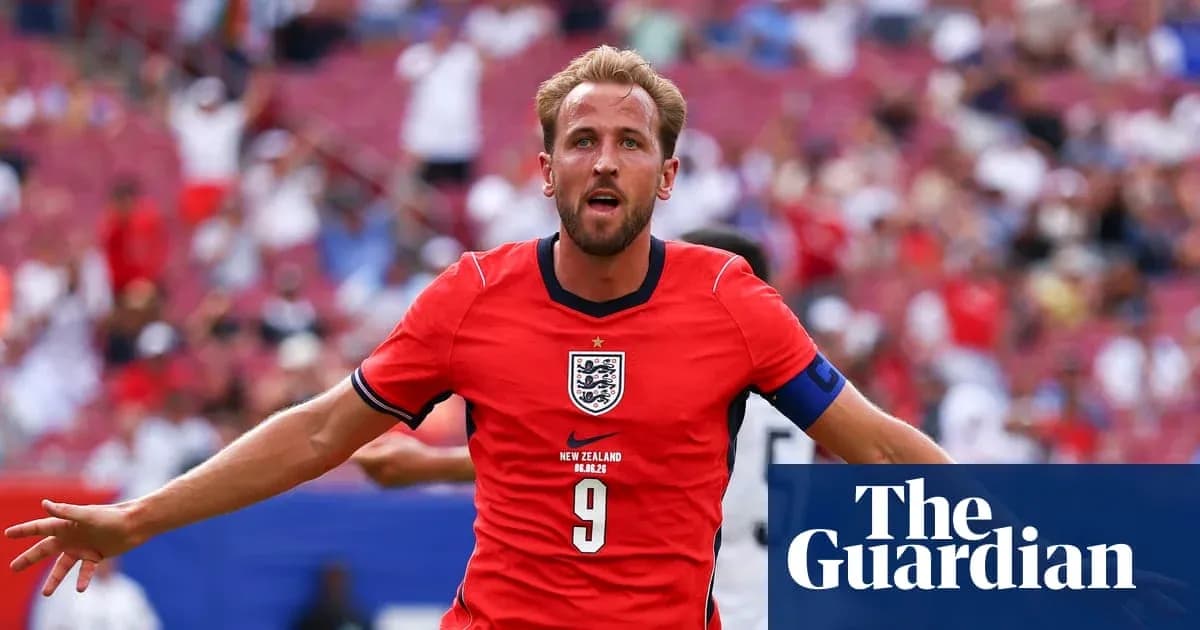
Kane, after England’s game against New Zealand in Tampa, sits on 67.
And this is not a striker who simply lurks on the last line. At Bayern he often drops so deep he looks like a No 6 out of possession, taking the ball from defenders, dictating tempo, switching play. His passing range almost mirrors his finishing. The assist for Luis Díaz in the Champions League semi-final first leg against Paris Saint-Germain – a perfectly judged ball that split the defence – was the kind of contribution usually reserved for elite midfielders.
It is little wonder Thomas Tuchel intends to replicate much of that Bayern blueprint with England at the World Cup.
From afterthought to Ballon d’Or contender
Kane’s name never truly entered the Ballon d’Or conversation during his Tottenham years. Too few trophies. Too many seasons ending with what-ifs.
Now the landscape has changed. As a regular in the closing stages of the Champions League and finally a serial winner at club level, he has forced his way into the group of genuine contenders. The World Cup will decide the rest. For a 32-year-old whose career has often felt like a long prelude, this summer has the air of a reckoning.
He has always been more tortoise than hare, grinding, improving, collecting small gains rather than exploding onto the scene. Football usually celebrates the sprinters. Kane is making a compelling case for the marathon man.
The unlikely prodigy
Those who knew him at Spurs’ academy still sound faintly bemused by what he has become. As a teenager he did not look like the blueprint of an elite athlete. Slightly overweight by academy standards. Lacking pace. Not the cleanest technician.
“You would never have thought that he would be what he is now,” one youth coach admitted. The turning point came around 14, when a growth spurt coincided with a leap in his technical level. His striking of the ball began to stand out. His attitude did the rest.
Any instruction – gym work, finishing drills, positional tweaks – only needed to be delivered once. He absorbed it, stored it, and acted on it. The player who supposedly lacked natural gifts built his career on repetition and detail.
The early loans did little to suggest greatness. Norwich was miserable. An ugly miss on his debut against West Ham stuck in the memory. His last appearance came in an FA Cup defeat to non-league Luton, when he was hauled off at half-time. Between those low points he found himself with the under-21s, barred from taking penalties because he was not considered good enough.
Leicester was not much kinder. During their 2013 Championship playoff semi-final against Watford, he and Jamie Vardy both started on the bench.
Even at Spurs, the breakthrough was not straightforward. Mauricio Pochettino did not initially see a future superstar when he watched Kane’s underwhelming pre-season in 2014. Kane remembers the moment vividly. “We had our body fat test done and I was the highest in the team, something like 18%,” he recalled. Pochettino called him in, told him his levels were too high, that he was not pushing himself hard enough. Then came the line that stuck: “You can be the best striker in the world.”
At the time it sounded like motivational exaggeration, a manager trying to light a fire under a struggling young forward. Hoeness’s verdict in 2025 carried the same ring of hyperbole.
Look at Kane now – the goals, the trophies, the leadership, the way he has bent his career back towards the summit – and those once far-fetched predictions no longer feel inflated. They read like early drafts of a story still being written, by a striker who has finally forced the game to meet him at his level.