Guillermo Ochoa Retires: A Legendary Career in Mexican Football
Guillermo Ochoa has finally done what Mexico never truly wanted him to do. He has let go.
On Tuesday, one of the most enduring figures in Mexican football announced his retirement from elite soccer, ending a career that stretched across continents, eras and six World Cups. He had long pointed to 2026 as his final dance. Many still clung to the idea of one more short-term deal, one more season, one more improbable save.
There will be no epilogue.
“I gave it my all; I left everything on the field for my clubs and the national team, and today I hang up my gloves,” Ochoa wrote in an emotional message on social media, cutting through months of speculation with a single, definitive line. Being a goalkeeper, he added, means living for that one instant when everything rests on you. When it comes, you cannot hesitate.
He rarely did.
A career measured in World Cups
Ochoa’s longevity sits in the record books as neatly as it does in the memory. Six World Cups with Mexico, a number matched only by Ronaldo and Messi. At first, he was the kid carrying the bags, the understudy soaking in the scale of the stage. Then the job became his.
From Brazil 2014 to Russia 2018 and Qatar 2022, he stood as Mexico’s last line, and often its most reliable one. Those tournaments turned him from domestic star into global cult figure: the wild curls, the headband, the elastic saves that seemed to defy both physics and the expectations placed on a country forever chasing that elusive quinto partido.
The 2026 World Cup was different. Age had caught up, and his role shrank. Raul Rangel wore the No. 1 mantle, but Javier Aguirre understood what Ochoa meant to the shirt and the stands. In Mexico’s final group game against Czechia, with the Estadio Azteca humming, Aguirre sent him on for the last 13 minutes.
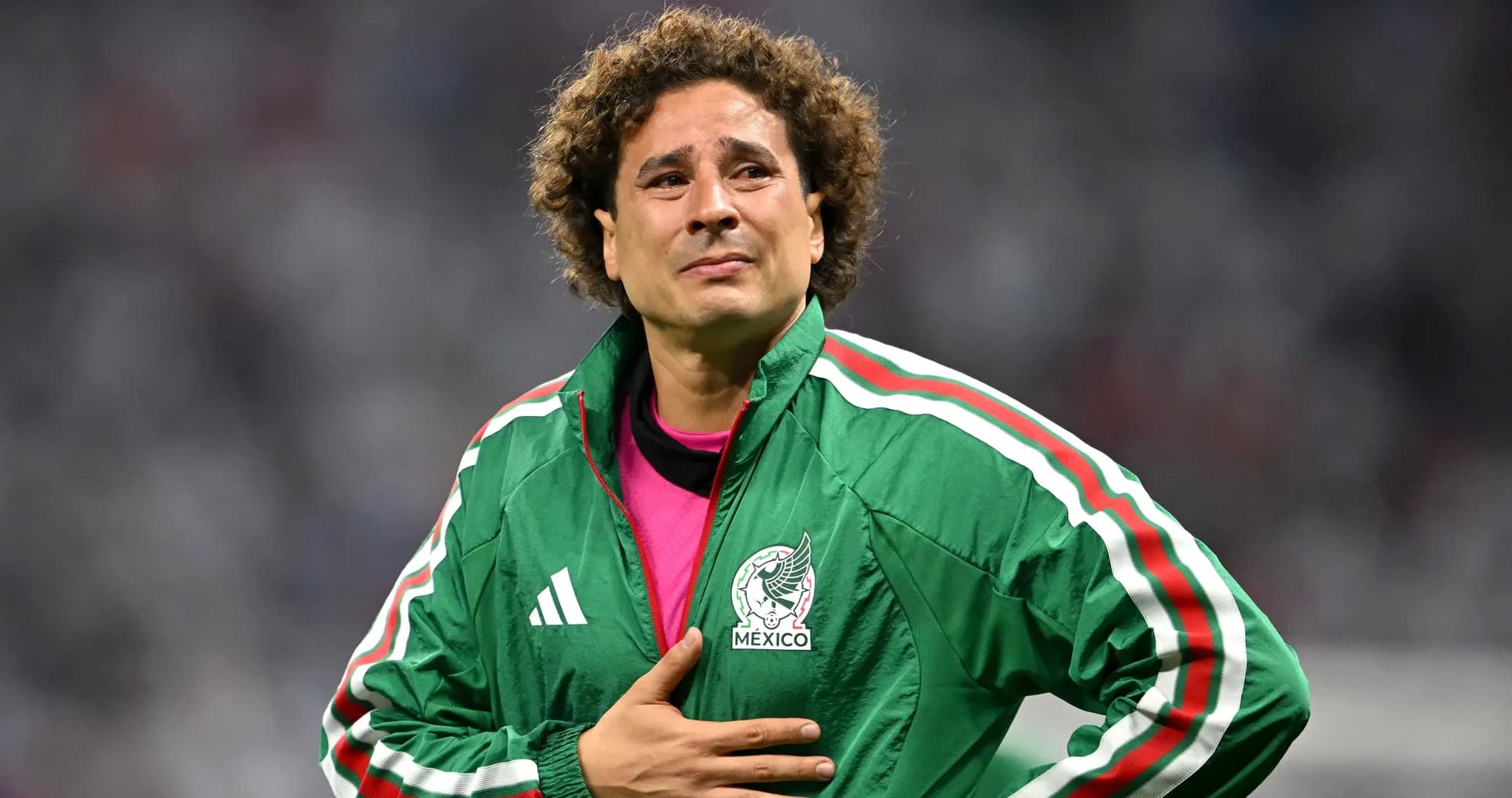
The substitution felt less like a tactical tweak and more like a curtain call. Every catch, every touch, every pause over a goal kick drew a roar. When the whistle went, the emotion finally spilled over.
Ochoa walked to his posts, kissed them both, and then dropped to his knees as teammates closed in around him. The embrace in front of the end that had watched him grow said as much as any speech could. This was the stadium where it had all begun. It was only fitting it should host his goodbye.
From Mexico City dream to European odyssey
His journey started in February 2004, a teenager thrown into the deep end with Club América and somehow looking like he’d been there for years. The reflexes were what people noticed first. The calm came next. He locked down the starting role and, by the 2005 Clausura, had a league title to his name.
Seven seasons with América turned him into a star at home. The next step made him a pioneer.
In 2011, Ochoa signed for Ajaccio, becoming the first Mexico-born goalkeeper to play in Europe. It was not a move to a superclub or a guaranteed trophy factory. It was a bet on himself, on his ability to adapt, to withstand the grind of a different kind of football and a different kind of scrutiny.
The bet paid off in experience and in reputation. His European route was anything but linear: Ajaccio, Malaga, Granada, Standard Liege, Salernitana, AVS Futebol, AEL Limassol. Each stop added another layer to a career that refused to be boxed in by geography or expectation. In Belgium, he lifted the Belgian Cup with Standard Liege, another medal for a cabinet that had started back home in Mexico City.
The pull of América never really faded. From 2019 to 2022, he returned to the club that shaped him, stepping back into the Azteca goal as if he had never left. That second spell did not just trade on nostalgia; he performed, he led, and he cemented his status as a club legend rather than a fondly remembered former star.
A farewell wrapped in gratitude
Looking back on that arc — from youth ranks in Mexico City to some of Europe’s biggest stages and back again — Ochoa framed it in simple terms.
“I never imagined how far a dream could take me. Today, I can only look back with pride and say: Thank you,” he wrote. He spoke of the affection of millions, of the peace that comes from knowing he had emptied the tank for Mexico.
Long after the final cheers of that World Cup farewell had faded and the Azteca’s great bowl had begun to empty, he wandered out to the centre circle alone. No cameras needed, no choreographed moment. Just a goalkeeper and a patch of grass he knew better than any other place on earth.
He stood there one last time, taking it in. A career that started with a teenage debut in 2004 and stretched to a sixth World Cup in 2026 had finally reached its full stop.
The gloves are off now. The legacy stays exactly where it has always been — on those goal lines, in those tournaments, and in the memory of a country that spent two decades trusting that, when that single decisive moment arrived, Guillermo Ochoa would not hesitate.